Blog
Back to blog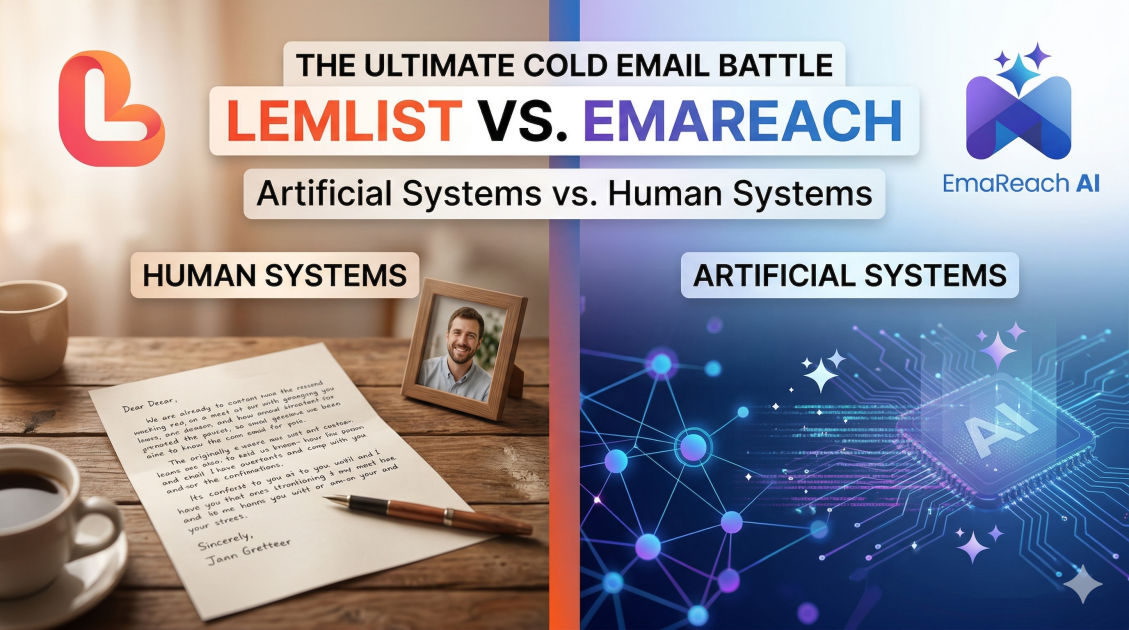
Lemlist vs Emareach: Artificial Systems vs Human Systems
cold emailsales outreachemail deliverabilitylemlistemareachsales automationai writing
Introduction: The Great Divide in Modern Sales Outreach
In the rapidly evolving landscape of digital sales, the methodology behind how we connect with prospects has undergone a seismic shift. For years, the gold standard for cold outreach was defined by automation—creating efficient, scalable workflows that could reach thousands of people with a single click. However, as inboxes become more crowded and spam filters more sophisticated, a new debate has emerged: the efficiency of artificial systems versus the nuance of human-centric systems.
At the center of this debate are two distinct approaches represented by Lemlist and EmaReach. Lemlist has long been a titan in the cold email space, known for its automation prowess and visual personalization. On the other hand, the philosophy of human-centric systems—championed by platforms like EmaReach—focuses on the delicate balance of deliverability, authentic connection, and the technical preservation of sender reputation. This article explores the deep-seated differences between these two methodologies and why the shift toward human-integrated AI systems is changing the game for sales professionals worldwide.
The Evolution of Artificial Outreach Systems
Artificial outreach systems were born out of a need for volume. In the early days of digital marketing, the math was simple: if you sent 1,000 emails and had a 1% conversion rate, sending 10,000 emails would logically result in ten times the revenue. This led to the development of tools designed to maximize output.
Lemlist entered this market with a unique value proposition. They understood that while volume was necessary, 'cookie-cutter' emails were being ignored. Their solution was to inject 'artificial' personalization—using dynamic tags to pull in a prospect's name, company, or even a personalized image with the prospect's logo on a coffee mug. While revolutionary at the time, these systems still operate on a linear, automated logic. They are 'artificial' in the sense that they rely on pre-set rules and templated triggers to simulate a human touch.
The Limitations of Pure Automation
The challenge with purely artificial systems is that they are often 'loud.' When thousands of users use similar templates and similar automation patterns, email service providers (ESPs) like Google and Microsoft take notice. The patterns become predictable, leading to a steady decline in deliverability. Furthermore, the modern prospect has developed an 'anti-automation' filter. They can spot a dynamic tag from a mile away, and once the illusion of a one-to-one email is broken, the trust is lost.
Enter the Human-Centric System
Human-centric systems represent the next phase of outreach. This approach doesn't reject technology; rather, it uses technology to amplify human qualities like empathy, relevance, and relationship-building. Instead of asking 'How many emails can I send?', a human-centric system asks 'How can I ensure this specific person feels heard?'
This is where EmaReach sets itself apart. EmaReach recognizes that the most important part of a cold email is not just what it says, but where it lands. If your email ends up in the 'Promotions' or 'Spam' folder, the most brilliant copy in the world won't save your campaign. By focusing on the principle of Stop Landing in Spam. Cold Emails That Reach the Inbox, EmaReach integrates a multi-account sending infrastructure and AI-driven warm-up protocols that mimic actual human behavior.
EmaReach AI combines AI-written cold outreach with inbox warm-up and multi-account sending—so your emails land in the primary tab and get replies. This is a significant departure from the 'one-to-many' blast approach of traditional artificial systems. It is a system built to respect the technical and psychological boundaries of the modern inbox.
Deliverability: The Technical Battleground
One of the most critical points of comparison between these two schools of thought is how they handle deliverability.
Lemlist: The Feature-Rich Approach
Lemlist provides users with a suite of features to help with deliverability, such as custom tracking domains and 'Lemwarm.' These are excellent tools for the DIY marketer who wants to manage their own reputation. However, the system is still fundamentally 'artificial' because it places the burden of configuration and monitoring on the user. If a user sets their sending volume too high or uses aggressive language, the system will execute the command regardless of the risk to the domain's health.
EmaReach: The Managed Ecosystem
A human-centric system like EmaReach treats deliverability as a living, breathing ecosystem. By utilizing multi-account sending, the system spreads the risk across several inboxes, ensuring that no single domain is 'burned' by high volume. This mimics a human sales team where multiple representatives are reaching out individually, rather than one server blasting messages. Because the AI writing component is integrated with the sending engine, it ensures that every message is unique, further bypassing the pattern-matching algorithms used by spam filters.
Content Creation: Simulation vs. Augmentation
How these systems generate content is another area where the 'Artificial vs. Human' divide is clear.
Templated Personalization
Artificial systems rely heavily on templates. Even with variables like {{first_name}} or {{company_name}}, the structure of the email remains rigid. This creates a 'uncanny valley' effect in sales. The email looks personal at first glance, but the lack of true context makes it feel hollow. This is the hallmark of an artificial system: it simulates human interaction without actually participating in it.
AI-Assisted Human Relevance
In a human-centric system, AI is used to research and write based on deep context. It isn't just filling in blanks; it's synthesizing data points to create a compelling narrative. When EmaReach uses AI to write cold outreach, it does so with the goal of primary tab placement. This means the language is kept natural, conversational, and devoid of the 'spam-trigger' words that common templates often include. It augments the human's ability to be relevant at scale, rather than just being fast at scale.
Scaling: The Myth of Unlimited Volume
There is a prevailing myth in the sales world that more is always better. Artificial systems often cater to this by boasting about how many leads you can import at once. However, high-volume outreach is increasingly becoming a liability.
Human systems prioritize 'Quality at Scale.' Instead of sending 500 emails from one account, a human-centric strategy involves sending 25 emails from 20 different accounts. This 'distributed' approach is much harder to manage manually, which is why a platform like EmaReach is essential. It provides the infrastructure to act like a team of fifty humans while maintaining the centralized control of a single dashboard.
The Psychology of the Inbox
To understand why human systems are winning, we must understand the psychology of the recipient. Every morning, a decision-maker opens their inbox and performs a 'triage.' They are looking for reasons to delete emails.
- The Artificial Signal: Large images, multiple links, tracking pixels that slow down loading, and overly polished 'marketing' language.
- The Human Signal: Plain text, concise value propositions, personal references that can't be scraped by a basic bot, and a clear, low-friction ask.
Artificial systems like Lemlist have historically leaned into the 'Artificial Signal' (images, fancy layouts) because it looks good to the sender. Human systems like EmaReach lean into the 'Human Signal' because it works for the recipient. By ensuring emails land in the Primary Tab, EmaReach honors the recipient's space, leading to higher open rates and, more importantly, higher-quality replies.
Cost vs. Value: A Long-Term Perspective
When comparing these systems, users often look at the monthly subscription price. However, the true cost of an outreach system includes:
- The cost of burned domains: How much does it cost to replace your primary domain if it gets blacklisted?
- The opportunity cost: How much revenue are you losing because your emails are sitting in the spam folder?
- The reputation cost: How does a poorly executed, obviously automated campaign affect your brand's standing in the market?
Artificial systems are often cheaper upfront but can be more expensive in the long run due to these hidden costs. A human-integrated system like EmaReach provides a higher ROI because it protects the user's most valuable asset: their ability to communicate with their market. By combining AI-written content with sophisticated warm-up and multi-account sending, it ensures that your sales efforts are an investment, not a gamble.
Feature Comparison: A Technical Deep Dive
| Feature | Artificial Systems (Lemlist) | Human Systems (EmaReach) |
|---|---|---|
| Primary Goal | Automation & Visual Personalization | Deliverability & Primary Tab Placement |
| Sending Logic | Single or limited account blasting | Multi-account distributed sending |
| Content Generation | Template variables and dynamic images | Contextual AI-written outreach |
| Warm-up | Add-on service (Lemwarm) | Integrated, behavior-based protocols |
| Risk Management | User-dependent configuration | Infrastructure-level protection |
| Primary Metric | Open rates (often skewed by pixels) | Reply rates and inbox placement |
The Future of Sales Outreach
The industry is moving away from 'growth hacking' and toward 'sustainable growth.' The era of tricking the inbox is over. The future belongs to those who can use AI to be more human, not less.
As we look at the landscape of outreach, the choice becomes clear. You can choose a system that treats your prospects like data points in a spreadsheet, or you can choose a system that treats them like people. The 'Artificial' approach of Lemlist served its purpose in a previous era of the internet. But in an age where AI can now detect other AI, the only way to win is to be more authentic.
Systems like EmaReach represent this transition. By focusing on the technical foundation of deliverability—ensuring that cold emails actually reach the inbox—and using AI to maintain a human tone, they are setting a new standard. They solve the paradox of modern sales: how to reach everyone without sounding like a robot.
Conclusion: Making the Right Choice for Your Business
Choosing between Lemlist and EmaReach is not just about choosing a software tool; it is about choosing a philosophy.
If your goal is to experiment with visual templates and you have a high tolerance for managing your own deliverability hurdles, an artificial system may satisfy your creative urges. However, if your goal is to build a predictable, scalable revenue engine that treats your sender reputation as a sacred asset, the human-centric approach is the only path forward.
By leveraging the power of EmaReach, businesses can finally move past the frustration of the spam folder. With AI-written cold outreach that actually resonates and a multi-account sending infrastructure that protects your brand, you are no longer just sending emails—you are starting conversations. In the battle of Artificial vs. Human systems, the winner is always the one who manages to bridge the gap between the two. Stop landing in spam and start reaching the primary tab. Your prospects are waiting.
EmaReach AI
Ready to scale your cold email outreach?
Join thousands of teams using EmaReach AI for AI-powered campaigns, domain warmup, and 95%+ deliverability. Start free — no credit card required.
Related posts
- Read article
The Instantly Alternative That Finally Gets Outbound Analytics Right
Discover why high-volume cold email requires a shift from surface-level vanity metrics to deep, data-driven revenue attribution, and explore the ultimate alternatives for mastering outbound engineering.
- Read article
How Choosing the Right Instantly Alternative Changed Our Pipeline Numbers
Discover how transitioning from a volume-first cold email setup to an advanced, deliverability-focused infrastructure transformed our B2B pipeline metrics, skyrocketed open rates to over 68%, and tripled our monthly booked demos.