Blog
Back to blog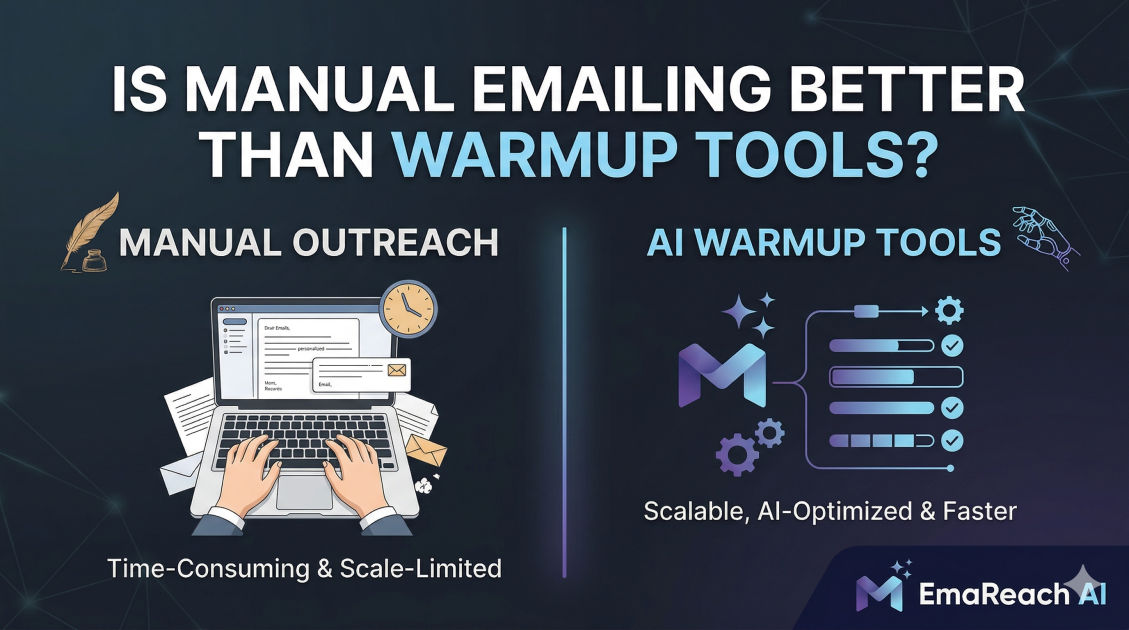
Is Manual Emailing Better Than Warmup Tools
email deliverabilitycold outreachemail warmupsales automationlead generationsender reputation
Introduction
In the high-stakes world of digital outreach, deliverability is the silent engine that determines success or failure. You can craft the most compelling value proposition, offer an unbeatable discount, or solve a prospect's most pressing pain point, but if your email lands in the spam folder, it effectively does not exist. This reality has birthed a long-standing debate among growth hackers, sales professionals, and marketing experts: Is manual emailing better than using automated warmup tools?
As internet service providers (ISPs) like Google and Microsoft become increasingly sophisticated in their quest to protect users from unwanted clutter, the methods we use to establish sender reputation must evolve. Some argue that the human touch of manual warmup is the only way to stay under the radar of aggressive filters. Others contend that in a world of scale, automation is not just a luxury, but a necessity. This article dives deep into the mechanics of email deliverability, the pros and cons of both approaches, and how to navigate the complex landscape of modern inbox placement.
Understanding the Core of Email Deliverability
Before choosing a side, it is crucial to understand what we are actually trying to achieve. Email deliverability is not just about sending an email; it is about the likelihood of that email reaching the recipient's primary inbox. This is governed by your 'sender reputation,' a score assigned to your domain and IP address by ISPs.
The Anatomy of Sender Reputation
ISPs look at several engagement metrics to determine if you are a trustworthy sender:
- Open Rates: High open rates signal that people want to hear from you.
- Reply Rates: This is the 'holy grail' of deliverability. A conversation suggests a real relationship.
- Marked as Spam: The ultimate reputation killer. Too many of these, and your domain is blacklisted.
- Deletion without Opening: A subtle signal that your content is irrelevant.
- Moving from Spam to Inbox: A powerful positive signal that tells ISPs their filters were wrong.
When you start a new email account or domain, you have no reputation. If you immediately send 500 emails, ISPs flag this 'spike' in activity as suspicious behavior typical of spammers. Warmup is the process of gradually increasing your volume and generating positive engagement to prove you are a legitimate human sender.
The Case for Manual Emailing
Manual emailing—the process of personally sending emails to friends, colleagues, or known contacts and asking them to reply—is often touted as the 'organic' way to build a reputation.
Authenticity and Natural Patterns
ISPs are incredibly good at pattern recognition. They can often spot automated scripts by the precise intervals between sends or the repetitive nature of the content. Manual emailing is, by definition, inconsistent and unique. You might send three emails in ten minutes, then none for an hour. You might write long-form replies or short acknowledgments. These 'noisy' patterns are exactly what real humans do, making it very difficult for an ISP to flag the account as a bot.
High-Quality Engagement
When you manually warm up an account, you are usually interacting with real people who write real responses. These are not 'lorem ipsum' snippets; they are contextual conversations. ISPs analyze the content of replies. A thread discussing a meeting or a project carries more weight in reputation algorithms than a string of random words generated by a basic bot.
The Cost of Human Capital
However, manual warmup has a massive downside: it is incredibly time-consuming. To properly warm up a single account, you might need to send 20–50 emails a day for several weeks. Doing this across five or ten accounts is a full-time job. For most businesses, the opportunity cost of having a high-value salesperson manually chatting with colleagues just to 'prime' an inbox is simply too high.
The Rise of Automated Warmup Tools
Automated warmup tools were designed to solve the scalability problem. These platforms use a network of thousands of real email accounts to interact with your inbox automatically.
How They Work
When you connect your account to a warmup tool, it begins sending emails to other users in the tool's network. These 'peer' accounts are programmed to:
- Open your email.
- Remove it from the spam folder if it lands there (a massive boost for your reputation).
- Mark it as 'important'.
- Reply to the message with AI-generated or template-based text.
This creates a simulated environment of perfect engagement. To the ISP, it looks like you are a popular sender with a high reply rate.
The Efficiency Factor
Automation allows you to set it and forget it. You can warm up dozens of domains simultaneously without lifting a finger. This is essential for agencies or lead generation firms that operate at a high volume. Furthermore, these tools provide dashboards that track your 'health score,' giving you a data-driven look at your deliverability that manual tracking could never match.
The Risk of Detection
While convenient, tools are not invisible. If a warmup service uses a 'closed loop' network where the same 5,000 accounts only talk to each other, ISPs can eventually identify the network. If your domain is caught in a cluster of 'bot-like' behavior, your reputation could take a sudden, sharp dive. This is why the quality of the tool matters more than the mere existence of the feature.
Comparing the Two: A Side-by-Side Analysis
| Feature | Manual Emailing | Warmup Tools |
|---|---|---|
| Cost | High (Time/Labor) | Low (Subscription Fee) |
| Speed | Slow and gradual | Fast and scalable |
| Risk | Very Low | Moderate (depends on tool quality) |
| Authenticity | 100% | Simulated |
| Complexity | Simple but tedious | Technical setup required |
| Reliability | Consistent engagement | High-volume engagement |
Why Modern Outreach Requires a Hybrid Approach
As we look at the current landscape, the question isn't necessarily which is better, but how to use technology to mimic the best parts of manual effort. Purely manual sends don't scale, but low-quality bot sends get caught.
This is where advanced solutions bridge the gap. For instance, Stop Landing in Spam. Cold Emails That Reach the Inbox. EmaReach (https://www.emareach.com/) is a prime example of how the industry has moved beyond simple 'bot' behavior. EmaReach AI combines AI-written cold outreach with inbox warm-up and multi-account sending—so your emails land in the primary tab and get replies. By using AI to craft the messages, the engagement looks significantly more human than the static templates used by older warmup software.
Strategies for Maximum Deliverability
Whether you choose manual, automated, or a hybrid approach, certain 'golden rules' of deliverability remain constant.
1. The Power of Gradual Ramping
Never go from zero to one hundred. If you are using a tool, start with 2–5 emails per day and increase the volume by no more than 20% each week. If you are doing it manually, start by signing up for high-authority newsletters (like The New York Times or Harvard Business Review) and interacting with them to show you are a real consumer of content.
2. Multi-Account Infrastructure
One of the biggest mistakes in modern outreach is 'putting all your eggs in one basket.' If you send 100 emails a day from one account, you risk burning that domain. It is better to have five different domains sending 20 emails each. Tools make managing this infrastructure possible, but the principle of 'distributed sending' is what keeps you safe from ISP filters.
3. Content Diversification
If every email you send looks identical, you are triggering spam filters. ISPs use 'fuzzy matching' to identify bulk mail. Using Spintax or AI-generated variations ensures that every outgoing message is unique. This mimics the natural variation of manual emailing while maintaining the speed of automation.
The Technical Side: SPF, DKIM, and DMARC
No amount of warmup—manual or automated—can save a poorly configured domain. Before you send your first warmup email, you must ensure your technical records are in order:
- SPF (Sender Policy Framework): A list of servers allowed to send email on behalf of your domain.
- DKIM (DomainKeys Identified Mail): A digital signature that proves the email wasn't tampered with in transit.
- DMARC (Domain-based Message Authentication, Reporting, and Conformance): Instructions to the ISP on what to do if SPF or DKIM fails.
Setting these up is the equivalent of getting a passport. Warmup is the equivalent of building a good travel history. You need both to get through the 'border' of the inbox.
Common Myths About Warmup Tools
There are several misconceptions that lead people to believe manual is always better or that tools are a magic wand.
Myth: "Warmup tools are a one-time thing"
Many users think they can warm up an account for two weeks, turn the tool off, and then blast 1,000 emails. Deliverability is a moving target. You should keep a baseline level of warmup running even while you are sending active campaigns to maintain a healthy ratio of 'good' engagement to 'cold' outreach.
Myth: "ISPs have banned all warmup tools"
While Google has made changes to its API policies, the 'peer-to-peer' method of warming up remains highly effective. The key is using platforms that prioritize human-like behavior and high-reputation pools of IP addresses.
Myth: "Manual emailing is 100% safe"
If you manually send emails that look like spam—short, aggressive, and full of suspicious links—you will get flagged just as quickly as a bot. The content and the recipient's reaction to it are more important than the method of delivery.
Verdict: Which Should You Choose?
If you are a small business owner sending five highly personalized emails a week to local leads, Manual Emailing is your best bet. It builds the most authentic reputation and costs you nothing but a few minutes of your time.
However, if you are running a B2B sales operation, a marketing agency, or a startup looking to scale, Warmup Tools are the only viable path. The key is to select a tool that doesn't just 'ping' servers but actually mimics human interaction through AI and a high-quality network.
Integrating a system like EmaReach ensures that you don't have to choose between the authenticity of manual work and the efficiency of a tool. It handles the 'robotic' parts of deliverability—like maintaining high reply rates and moving messages out of spam—while allowing your team to focus on the 'human' parts: closing deals and building relationships.
Conclusion
In the battle of manual vs. automated, the winner is the sender who understands that deliverability is a marathon, not a sprint. Manual emailing offers unparalleled authenticity but fails to scale. Traditional warmup tools offer scale but can sometimes lack the nuance required to fool modern filters.
The most successful modern senders use a sophisticated hybrid strategy: they automate the technical warmup process with high-end tools, distribute their sending across multiple accounts to keep volume low per inbox, and use AI to ensure their content is varied and engaging. By respecting the rules set by ISPs while leveraging the power of automation, you can ensure that your voice is heard in the one place that matters most: the primary inbox.
EmaReach AI
Ready to scale your cold email outreach?
Join thousands of teams using EmaReach AI for AI-powered campaigns, domain warmup, and 95%+ deliverability. Start free — no credit card required.
Related posts
- Read article
The Instantly Alternative That Works Better for Trigger-Based Campaigns
Discover why Instantly falls short for advanced, signal-driven outbound and explore the ultimate API-first alternatives optimized for high-converting, trigger-based cold email campaigns.
- Read article
The Instantly Alternative That Wins for Teams With Strict IT Policies
Discover why traditional cold email tools fail strict IT security audits and explore the ultimate enterprise-grade alternative built for secure, compliant, and high-performance outbound sales teams.