Blog
Back to blog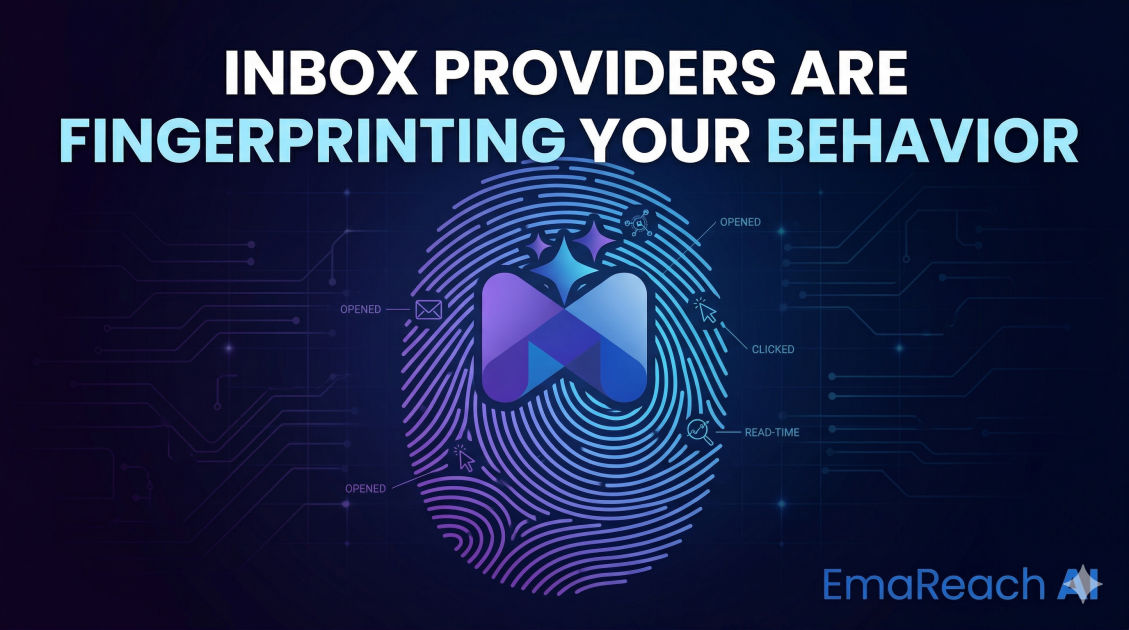
Inbox Providers Are Fingerprinting Your Behavior
email deliverabilityinbox providersbehavioral fingerprintingcold emailsender reputationemail marketingAI outreach
The Invisible Guardian: Understanding Inbox Fingerprinting
For decades, the battle for the inbox was fought on the grounds of keywords and blacklisted IP addresses. If your email didn't contain 'spammy' words and your server had a decent reputation, you were likely to land in the primary tab. However, the landscape has shifted dramatically. Major inbox providers like Google, Microsoft, and Yahoo have evolved beyond simple filters. They are now employing sophisticated behavioral fingerprinting to determine the fate of every message sent.
Fingerprinting is the process of collecting minute data points to create a unique profile of a sender's habits, technical configurations, and engagement patterns. It is no longer just about what you send, but how you send it, when you send it, and how users react to it in real-time. This article explores the depth of these tracking mechanisms and how they impact modern email deliverability.
What is Behavioral Fingerprinting in Email?
Behavioral fingerprinting refers to the algorithmic analysis of a sender's entire ecosystem. Inbox providers use machine learning models to identify patterns that deviate from 'human' or 'legitimate business' norms. Unlike a static fingerprint, a behavioral fingerprint is dynamic; it evolves based on every interaction or lack thereof.
When you send an email, the receiving ISP (Internet Service Provider) isn't just looking at the SPF or DKIM records. It is looking at the velocity of your sends, the consistency of your volume, and the 'digital exhaust' your infrastructure leaves behind. If your behavior matches the fingerprint of a known spammer or a low-quality automation tool, your emails are diverted to the junk folder before the recipient even has a chance to see them.
The Shift from Content to Context
In the past, avoiding words like "free," "guaranteed," or "winner" was the primary strategy for hitting the inbox. Today, Google's filters are smart enough to understand context. They can differentiate between a legitimate promotional offer and a phishing attempt. The focus has shifted from the content of a single email to the historical context of the sender. This means that a clean list and a professional template are no longer enough to bypass the watchful eye of behavioral algorithms.
The Anatomy of an Email Fingerprint
To understand how to navigate this environment, we must break down the specific data points that inbox providers use to build your sender profile.
1. Technical Infrastructure Fingerprinting
Every email contains metadata in its headers that reveals a wealth of information about the sending source. Inbox providers analyze:
- User-Agent Strings: The software used to generate and send the email. If you use a common open-source library that is frequently used by botnets, your fingerprint is immediately flagged.
- IP Warm-up Patterns: Sudden spikes in volume from a new IP address are a classic sign of a compromised server or a reckless marketer. Providers look for a steady, linear growth in volume.
- DNS Consistency: If your SPF, DKIM, and DMARC records are frequently changing or inconsistently applied across subdomains, it signals a lack of professional management.
2. Engagement Metadata
This is perhaps the most influential component of your fingerprint. Providers track how recipients interact with your mail:
- Open and Click Rates: High engagement signals value.
- 'Mark as Spam' vs. 'Not Spam': When a user moves an email out of the spam folder, it provides a massive boost to your reputation fingerprint.
- Time-to-Open: How quickly a user interacts with your mail can signal its urgency and relevance.
- Deletion without Opening: Consistently being deleted without being read is a strong signal that your content is unwanted.
3. Sending Cadence and Velocity
Spammers typically send in massive bursts. Legitimate businesses have a more predictable, human-like rhythm. Fingerprinting monitors:
- Hourly Distribution: Do you send 10,000 emails in one minute and then nothing for a week? Or do you distribute them evenly throughout the workday?
- Time Zone Alignment: If you claim to be a local business in New York but send all your emails at 3:00 AM EST, your fingerprint looks suspicious.
The Role of AI in Pattern Recognition
Modern inbox providers utilize neural networks that can process billions of data points per second. These AI models are trained to spot the smallest inconsistencies. For instance, they can detect if the 'writing style' of an email (the linguistic fingerprint) matches the usual style of a specific brand. If an account is hijacked and starts sending wildly different content, the AI recognizes the shift in the fingerprint and locks down the account.
This is why traditional 'spin-tax'—the practice of swapping out synonyms to avoid duplicate content filters—is becoming less effective. AI can see through these simple permutations to find the underlying intent and structure of the message.
Why Cold Outreach is Under Fire
For those involved in cold outreach, fingerprinting is a significant hurdle. When you reach out to people who haven't solicited your mail, your engagement rates are naturally lower. This can lead to a 'negative fingerprint' that sticks to your domain.
To combat this, you need a strategy that focuses on high-quality, personalized engagement. This is where EmaReach (https://www.emareach.com/) becomes essential. Stop Landing in Spam. Cold Emails That Reach the Inbox. EmaReach AI combines AI-written cold outreach with inbox warm-up and multi-account sending—so your emails land in the primary tab and get replies. By diversifying your sending across multiple accounts and using AI to ensure each message is unique, you can effectively manage your behavioral fingerprint.
Strategic Ways to Manage Your Fingerprint
Since you cannot opt-out of being fingerprinted, the goal is to ensure your fingerprint looks as healthy and 'human' as possible. Here are actionable strategies to maintain a positive sender reputation:
Maintain Volume Consistency
Avoid the temptation to blast your entire list at once. Use 'drip' sending features to spread your volume over hours or days. This mimics the natural flow of communication and prevents the 'spike' flags that trigger aggressive filtering.
Prioritize List Hygiene
Your fingerprint is heavily influenced by the quality of your recipients. Sending to dead accounts (hard bounces) or 'spam traps' (email addresses created specifically to catch spammers) will destroy your reputation instantly. Regularly scrub your list to remove inactive users who haven't opened an email in several months.
Diversify Your Sending Infrastructure
Putting all your eggs in one basket is risky. If one IP address or domain gets a 'bad' fingerprint, it can take months to recover. By using a multi-account approach, you spread the risk and allow for a more natural distribution of mail. Tools like EmaReach help manage this complexity by coordinating multiple accounts to act in unison while maintaining individual integrity.
Encourage Positive Interactions
Ask your subscribers to take actions that improve your fingerprint. For example, in your welcome email, ask them to "reply with a quick hello" or "move this email to your primary folder." These manual user actions are the strongest possible signals to an inbox provider that your mail is wanted.
The Impact of Domain Reputation vs. IP Reputation
In the era of behavioral fingerprinting, Domain Reputation has surpassed IP reputation in importance. Historically, if an IP was 'burned,' you could simply move to a new one. Now, the 'fingerprint' is tied to your domain name and your brand's digital identity.
Providers track how your domain performs across various ESPs (Email Service Providers). If you send a low-quality campaign from Mailchimp and then switch to SendGrid, Google still knows it is you. The fingerprint follows the domain. This makes it vital to protect your primary domain at all costs. Many advanced senders use 'shadow domains'—domains that are similar to their primary one—specifically for outreach, keeping their core corporate domain safe from potential fingerprint degradation.
Understanding the 'Feedback Loop'
Inbox providers offer 'Feedback Loops' (FBLs) that notify senders when a recipient marks an email as spam. While this is helpful for list cleaning, the frequency of these reports is a major component of your fingerprint. A high complaint rate (usually anything over 0.1%) tells the provider that your behavior is intrusive.
However, there is a hidden feedback loop: the invisible engagement metrics. Even if someone doesn't hit the 'spam' button, the act of ignoring your email, or worse, deleting it immediately, feeds into the algorithm. To maintain a positive fingerprint, you must ensure your content is highly relevant to the segment you are targeting.
Personalization at Scale
One of the best ways to keep engagement high and your fingerprint clean is through deep personalization. When an email feels like it was written specifically for the recipient, they are much more likely to engage. Generic templates are the hallmark of a 'bad' fingerprint. Using AI to tailor every message based on the recipient's industry, role, or recent news can significantly boost your deliverability.
The Future of Inbox Fingerprinting
As privacy regulations like GDPR and CCPA limit the amount of personal data companies can collect, inbox providers are leaning even harder into behavioral data. Since this data is generated within their own 'walled gardens' (like the Gmail or Outlook ecosystem), they have full control over it.
We are moving toward a 'Trust-Based' inbox. In the future, emails may not even reach the spam folder; they might simply be discarded at the gateway if the sender's fingerprint does not meet a certain trust threshold. This makes the use of sophisticated warm-up tools and AI-driven sending strategies more than just a luxury—they are a requirement for survival in the digital inbox.
The Role of Warm-up in Fingerprinting
Warm-up is the process of gradually increasing your email volume to establish a positive history with providers. But modern warm-up is more than just volume; it's about generating 'fake' engagement that looks real. High-quality warm-up services use a network of real accounts to open, reply to, and mark your emails as important. This 'seeds' the provider's database with positive behavioral signals, creating a healthy fingerprint from day one.
Conclusion: Navigating the Fingerprinted Future
The era of 'batch and blast' is over. We live in a world where every click, skip, and delete is recorded and used to build a profile of your brand. Understanding that inbox providers are fingerprinting your behavior is the first step toward mastering deliverability.
To succeed, you must think like the algorithms. You must be consistent, relevant, and human-centric in your approach. Protect your technical infrastructure, prioritize engagement over sheer volume, and leverage advanced tools to manage the complexities of modern outreach. By focusing on building a 'trustworthy' fingerprint, you ensure that your message doesn't just get sent, but actually gets heard.
For those looking to stay ahead of these algorithmic shifts, especially in the competitive world of cold outreach, using a platform like EmaReach provides the necessary edge. By combining AI intelligence with robust deliverability practices, you can navigate the world of fingerprinting with confidence and ensure your cold emails always reach their destination.
EmaReach AI
Ready to scale your cold email outreach?
Join thousands of teams using EmaReach AI for AI-powered campaigns, domain warmup, and 95%+ deliverability. Start free — no credit card required.
Related posts
- Read article
The Instantly Alternative That Finally Gets Outbound Analytics Right
Discover why high-volume cold email requires a shift from surface-level vanity metrics to deep, data-driven revenue attribution, and explore the ultimate alternatives for mastering outbound engineering.
- Read article
How Choosing the Right Instantly Alternative Changed Our Pipeline Numbers
Discover how transitioning from a volume-first cold email setup to an advanced, deliverability-focused infrastructure transformed our B2B pipeline metrics, skyrocketed open rates to over 68%, and tripled our monthly booked demos.