Blog
Back to blog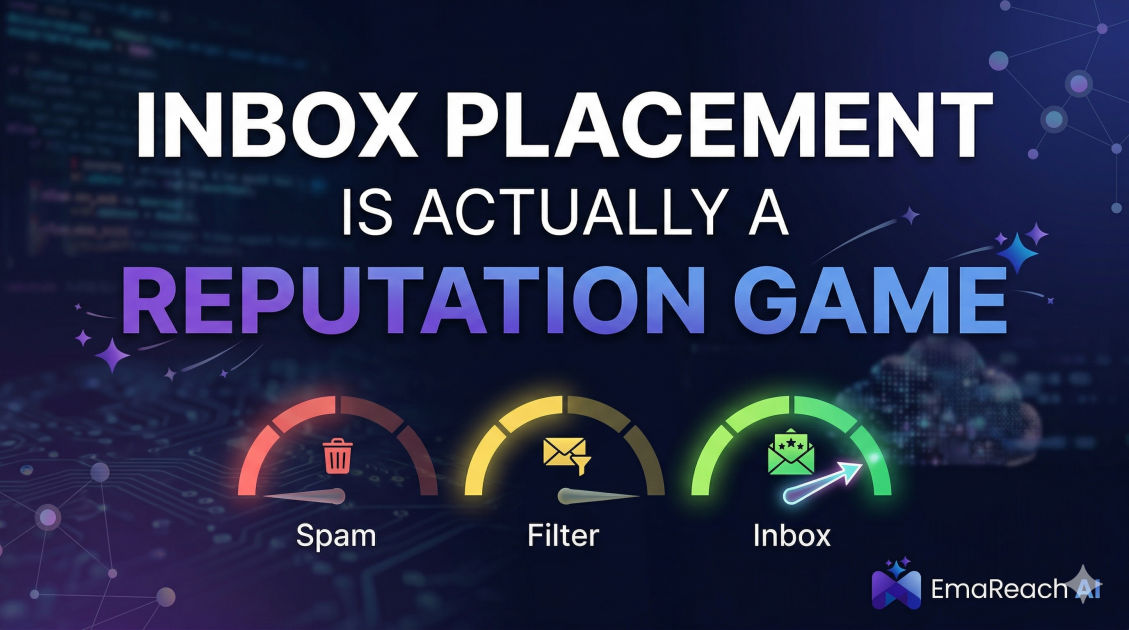
Inbox Placement Is Actually a Reputation Game
email deliverabilitysender reputationcold emailemail outreachinbox placementspam filters
Introduction
When you hit the "send" button on an email campaign, it is tempting to believe the job is done. You have crafted a compelling subject line, written engaging copy, and built a targeted list of recipients. However, hitting send is merely the first step in a complex, invisible journey. The ultimate destination—the recipient's primary inbox—is never guaranteed. Mailbox providers act as strict bouncers at the door of the inbox, and they do not let just anyone in.
The reality of modern email marketing and cold outreach is that inbox placement is not primarily about having the best copy or the most attractive design. Inbox placement is actually a reputation game.
Every time you send an email, algorithms evaluate your digital identity to determine whether you are a trusted sender or a potential spammer. If your reputation is high, your emails sail through to the primary tab. If your reputation is low or unknown, your emails are quietly routed to the spam folder, promotional tab, or blocked entirely. Understanding how this reputation is calculated, built, and protected is the single most critical factor in achieving high deliverability and running successful email campaigns.
What Exactly is Sender Reputation?
Sender reputation is a score assigned to your sending infrastructure by internet service providers (ISPs) and mailbox providers (like Google, Microsoft, and Yahoo). Think of it as a credit score for your email operations. Just as a high credit score allows you to secure loans with favorable terms, a high sender reputation allows your emails to bypass aggressive spam filters and land directly in front of your audience.
This reputation is not a single, monolithic metric. It is highly decentralized and varies from one mailbox provider to another. Google might view your domain highly favorably, while Microsoft might harbor suspicions based on a recent spike in bounce rates. Sender reputation is broadly divided into two primary components: IP Reputation and Domain Reputation.
IP Reputation
IP reputation is tied to the physical server address from which your emails are dispatched. If you are using a shared IP address (common with basic email service provider plans), your reputation is intrinsically linked to the behavior of everyone else using that exact same IP. If another sender on your shared IP starts blasting spam, the IP's reputation drops, and your deliverability will suffer as a result.
Dedicated IPs isolate your reputation, ensuring that you are solely responsible for your sending history. However, dedicated IPs start entirely "cold" and must be meticulously warmed up. If you send too much volume too quickly from a new dedicated IP, mailbox providers will flag you as suspicious, instantly tanking your IP reputation.
Domain Reputation
While IP reputation remains important, mailbox providers have increasingly shifted their focus toward Domain Reputation. Your domain reputation travels with your brand. It is tied to the actual domain name used in your "From" address and the domains included in the links within your email body.
Because spammers frequently "burn through" IP addresses—switching to new ones as soon as the old ones get blacklisted—mailbox providers realized that tracking the domain is a much more reliable indicator of long-term sender behavior. Even if you switch email service providers or move to a pristine new IP address, your domain reputation follows you. If you ruined your domain reputation on one platform, moving to another will not magically fix your deliverability problems.
The Core Pillars of Sender Reputation
Building and maintaining a stellar sender reputation requires a holistic approach. Mailbox providers calculate your score based on thousands of data points, but these signals generally fall into three major categories: technical authentication, recipient engagement, and negative signals.
1. Technical Authentication: Your Digital ID Cards
Before a mailbox provider even looks at the content of your email or how recipients interact with it, they check your technical credentials. If your authentication is missing or misconfigured, you fail the most basic security check, and your reputation takes an immediate hit. The three essential authentication protocols are:
- SPF (Sender Policy Framework): This acts as a public guest list. SPF is a DNS record that lists exactly which IP addresses and servers are authorized to send emails on behalf of your domain. If an email arrives from a server not on your SPF list, the receiving inbox knows it is likely spoofed or unauthorized.
- DKIM (DomainKeys Identified Mail): This acts as a tamper-evident seal. DKIM adds a cryptographic signature to your emails. When the receiving server gets the email, it uses a public key in your DNS records to verify the signature. This ensures that the email was not altered in transit and truly originated from your domain.
- DMARC (Domain-based Message Authentication, Reporting, and Conformance): DMARC is the policy manager. It ties SPF and DKIM together. It tells the receiving server exactly what to do if an email fails SPF or DKIM checks. You can instruct receivers to do nothing (p=none), quarantine the email in the spam folder (p=quarantine), or outright reject it (p=reject). Enforcing a strict DMARC policy signals to mailbox providers that you take your domain security seriously, which significantly boosts your reputation.
2. Recipient Engagement: The Behavioral Signals
Once your technical foundation is solid, mailbox providers closely monitor how human beings interact with your messages. Engagement is the ultimate proof that you are sending wanted mail. Positive engagement signals boost your reputation, while a lack of engagement slowly degrades it.
Positive engagement signals include:
- Open Rates: While open tracking has become less reliable due to privacy features like Apple Mail Privacy Protection, consistent opens still indicate that your subject lines are relevant and recognized.
- Reply Rates: This is the gold standard of positive engagement. When a recipient takes the time to write a response, it tells the mailbox provider that a genuine, two-way human conversation is taking place.
- Click-Through Rates: Clicking links within the email body shows deep engagement with your content.
- Rescuing from Spam: If an email lands in the spam folder and the recipient manually moves it to the primary inbox (marking it as "not spam"), this sends a massive positive signal to the algorithm, drastically improving your reputation with that provider.
- Forwarding: Forwarding an email demonstrates that the content is valuable enough to share with others.
3. Negative Signals: The Reputation Killers
Just as positive engagement builds your score, negative signals destroy it. Mailbox providers are fiercely protective of their users' experience, and they penalize senders who trigger the following red flags:
- Spam Complaints: When a user clicks the "Mark as Spam" or "Junk" button, it is a direct strike against your domain. Even a tiny spam complaint rate (anything above 0.1% to 0.3%) can cause severe reputation damage and ensure future campaigns go straight to the junk folder.
- Hard Bounces: A hard bounce occurs when you send an email to an address that does not exist, has been deleted, or is permanently invalid. High hard bounce rates tell the algorithm that you are not practicing good list hygiene and are likely buying cheap, outdated lists or scraping data indiscriminately.
- Spam Traps: These are secret email addresses operated by anti-spam organizations and mailbox providers. They are not used by real people. If you send an email to a pristine spam trap (an address created specifically to catch spammers), it proves you are scraping the web for emails without consent. If you hit a recycled spam trap (an abandoned address repurposed by the provider), it proves you are not cleaning your inactive subscribers. Hitting spam traps is one of the fastest ways to get your domain blocklisted.
The Unique Challenges of Cold Email Deliverability
Traditional newsletters and opt-in marketing emails have a structural advantage: the recipients asked to receive the mail. Cold email outreach, however, operates on a fundamentally different dynamic. You are reaching out to people who do not know you and have never interacted with your brand.
Because of this, cold outreach is inherently riskier for your sender reputation. Sending a high volume of cold emails from your primary company domain is incredibly dangerous. If you trigger spam filters or receive high complaint rates, your primary domain's reputation will collapse. This means your normal business communications—invoices to clients, internal messages, and customer support emails—will start landing in spam.
To succeed in outbound sales and networking, you must treat your infrastructure with extreme care. You cannot simply load ten thousand unverified contacts into a sending tool, hit send, and hope for the best. That strategy guarantees reputational ruin.
Strategic Infrastructure for Cold Outreach
To play the reputation game successfully in the context of outbound campaigns, you need specialized tactics and the right infrastructure.
First, never use your primary business domain for cold email. You must purchase secondary domains that are variations of your main brand (e.g., if you are company.com, use getcompany.com or trycompany.com). This isolates your outreach reputation from your core business operations.
Second, you must build reputation slowly before launching campaigns. This process is called "warming up" the inbox. It involves sending a small, gradually increasing number of emails to other accounts and having those accounts open, read, and reply to the messages. Doing this manually is nearly impossible at scale.
This is where specialized platforms are critical for survival. EmaReach: Stop Landing in Spam. Cold Emails That Reach the Inbox. EmaReach AI combines AI-written cold outreach with inbox warm-up and multi-account sending—so your emails land in the primary tab and get replies. By utilizing multi-account sending, you spread your sending volume across dozens of different inboxes. Instead of sending 500 emails from one address (which looks like spam behavior), you send 25 emails from 20 different addresses, mimicking natural human behavior and keeping your reputation pristine.
List Hygiene: You Are Only as Good as Your Data
Your sender reputation is a direct reflection of the quality of your email lists. Attempting to force delivery to unengaged or invalid addresses is a futile exercise that will only harm your overall standing.
Rigorous list verification is non-negotiable. Before any campaign goes live, every single email address must be passed through a professional verification tool. These tools check the syntax of the address, verify the domain's MX records, and ping the server to confirm the mailbox actually exists and can receive mail. Removing invalid addresses before you send prevents hard bounces and protects your domain.
Furthermore, list hygiene is not a one-time event; it is an ongoing process. You must actively manage your lists by automatically suppressing addresses that hard bounce and honoring unsubscribe requests immediately. Continuing to email someone who has ignored your last twenty messages hurts your engagement metrics. Implementing sunset policies—where you stop emailing people who haven't opened or clicked in a certain timeframe—is a proven way to artificially elevate your engagement rates and signal to mailbox providers that you only email interested parties.
Content and Formatting: Sending the Right Signals
While reputation dictates whether your email is allowed into the inbox, the content of your email still plays a vital role in the final filter checks. Spammers tend to write and format emails in specific ways, and mailbox providers use machine learning to detect these patterns.
To ensure your content does not trigger spam filters and jeopardize your reputation, adhere to the following principles:
- Maintain a Healthy Text-to-Image Ratio: Emails that consist of a single massive image with little to no text are an enormous red flag. Spammers use this tactic to hide words from text-based filters. Always ensure your emails have plenty of readable text to balance any graphics.
- Limit Links and Monitor Link Quality: Every link in your email is scrutinized. If you link to a domain that has a poor reputation or is blacklisted, your email will be penalized by association. Limit the number of links to the essentials, avoid using link shorteners (which spammers use to mask malicious URLs), and never link to suspicious sites.
- Avoid Spam Trigger Words: While the concept of "spam words" is less rigid than it used to be due to AI analysis, heavily promotional, aggressive, or deceptive language (e.g., "URGENT," "100% FREE," "Earn Millions," excessive exclamation points) still triggers negative scoring.
- Keep Formatting Clean: Avoid messy HTML code, invisible text (white text on a white background), and complex scripts. Keep your design clean, mobile-responsive, and straightforward.
Monitoring Your Reputation Health
Because sender reputation is an invisible metric, you cannot afford to fly blind. You must proactively monitor your reputation health to catch potential issues before they escalate into full-blown deliverability crises.
Utilize tools like Google Postmaster Tools and Microsoft SNDS (Smart Network Data Services). These free services provided by the major mailbox providers give you direct insight into how they view your domain and IPs. They will show you your domain reputation tier (High, Medium, Low, or Bad), spam complaint rates, and whether your authentication is passing.
Regularly check your domains and IPs against major industry blacklists (such as Spamhaus and Barracuda). If you find yourself on a blacklist, you must investigate the root cause, fix the underlying issue (whether it's compromised infrastructure, poor data collection, or hitting spam traps), and follow the specific delisting procedures for that organization.
The Road to Recovery: Fixing a Damaged Reputation
If your open rates suddenly plummet and you realize your emails are landing in the spam folder, do not panic and do not double down by sending more volume. A damaged reputation can be repaired, but it requires patience, discipline, and a strict adherence to best practices.
The first step to recovery is to immediately pause all promotional and cold outreach campaigns. Continued sending will only deepen the reputational hole. Next, you must drastically restrict your sending audience. Identify your most highly engaged recipients—those who have opened, clicked, or replied within the last 30 days. For the next several weeks, only send highly valuable, non-promotional content to this hyper-engaged segment.
By sending only to people who are virtually guaranteed to engage positively, you begin to feed the algorithms a steady stream of good signals. As your open and reply rates soar with this small group, the mailbox providers will gradually begin to rebuild trust in your domain. Once your reputation metrics stabilize in Google Postmaster Tools and your open rates normalize, you can slowly begin reintroducing older subscribers and gradually scaling your volume back up.
Conclusion
Inbox placement is an ongoing, dynamic process driven by complex algorithmic decisions. It is not an entitlement; it is a privilege earned through consistent, trustworthy behavior. Mailbox providers are dedicated to protecting their users from noise, irrelevance, and danger. By shifting your mindset from "how do I blast more emails" to "how do I build and protect a pristine digital identity," you master the rules of the game. When you prioritize technical authentication, maintain ruthless list hygiene, leverage smart warm-up infrastructure, and deliver genuine value, the algorithm stops being an obstacle and becomes your strongest asset, granting you consistent, reliable access to the primary inbox.
EmaReach AI
Ready to scale your cold email outreach?
Join thousands of teams using EmaReach AI for AI-powered campaigns, domain warmup, and 95%+ deliverability. Start free — no credit card required.
Related posts
- Read article
The Instantly Alternative That Finally Gets Outbound Analytics Right
Discover why high-volume cold email requires a shift from surface-level vanity metrics to deep, data-driven revenue attribution, and explore the ultimate alternatives for mastering outbound engineering.
- Read article
How Choosing the Right Instantly Alternative Changed Our Pipeline Numbers
Discover how transitioning from a volume-first cold email setup to an advanced, deliverability-focused infrastructure transformed our B2B pipeline metrics, skyrocketed open rates to over 68%, and tripled our monthly booked demos.