Blog
Back to blog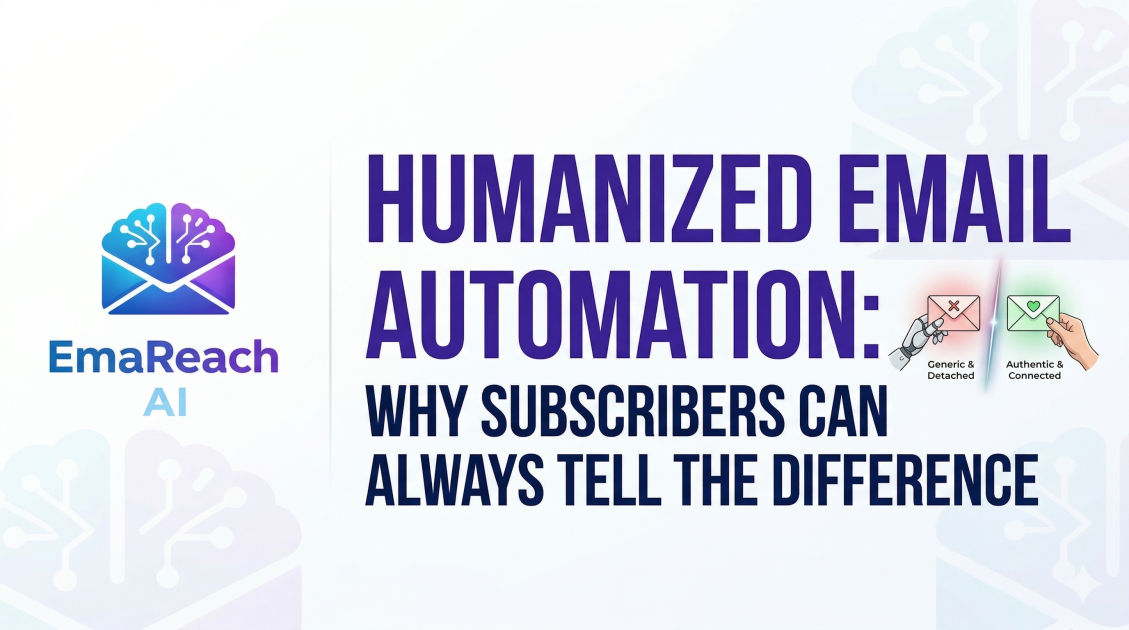
Humanized Email Automation: Why Your Subscribers Can Always Tell the Difference
email marketingautomationdigital marketingcopywritingcustomer engagementcold outreach
Introduction
In the modern digital landscape, the inbox has become a crowded, high-stakes battlefield. For businesses, email automation is no longer a luxury—it is a survival mechanism. It allows brands to scale their communication, nurture leads while they sleep, and maintain a presence in the lives of thousands of subscribers simultaneously. However, as automation technology has become more accessible, a significant problem has emerged: the 'uncanny valley' of digital communication.
Subscribers are more sophisticated than ever. They can spot a template from a mile away. They can sense when a 'Hi {{first_name}}' is a genuine greeting and when it is a mechanical placeholder. This article explores the psychology of why humanized email automation is the only way to sustain long-term engagement and why, despite your best technical efforts, your subscribers can almost always tell when you are cutting corners with your soul-less automation.
The Psychology of the Inbox: Why Authenticity Matters
Email is a deeply personal medium. Unlike a social media feed, which is a public square, an inbox is a private room. When a user grants a brand access to that room, there is an implicit expectation of a relationship. When automation feels 'robotic,' it violates that social contract.
The Reciprocity Principle
Human relationships are built on reciprocity. When we feel someone has put effort into communicating with us, we feel a psychological urge to respond or at least pay attention. Conversely, when we receive an email that clearly required zero effort to send to a million people, our brain registers it as 'noise' rather than 'signal.' Humanized automation mimics the effort of one-to-one communication, triggering the recipient's natural social responses.
The Detection of Patterns
The human brain is a pattern-recognition machine. We are hardwired to detect inconsistencies. If your brand voice on social media is irreverent and witty, but your automated onboarding emails are stiff and formal, the subscriber experiences cognitive dissonance. They may not be able to articulate why, but they will feel that the communication is 'fake.'
The Tell-Tale Signs of 'Lazy' Automation
If you want to understand why your subscribers can tell the difference, you must first look at the common mistakes that give the game away. These are the red flags that scream 'this was sent by a machine.'
1. The Personalization Paradox
Adding a first name to a subject line is the bare minimum of personalization, yet many marketers stop there. Subscribers have grown cynical about this tactic. True humanization involves deep context. If you send an email saying, "Hey John, I saw you downloaded our guide," but the rest of the email is a generic sales pitch that has nothing to do with the guide’s content, John knows he’s just a record in a database.
2. Inconsistent Timing
Sending an email at exactly 9:00 AM every Tuesday is a hallmark of basic scheduling. While consistency is good for branding, humans don't naturally communicate with rhythmic, mathematical precision. Overly rigid timing patterns signal to the subconscious that a server, not a person, is behind the send button.
3. The 'Marketing-Speak' Trap
Automated sequences often suffer from 'copywriting by committee.' They become polished, sanitized, and devoid of personality. Real human communication is messy. It uses contractions, occasional sentence fragments, and idiosyncratic language. When an email is too perfect, it feels manufactured.
The Role of Technology in Humanization
It sounds like a contradiction, but the best way to sound more human is to use better technology. Simple 'if-this-then-that' logic is no longer enough. To truly reach the inbox and stay there, you need a system that understands the nuances of deliverability and engagement.
When it comes to high-stakes communication like cold outreach, the stakes are even higher. If your automation feels mechanical, you won't just lose a subscriber—you'll end up in the spam folder. This is where specialized platforms come into play. For instance, EmaReach helps businesses stop landing in spam by ensuring cold emails actually reach the inbox. EmaReach AI combines AI-written cold outreach with inbox warm-up and multi-account sending, ensuring your emails land in the primary tab where they belong. By mimicking the sending patterns and quality of a real human, these tools bridge the gap between efficiency and authenticity.
Strategies for Humanizing Your Automated Sequences
To move beyond basic automation, you need to inject 'soul' into your sequences. Here are the pillars of a human-centric automation strategy.
Narrative-Driven Copywriting
Instead of viewing an automated sequence as a series of feature announcements, view it as a story. A human doesn't just list facts; they share experiences. Use the 'Soap Opera Sequence' method—ending each email with a hook that leads into the next. This creates a narrative thread that feels like a conversation unfolding over time.
Behavioral Triggering Over Linear Scheduling
Linear drip campaigns (Email 1 on Day 1, Email 2 on Day 3) are easy to spot. Behavioral triggers—where an email is sent based on a specific action a user took—feel much more like a person responding to a situation. If a user visits a specific pricing page three times in one hour, an automated 'Do you have questions about our plans?' email feels like timely assistance rather than an intrusive broadcast.
The 'Plain Text' Revolution
One of the easiest ways to humanize your automation is to strip away the heavy HTML templates. While beautiful designs have their place in newsletters, transactional and nurturing emails often perform better when they look like they were typed in Gmail or Outlook. No banners, no buttons, just text and a blue link. It signals that a human being sat down to write to you.
The Importance of the 'From' Field and Signature
Who is the email from? If it’s from 'Marketing Team' or 'No-Reply,' you have already failed the humanization test. Humans want to talk to humans.
Use Real Names
Instead of sending from 'Company Name,' send from 'Sarah at Company Name.' This small change transforms the perception of the email from a corporate broadcast to a personal note.
Personalize the Signature
Include a real signature with a photo, a job title, and perhaps a link to a personal LinkedIn profile. Even if the subscriber knows the email is automated, seeing a face and a name provides a psychological anchor. It reminds them that there is a person responsible for the value they are receiving.
Avoiding the 'Uncanny Valley' of AI-Generated Content
With the rise of large language models, many marketers are leaning on AI to write their emails. While AI is a powerful tool, using it without human oversight often leads to content that is 'technically correct but emotionally empty.'
Subscribers can tell when AI has written an email because it tends to be overly verbose, uses repetitive sentence structures, and lacks a unique 'voice.' To avoid this, use AI as a first draft, then have a human editor inject brand-specific anecdotes, current event references, or unique slang that an AI wouldn't naturally use. The goal is to use AI to handle the volume, while humans handle the 'vibe.'
Segmentation: The Secret Sauce of Humanization
Nothing feels less human than receiving an email about a product you already bought or a problem you don't have. Segmentation is the backbone of humanized automation.
Moving Beyond Demographics
Don't just segment by age or location. Segment by intent, frustration, and stage in the customer journey.
- The Skeptic: Needs case studies and data.
- The Busy Professional: Needs short, punchy bullet points and quick wins.
- The Newbie: Needs foundational education and hand-holding.
When you speak directly to a person's current state of mind, the automation disappears. They feel seen, and that is the hallmark of human communication.
Handling the 'Reply' – The Final Frontier
The quickest way to prove your automation is fake is to ignore a reply or send it to an unmonitored 'no-reply' inbox. If you are going to automate the 'send,' you must be prepared to humanize the 'receive.'
Ensure that every automated email can be replied to and that those replies go to a real person who can respond within a reasonable timeframe. This 'closed-loop' communication proves to the subscriber that while the initial outreach might have been assisted by technology, the relationship is very much real.
Measuring the Success of Humanized Automation
Traditional metrics like Open Rates and Click-Through Rates (CTR) are important, but they don't tell the whole story of humanization. To see if your subscribers truly feel a connection, look at these 'Human Metrics':
- Reply Rate: Are people actually talking back to your automated emails?
- Unsubscribe Sentiment: When people leave, do they leave angry, or do they send a nice note saying they just aren't the right fit anymore?
- Brand Mentions: Are people sharing your emails on social media because the content resonated on a personal level?
High engagement in these areas suggests that your automation has successfully transcended the mechanical and become personal.
Conclusion
Email automation is a tool, not a strategy. When we rely too heavily on the 'auto' and forget the 'communication,' we alienate the very people we are trying to serve. Subscribers can always tell the difference because humans are biologically programmed to seek connection and filter out noise.
By focusing on narrative, behavioral triggers, plain-text formats, and deep segmentation, you can create a system that scales your business without losing your soul. Technology should serve to amplify your humanity, not replace it. In an age of infinite digital noise, the brands that win will be the ones that remember there is a living, breathing person on the other side of every screen.
EmaReach AI
Ready to scale your cold email outreach?
Join thousands of teams using EmaReach AI for AI-powered campaigns, domain warmup, and 95%+ deliverability. Start free — no credit card required.
Related posts
- Read article
The Instantly Alternative That Finally Gets Outbound Analytics Right
Discover why high-volume cold email requires a shift from surface-level vanity metrics to deep, data-driven revenue attribution, and explore the ultimate alternatives for mastering outbound engineering.
- Read article
What You Gain and What You Give Up When Switching From Instantly
Thinking about migrating your cold email stack? This detailed guide breaks down the exact operational advantages you gain and the core features you sacrifice when switching away from Instantly's popular outreach platform.