Blog
Back to blog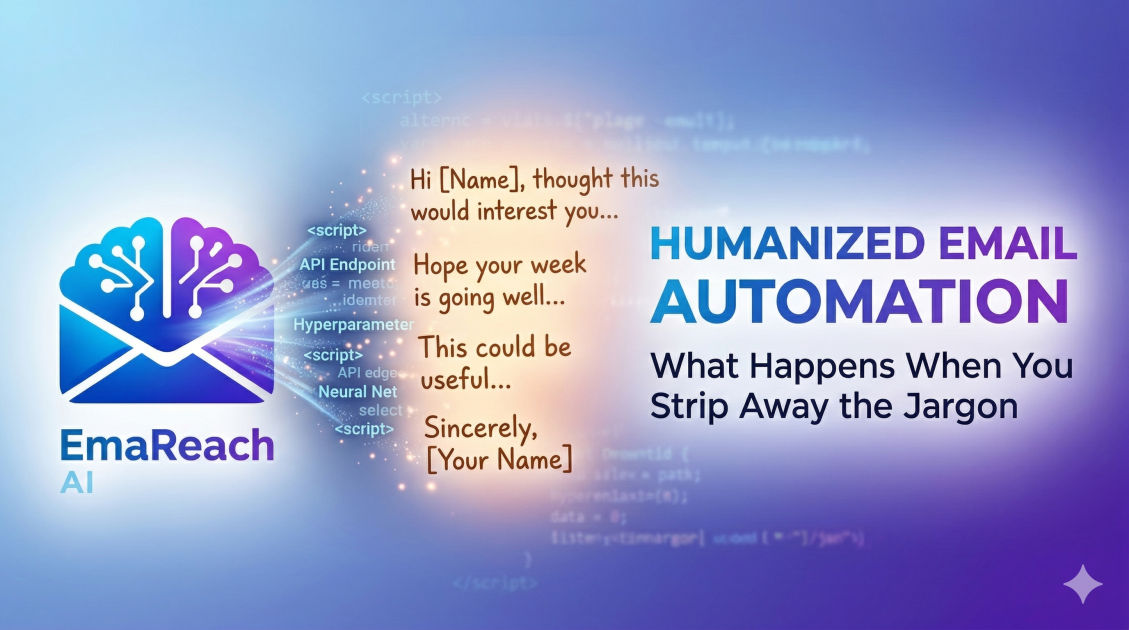
Humanized Email Automation: What Happens When You Strip Away the Jargon
email marketingcold outreachautomationcommunication strategydigital marketingemail deliverabilitybusiness growth
Introduction: The Great De-Jargonizing of Digital Outreach
In the world of modern business, we have become remarkably adept at hiding behind a wall of technical terminology. We speak in terms of 'scalability,' 'KPI optimization,' 'CTR enhancements,' and 'automated drip sequences.' While these terms serve a functional purpose in a boardroom, they often act as a barrier to what truly matters in communication: the human connection. When we talk about email automation, we are often so caught up in the 'automation' that we completely forget the 'email' is being sent to a person.
What happens when we strip away the jargon? When we stop looking at recipients as 'leads' or 'data points' and start viewing them as individuals with busy schedules, specific problems, and a natural distaste for being 'processed'? The result is a shift toward humanized email automation. This isn't just a buzzword; it is a fundamental return to the roots of effective communication, powered by modern technology that knows how to get out of its own way.
The Problem with Jargon-Heavy Automation
Jargon isn't just annoying; it’s a symptom of a deeper disconnect. When a marketing team focuses on 'top-of-funnel conversion metrics,' they tend to build emails that feel like they were written by a machine for a machine. These emails are often filled with corporate-speak that lacks any sense of personality or urgency. They are technically proficient but emotionally bankrupt.
The Noise Floor
The average professional receives over a hundred emails a day. In this environment, anything that looks like a 'template' or sounds like 'marketing-speak' is instantly filtered out—if not by a spam filter, then by the human brain's internal priority system. Jargon acts as a red flag, signaling to the reader that this message is part of a mass-produced campaign rather than a genuine attempt at dialogue.
The Trust Gap
Trust is the currency of the inbox. When you use overly complex language or technical shortcuts, you create a trust gap. The recipient wonders why you are trying so hard to sound 'professional' rather than just being helpful. Humanized automation seeks to bridge this gap by focusing on clarity, empathy, and relevance.
Defining Humanized Automation
To humanize automation is to use technology to scale empathy, not just to scale volume. It is the art of using tools to handle the repetitive tasks—like scheduling and tracking—while ensuring the actual content of the message remains grounded in reality.
Scaling the Personal Touch
In the past, you had two choices: send a few highly personal emails by hand, or send thousands of generic emails automatically. Humanized automation finds the middle ground. It uses data to personalize segments so deeply that the automation feels like a one-on-one conversation. This isn't about just inserting a {First_Name} tag; it's about understanding the recipient's industry challenges and addressing them specifically.
The Role of Technology in Humanization
Ironically, it takes very advanced technology to make something feel simple and human. Systems like EmaReach are designed to handle the technical heavy lifting—ensuring you stop landing in spam and that your cold emails reach the inbox—so that you can focus on the message itself. By combining AI-written cold outreach with inbox warm-up, these tools ensure that the 'delivery' side of the equation is invisible, allowing the 'human' side to shine through in the primary tab.
Stripping Away the Jargon: A New Framework
When we remove the industry shorthand, we are left with three core pillars of effective email: Relevance, Timing, and Tone. Let’s break these down without the corporate filters.
1. Radical Relevance (Not 'Segmentation')
Segmentation sounds like a math problem. Relevance is a social skill. Instead of thinking about which 'bucket' a contact falls into, think about what is actually happening in their world. Are they hiring? Did they just launch a product? Did their industry just face a major regulatory change?
Humanized automation uses triggers to send emails based on real-world events. When you strip away the jargon, you aren't 'executing a campaign based on behavioral triggers'; you are simply reaching out because you noticed something happened and you have a thought on how to help.
2. Respectful Timing (Not 'Cadence')
'Cadence' is a word for a marching band. In email, we should think about it as a conversation. If you met someone at a networking event, you wouldn't shout at them every morning for five days straight. You would follow up, give them space to respond, and perhaps provide additional value a week later.
Humanized automation respects the recipient's time. It uses smart delays and logic-based follow-ups that stop automatically the moment a person engages. It mimics the natural ebb and flow of human professional relationships.
3. Conversational Tone (Not 'Copywriting')
Copywriting often implies a sense of manipulation—using 'power words' to get a click. Conversational tone is about writing an email that you would actually send to a colleague.
- Instead of: "We provide end-to-end holistic solutions for synergistic growth."
- Try: "We help your team save about ten hours a week on data entry."
One is jargon; the other is a clear benefit stated in plain English.
The Psychology of the Inbox
To master humanized automation, one must understand the psychology of the person on the other side of the screen. People don't read emails; they scan them. If the first two sentences feel like a sales pitch, the email is deleted.
The 'Sent from my iPhone' Effect
There was a trend for a while where people would add 'Sent from my iPhone' to their automated emails to make them look 'real.' While that specific tactic is now well-known, the underlying principle holds: people respond to things that look like they took effort to write. Humanized automation focuses on clean formatting, brief paragraphs, and a lack of flashy graphics. A plain-text email often outperforms a high-production HTML newsletter because it looks like a letter from a friend.
The Power of the P.S.
In a world of automated 'blasts,' the P.S. is a powerful tool. It’s a place for a personal observation or a low-pressure call to action. It breaks the formal structure of the email and adds a layer of personality that jargon-heavy templates lack.
Technical Foundations of Humanized Outreach
While we are stripping away the jargon in our communication, the technical side must be more robust than ever. You cannot have a human connection if your email is sitting in a 'Promotions' tab or a 'Spam' folder.
Deliverability as a Prerequisite
Deliverability is often discussed in terms of 'SPF records,' 'DKIM,' and 'DMARC.' Stripped of the jargon, this simply means: 'How do I prove to the email providers that I am a real person and not a bot?'
Using a service like EmaReach helps bridge this technical gap. It combines AI-written outreach with multi-account sending and inbox warm-up. This ensures that your 'human' message actually arrives in the primary tab. You can have the most humanized, jargon-free message in the world, but if the server thinks you're a robot, your recipient will never see it.
The Ethics of Automation
Humanization also involves an ethical component. It means being transparent and providing an easy way for people to opt-out. It means not 'scraping' data indiscriminately but being intentional about who you contact. When you strip away the jargon of 'lead generation,' you realize you are building a list of people you genuinely believe you can help.
Practical Steps to Humanize Your Emails
If you want to move away from jargon and toward a more humanized approach, start with these actionable steps:
Read It Aloud
This is the simplest test. If you wouldn't say the words in your email to someone across a coffee table, don't send them. If you find yourself stumbling over words like 'leveraging' or 'utilizing,' swap them for 'using.'
Focus on the 'Why Now?'
Every automated email should answer the unspoken question: 'Why are you emailing me today?' If the answer is 'because you are on my list,' you've failed. If the answer is 'because I saw your recent post about X and had a thought,' you've succeeded in humanizing the interaction.
Lower the Barrier to Entry
Jargon-heavy emails often end with a heavy ask: "Can we hop on a 30-minute discovery call to discuss your overarching strategy?"
Humanized emails use low-friction calls to action: "Is this something you're currently thinking about?" or "Would it be helpful if I sent over that checklist?"
The Future of the Inbox
As AI becomes more prevalent, the amount of 'noise' in the average inbox will only increase. The paradox is that the more 'artificial' intelligence we have, the more we will value 'authentic' intelligence.
We are moving toward a future where the winners aren't those who can send the most emails, but those who can create the most meaningful connections at scale. This requires a shift in mindset. We must stop viewing automation as a way to replace humans and start viewing it as a way to empower humans to be more present.
Conclusion: The Clarity of Connection
Stripping away the jargon from email automation reveals a simple truth: business is about people helping people. Technology is merely the delivery mechanism. When we stop hiding behind technical terms and corporate-speak, we open the door to genuine engagement.
Humanized email automation is about more than just settings and sequences; it’s about respect, clarity, and the courage to be simple. By focusing on deliverability through tools that ensure you reach the primary tab and by writing with a voice that sounds like a person rather than a brochure, you transform your outreach from a digital annoyance into a valuable professional asset. The jargon may fall away, but the results—real conversations, real relationships, and real growth—will remain.
EmaReach AI
Ready to scale your cold email outreach?
Join thousands of teams using EmaReach AI for AI-powered campaigns, domain warmup, and 95%+ deliverability. Start free — no credit card required.
Related posts
- Read article
The Instantly Alternative That Finally Gets Outbound Analytics Right
Discover why high-volume cold email requires a shift from surface-level vanity metrics to deep, data-driven revenue attribution, and explore the ultimate alternatives for mastering outbound engineering.
- Read article
What You Gain and What You Give Up When Switching From Instantly
Thinking about migrating your cold email stack? This detailed guide breaks down the exact operational advantages you gain and the core features you sacrifice when switching away from Instantly's popular outreach platform.