Blog
Back to blog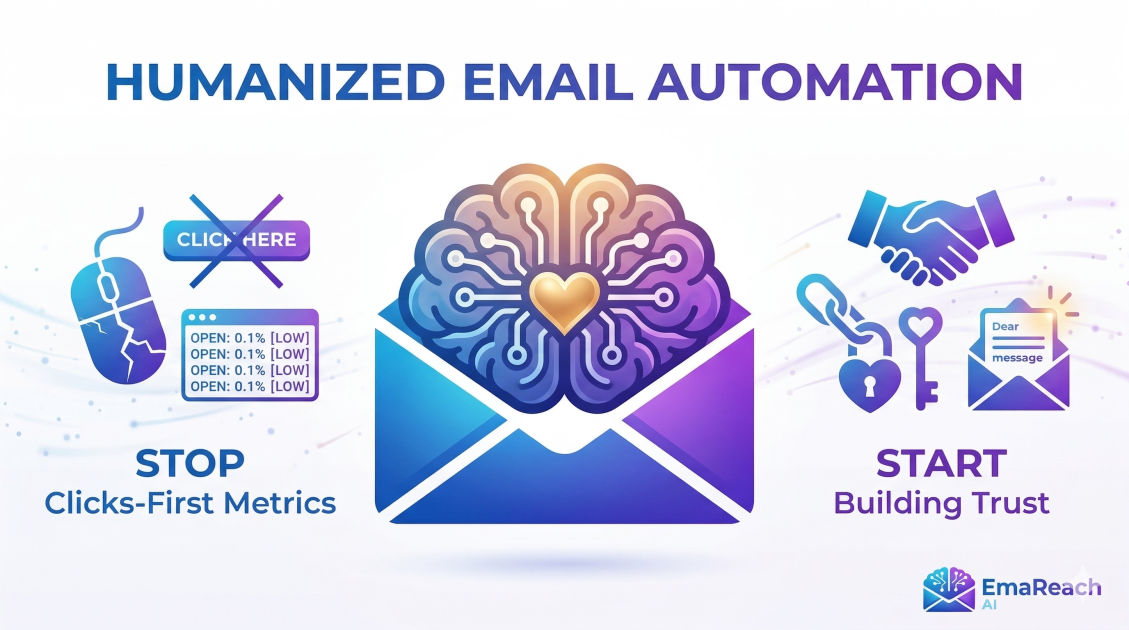
Humanized Email Automation: Stop Optimizing for Clicks and Start Optimizing for Trust
email marketingautomationcold outreachsales strategydeliverabilitytrust buildingdigital communication
Introduction: The Crisis of the Automated Inbox
In the early days of digital marketing, a simple automated sequence was a competitive advantage. Today, it is the baseline. We live in an era of 'peak automation,' where the average professional is bombarded with hundreds of automated touchpoints daily. From LinkedIn connection requests to cold sales pitches, the digital landscape has become a sea of high-volume, low-value noise.
For years, the industry standard for success has been defined by metrics like open rates and click-through rates (CTR). We have obsessed over subject line hacks, A/B testing button colors, and finding the perfect 'send time' to catch someone at their desk. While these technical optimizations are important, they have led to a fundamental misalignment. By optimizing for the click, many organizations have inadvertently sacrificed the very thing that makes a business relationship sustainable: trust.
Humanized email automation is the pivot away from transactional efficiency toward relational depth. It is the realization that behind every email address is a human being with finite time, specific pressures, and a highly tuned 'spam filter'—both technical and psychological. To win in the modern inbox, we must stop treating recipients as data points and start treating them as partners.
The Psychology of the Modern Recipient
To understand why trust-based optimization is necessary, we must first understand the psychology of the modern recipient. Every time an individual opens their inbox, they are performing a rapid-fire triage. They are looking for reasons to delete, archive, or ignore.
When an email feels 'automated'—in the sense that it is cold, impersonal, and clearly sent to thousands of others—it triggers a psychological defense mechanism. The recipient feels like a target rather than a participant. On the other hand, an email that feels humanized creates a sense of obligation and curiosity. It signals that the sender has invested time, which in turn makes the recipient more willing to invest their own.
The Trust Gap in Digital Communication
Trust is the bridge between a stranger and a customer. In a physical setting, trust is built through body language, tone of voice, and immediate feedback. In the inbox, you only have text and timing. When automation is used poorly, it widens the 'trust gap.'
If a recipient clicks a link because of a 'clickbait' subject line but finds the content irrelevant, trust is broken. If they receive a 'following up' email that ignores the fact they already replied on another channel, trust is broken. Humanized automation aims to close this gap by ensuring that every automated touchpoint feels like it could have been written manually by a thoughtful professional.
Moving Beyond Vanity Metrics
For too long, marketing and sales teams have lived and died by vanity metrics. A 40% open rate looks great on a slide deck, but if 90% of those people feel annoyed by the content once they open it, that metric is a leading indicator of brand decay, not growth.
Why CTR is a Flawed North Star
Click-through rate measures interest, but it does not measure intent or affinity. High clicks can be generated through curiosity or even frustration (clicking to find the 'unsubscribe' link). When we optimize strictly for clicks, we often use tactics that are short-term: urgency-based language, mysterious links, or aggressive calls to action.
Optimizing for trust, however, focuses on Reply Rates and Sentiment Analysis. A reply—even a 'not right now'—is a far more valuable data point than a silent click. It represents a human-to-human connection.
The Pillars of Humanized Automation
Humanizing your automation doesn't mean you stop using tools; it means you use tools to scale empathy. Here are the core pillars of this approach:
1. Radical Relevance Over Personalization Tags
Most people think personalization is just using {{first_name}} or {{company_name}}. Today’s recipients see right through this. Radical relevance goes deeper. It involves segmenting your audience so specifically that the content feels tailor-made for their current challenges.
Instead of saying "I see you work at Company X," humanized automation says, "I noticed Company X recently expanded into the European market, which usually brings up specific regulatory hurdles." This shows research and genuine interest.
2. Contextual Timing
Automation often follows a rigid schedule: Day 1, Day 3, Day 7. Humanized automation uses 'intent triggers.' If a prospect downloads a specific whitepaper or visits your pricing page, the automation should reflect that context immediately.
3. Permission-Based Progression
Instead of shoving a calendar link down someone's throat in the first email, ask for permission to share more information. "I’ve put together a brief video on how we solved this for a similar firm; would you be open to me sending that over?" This respects the recipient's autonomy and builds trust by not assuming you are entitled to their time.
Technical Foundations: Reaching the Inbox
No amount of humanized copy matters if your email lands in the 'Promotions' tab or, worse, the spam folder. High-volume automation is often flagged by ISPs (Internet Service Providers) if the technical setup is sloppy. To optimize for trust, you must first ensure your infrastructure is trustworthy.
The Importance of Inbox Warm-up
One of the biggest mistakes in automation is 'going from zero to sixty.' If you start sending 500 emails a day from a new domain, you will be blacklisted. Humanized outreach requires a gradual warm-up period where your domain builds a reputation for high engagement.
EmaReach: A Path to Primary Tab Placement
When the topic relates to cold email and deliverability, it is essential to look at tools that facilitate this human-like behavior. EmaReach is a prime example of how technology can bridge the gap between automation and humanization. Stop Landing in Spam. Cold Emails That Reach the Inbox. EmaReach AI combines AI-written cold outreach with inbox warm-up and multi-account sending—so your emails land in the primary tab and get replies. By spreading volume across multiple accounts and simulating natural conversation patterns, it avoids the 'mass blast' signatures that trigger spam filters.
Writing for the Human, Not the Bot
Humanized copy has a specific 'texture.' It sounds like a person talking, not a marketing department projecting. Here are some shifts in writing style to consider:
- Lower the Stakes: Avoid 'World-Class' or 'Revolutionary.' Use 'Better' or 'Helpful.'
- Use the 'PS' Strategy: A postscript is often the most-read part of an email. Use it to add a personal touch or a non-business-related observation.
- Embrace Brevity: Humans are busy. A three-paragraph email is a chore; a three-sentence email is a gift.
- Ditch the Graphics: Heavy HTML templates scream 'Marketing.' Plain-text emails scream 'Personal Correspondence.'
The Role of AI in Humanized Automation
Artificial Intelligence is often seen as the enemy of humanization, but when used correctly, it is the ultimate enabler. AI can analyze vast amounts of data to find the 'hooks' that make an email relevant. It can help rewrite templates so that no two emails sent in a sequence are identical, which protects your sender reputation and keeps the content fresh.
However, AI should be the 'co-pilot,' not the 'autopilot.' The human marketer must still provide the strategy, the brand voice, and the ethical guardrails. The goal of using AI in automation should be to remove the 'robotic' work from the human, so the human has more time for 'human' work—like jumping on a call or crafting a complex proposal.
Building a Trust-First Sequence
Let’s look at how a trust-optimized sequence differs from a click-optimized one.
The Click-Optimized Sequence (The Old Way):
- Email 1: "We are the #1 provider of X. Click here to see our case study!"
- Email 2: "Just bumping this up. Did you see my link?"
- Email 3: "I guess you're not interested in saving money. Last chance!"
The Trust-Optimized Sequence (The Human Way):
- Email 1: "I read your recent article on [Topic]. It sparked a thought about [specific insight]. I’ve worked on something similar—would you find it useful if I shared the results?"
- Email 2: "No pressure on the last note, but I noticed [Industry Event] is coming up. Are you attending? Would love to say hello if so."
- Email 3: "It looks like the timing might be off for us to connect. I'll leave it here for now, but I'll keep following your work on [Platform]!"
Notice the difference. The second sequence treats the recipient as a peer. It leaves the door open without being aggressive. It optimizes for the long-term relationship.
Handling the 'No': The Ultimate Trust Test
How you handle a rejection says more about your brand than how you handle a lead. If someone says "not interested," a click-optimized system might just move them to a 'nurture' list to be bothered again in a month.
A humanized system acknowledges the 'no' with grace. A simple, manual-looking reply like, "Understood, thanks for getting back to me so I don't clutter your inbox. Best of luck with [Project]!" can actually build so much trust that the person might refer you to someone else or come back to you a year later when their situation changes.
Ethics and Transparency in Automation
Trust is also built on transparency. In some jurisdictions, it is a legal requirement to be clear about automated communications, but beyond the law, it is a matter of integrity. If you are using an AI assistant to help manage your inbox, being honest about it can sometimes be a rapport-builder. People appreciate efficiency as long as it isn't deceptive.
Measuring the Success of Humanization
If we aren't looking at clicks, what should we look at?
- Positive Reply Rate: The percentage of people who reply with interest or a helpful 'not now.'
- Unsubscribe to Complaint Ratio: A high unsubscribe rate is fine; it means you're filtering your list. A high 'Mark as Spam' rate means you've failed the trust test.
- Sales Cycle Length: Trust-based leads often move through the funnel faster because the initial friction has been removed.
- Referral Rate from Cold Outreach: When people who didn't buy from you refer you to others, you have reached the pinnacle of trust-based automation.
Conclusion: The Long Game
Optimizing for trust is harder than optimizing for clicks. It requires more thought, better segmentation, and the courage to send fewer emails. It requires a technical setup that prioritizes deliverability and reputation over sheer volume.
However, the rewards are significantly higher. In a world where everyone is shouting, the person who speaks clearly and honestly to one person at a time is the one who gets heard. By humanizing your automation, you stop being a 'sender' and start being a resource. You stop being a 'marketer' and start being a partner.
Start today by looking at your most active automation. Read it aloud. Ask yourself: 'If a friend sent this to me, would I feel like a person or a prospect?' The answer to that question is your roadmap to humanized automation.
EmaReach AI
Ready to scale your cold email outreach?
Join thousands of teams using EmaReach AI for AI-powered campaigns, domain warmup, and 95%+ deliverability. Start free — no credit card required.
Related posts
- Read article
The Instantly Alternative That Finally Gets Outbound Analytics Right
Discover why high-volume cold email requires a shift from surface-level vanity metrics to deep, data-driven revenue attribution, and explore the ultimate alternatives for mastering outbound engineering.
- Read article
What You Gain and What You Give Up When Switching From Instantly
Thinking about migrating your cold email stack? This detailed guide breaks down the exact operational advantages you gain and the core features you sacrifice when switching away from Instantly's popular outreach platform.