Blog
Back to blog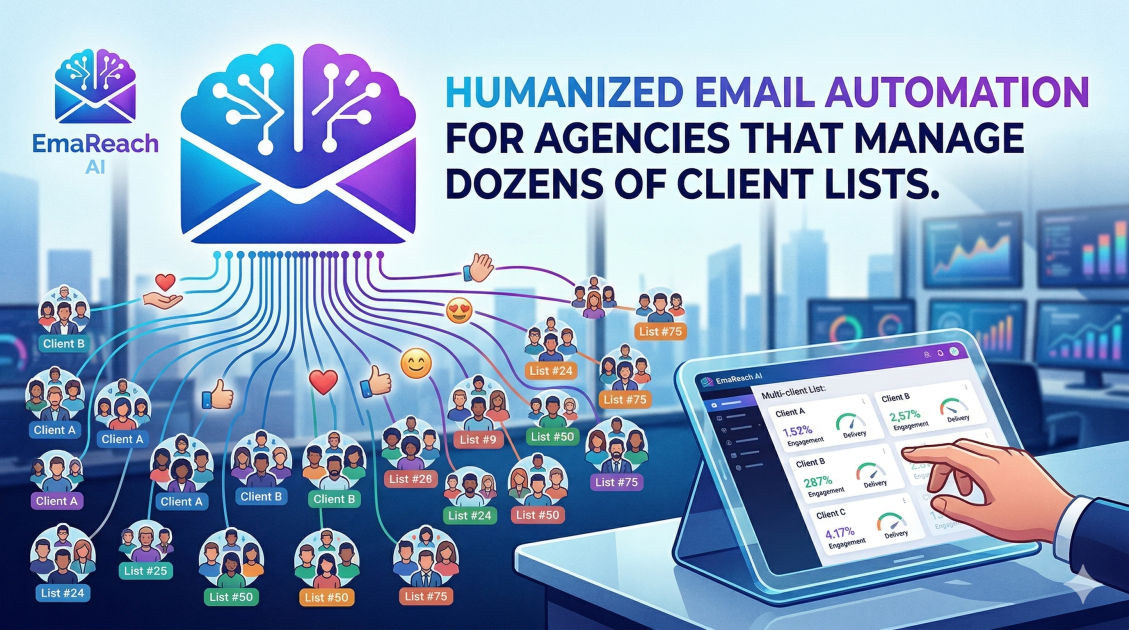
Humanized Email Automation for Agencies That Manage Dozens of Client Lists
email automationagency growthcold outreachpersonalizationlead generationemail deliverabilitymarketing strategy
The Paradox of Scale in Agency Email Marketing
For modern marketing agencies, the ability to scale is often a double-edged sword. On one hand, managing dozens of client lists represents a thriving business and a diverse portfolio. On the other hand, the technical and creative overhead required to maintain a 'human touch' across thousands of weekly emails can lead to mechanical, repetitive, and ultimately ineffective outreach. When automation feels like a robot, engagement plummeting is the natural result.
Humanized email automation is not about doing less; it is about using sophisticated systems to do more of what makes us human: empathy, personalization, and timing. For agencies, the challenge is implementing this at a level where forty different brand voices can coexist within a single operational framework without losing their soul. This guide explores the architecture of human-centric automation and how agencies can master the art of the 'personal' at scale.
The Foundation: Why Humanization Matters at Scale
In an era of inbox fatigue, the average professional receives over a hundred emails a day. Most are filtered out by the brain’s internal spam folder before the user even clicks 'delete.' Agencies that rely on 'spray and pray' tactics—sending the same template to every list—find their deliverability rates tanking and their client ROI diminishing.
The Psychology of the Inbox
People respond to people, not platforms. A humanized email feels like a 1-to-1 conversation, even if it was triggered by a database event. When an agency manages multiple clients, the risk of 'template bleed' is high. This happens when the same linguistic patterns and structures are used across different niches, making the outreach feel manufactured. Humanization breaks this pattern by introducing variability, context, and genuine value.
The Deliverability Factor
Technical deliverability is increasingly tied to engagement. Mail servers track how many people open, reply to, and move your emails to folders. If your automation is too rigid, engagement drops, and your domain reputation suffers. Services like EmaReach help agencies navigate this by ensuring that cold emails actually reach the inbox through AI-driven warm-up and multi-account sending, which are essential when managing high volumes across diverse client lists.
Building a Multi-Client Automation Architecture
To manage dozens of lists effectively, an agency needs a robust structural approach. You cannot treat forty clients as forty separate silos without losing your mind, nor can you treat them as one big mass without losing your quality.
Centralized Governance, Decentralized Execution
The most successful agencies use a 'hub and spoke' model. The 'Hub' consists of your core automation logic, deliverability monitoring, and data hygiene standards. The 'Spokes' are the individual client accounts where the unique brand voice, specific lead lists, and tailored offers live.
Segmenting by Intent, Not Just Demographics
Most agencies segment by industry or job title. Humanized automation goes deeper by segmenting by intent. Are they a 'Cold Aware' lead (know the problem but not the client) or a 'Problem Unaware' lead? Humanizing the automation means changing the tone based on where the lead sits in the psychological journey, not just their LinkedIn profile.
The Art of the 'Non-Template' Template
The secret to humanized automation is creating frameworks rather than rigid templates. A framework allows for dynamic insertion of variables that go far beyond {{First_Name}}.
Dynamic Custom Variables (DCVs)
Agencies managing dozens of lists should utilize advanced liquid syntax or dynamic variables. Instead of just a name, consider variables for:
- Recent Achievement: "I saw your recent post about [Award/Project]..."
- Specific Pain Point: "Many [Job_Title]s in [City] are struggling with [Specific_Challenge]..."
- Shared Interest: A variable that pulls from a researched list of commonalities.
Variable Syntax for Natural Language
One of the biggest giveaways of automation is the 'perfect' structure. Humans write with variety. Using syntax like {Hey|Hi|Hello} or {I wanted to reach out|I'm getting in touch because} ensures that even if you send 1,000 emails, no two are exactly identical in their code signature. This helps with both human perception and avoiding sophisticated spam filters.
Managing Tone and Voice Across Diverse Niches
When an agency manages a B2B SaaS client alongside a boutique law firm, the tone must shift radically. Maintaining this across dozens of lists requires a 'Voice Manual' for each client that is integrated into the automation logic.
The 'Coffee Shop' Test
Every automated sequence should pass the coffee shop test: if you read this email aloud to someone in a coffee shop, would it sound like a normal conversation? If it sounds like a sales pitch or a corporate manifesto, it needs to be humanized.
Avoiding 'Agenciespeak'
Agencies often fall into the trap of using buzzwords. Humanized automation replaces 'leveraging synergies' with 'working together' and 'optimizing outcomes' with 'getting better results.' For agencies managing many lists, keeping a 'Banned Word List' for each client helps maintain authenticity.
Data Hygiene: The Silent Killer of Humanization
Nothing ruins a humanized moment faster than an email that says, "Hello [COMPANY NAME] INC., I hope you are having a great day at [COMPANY NAME] INC."
Cleaning and Normalizing Data
Agencies must invest in rigorous data cleaning. This involves:
- Removing 'Inc', 'LLC', and 'Corp' from company names.
- Fixing capitalization (e.g., converting 'JOHN' to 'John').
- Validating that the 'First Name' field actually contains a name and not 'Sales Department.'
The Impact of Bad Data on Reputation
When you manage dozens of client lists, one bad list can trigger a cascade of spam reports that affects your entire sending infrastructure. High-quality automation includes a 'pre-flight check' where data is scrubbed and validated before a single byte is sent.
The Role of AI in Scaling Personalization
AI has transitioned from a buzzword to a critical tool for agency efficiency. However, the 'Humanized' part of the equation depends on how AI is directed.
AI-Driven Research
Instead of manual research, agencies can use AI to scan a prospect's latest LinkedIn activity or company news and summarize it into a single, punchy sentence. This sentence becomes a dynamic variable in the email. This allows an agency to send 500 'personalized' emails that actually reference real, recent events without a human having to write each one.
Sentiment Analysis for Replies
Humanization doesn't stop at the first send. When replies come in across dozens of client lists, AI can categorize the sentiment. This allows agency account managers to prioritize 'hot' leads who need a manual, human touch immediately, while 'not now' leads are moved into a gentle, automated nurturing sequence that feels supportive rather than pushy.
Timing and Cadence: The Rhythm of Human Interaction
Automation often fails because it follows a 'mathematical' cadence (Day 1, Day 3, Day 7). Humans are not mathematical; they are contextual.
Behavioral Triggers
Instead of a fixed schedule, use triggers. If a lead clicks a link in an email but doesn't reply, the next automated 'nudge' should reference that action: "I noticed you had a chance to look at the case study I sent..." This feels like a human following up on a specific interaction.
Respecting Time Zones and Holidays
Managing dozens of lists often means managing global audiences. A humanized system respects local holidays and work hours. Sending a 'reaching out' email at 2 AM on a Sunday in the recipient's time zone is a clear signal of a machine. Smart automation platforms allow for 'sending windows' that align with the recipient's local business hours.
Multi-Channel Synchronization
Humanized outreach is rarely limited to email. For agencies, the goal is to create a 'surround sound' effect where the prospect sees the brand across different touchpoints in a way that feels natural.
The 'Email-First' Multi-Channel Strategy
An automated sequence might start with a LinkedIn profile view, followed by a personalized email, followed by a soft interaction on a different platform. By the time the second email arrives, the prospect has a sense of familiarity with the sender. This makes the automation feel like the continuation of a relationship rather than a cold intrusion.
Scaling the Unscalable: Manual Tasks in Automated Workflows
Sometimes, the most human thing you can do is pause the automation. Agencies should build 'Manual Tasks' into their automated flows. For high-value prospects, the system might trigger a notification to the account manager: "Stop automation here. Send a 30-second personalized video." This 'hybrid' approach ensures that the bulk of the work is automated while the most critical moments remain purely human.
Measuring Success Beyond Open Rates
When managing dozens of lists, agencies often get lost in 'vanity metrics.' To truly judge the success of humanized automation, you must look deeper.
Negative Reply Rate
A high open rate is useless if your 'Unsubscribe' or 'Stop emailing me' rate is equally high. Humanized automation should result in a lower negative reply rate because the content is relevant and respectful.
The 'Referral' Metric
One of the best signs of humanized outreach is when a prospect replies, "I'm not the right person, but you should talk to [Name]." This happens when the email is professional and human enough that the recipient feels comfortable 'vouching' for the sender within their organization.
The Ethics of Agency Automation
Transparency and respect are the cornerstones of humanization. Agencies have a responsibility to handle data ethically and ensure that their automation does not become a nuisance. This involves making it easy to opt-out and being honest about the nature of the outreach when asked. A humanized approach is built on trust, and trust is the most valuable currency in an agency-client relationship.
Conclusion
Humanized email automation is the 'holy grail' for agencies managing dozens of client lists. It represents the perfect marriage of technological efficiency and psychological resonance. By focusing on dynamic personalization, rigorous data hygiene, and behavioral triggers, agencies can scale their operations without losing the personal touch that drives conversions.
In the competitive landscape of digital marketing, the agencies that succeed won't be the ones with the loudest megaphones, but the ones with the most thoughtful whispers. Using tools that prioritize deliverability and natural engagement—like EmaReach—allows agencies to focus on the high-level strategy and creative nuances that truly make an impact. Automation is the engine, but human empathy remains the driver. When you align the two, the potential for growth is limitless.
EmaReach AI
Ready to scale your cold email outreach?
Join thousands of teams using EmaReach AI for AI-powered campaigns, domain warmup, and 95%+ deliverability. Start free — no credit card required.
Related posts
- Read article
The Instantly Alternative That Finally Gets Outbound Analytics Right
Discover why high-volume cold email requires a shift from surface-level vanity metrics to deep, data-driven revenue attribution, and explore the ultimate alternatives for mastering outbound engineering.
- Read article
What You Gain and What You Give Up When Switching From Instantly
Thinking about migrating your cold email stack? This detailed guide breaks down the exact operational advantages you gain and the core features you sacrifice when switching away from Instantly's popular outreach platform.