Blog
Back to blog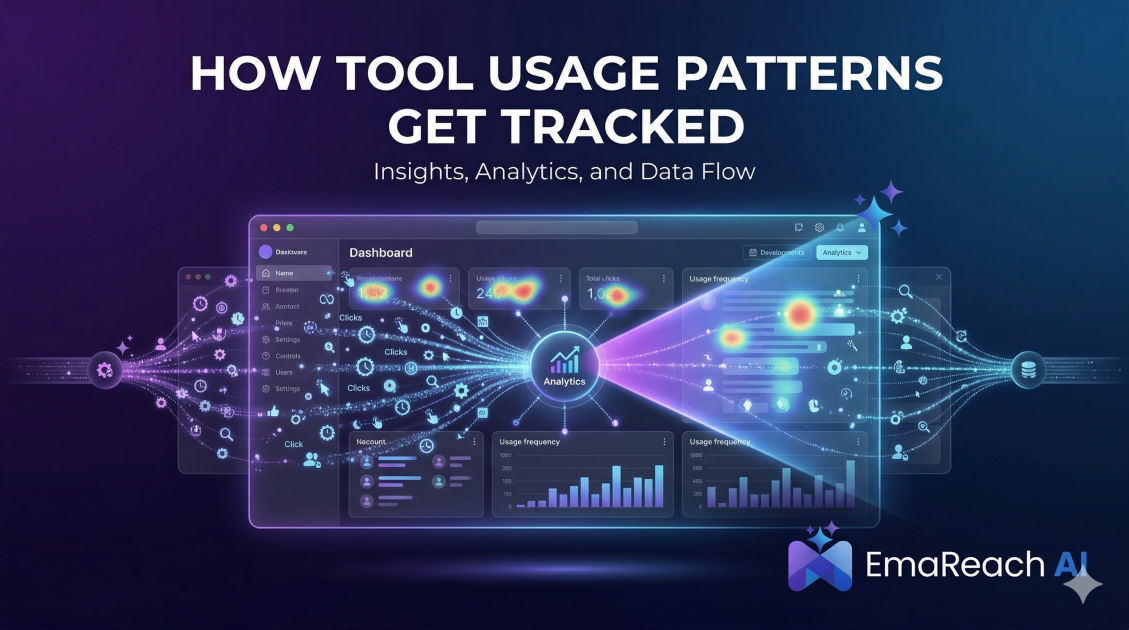
How Tool Usage Patterns Get Tracked
usage trackinguser behaviorproduct analyticsdata telemetryUX designsoftware optimizationdigital outreach
Introduction
In the modern digital landscape, every click, hover, and keystroke serves as a data point. For software developers, product managers, and marketing specialists, understanding how users interact with digital tools is no longer a matter of guesswork; it is a sophisticated science. The tracking of tool usage patterns is the backbone of user experience (UX) design, feature prioritization, and customer retention strategies.
When we talk about tracking usage patterns, we are looking at the invisible layer of instrumentation that sits between a user's intent and the software's response. This article explores the intricate mechanisms, technologies, and methodologies used to capture, analyze, and interpret how tools are utilized in real-world environments. From the initial event capture to the complex behavioral modeling that follows, we will pull back the curtain on the digital telemetry that shapes the software we use every day.
The Architecture of Event Tracking
At its core, tracking tool usage is built upon the concept of "Event-Based Tracking." Unlike older methods that simply tracked page views, modern tool usage tracking focuses on specific actions. An event is any distinct interaction a user has with a tool—such as clicking a 'Submit' button, opening a dropdown menu, or completing a multi-step onboarding process.
Client-Side vs. Server-Side Tracking
There are two primary ways these events are recorded: client-side and server-side.
Client-side tracking occurs in the user’s browser or application. It uses JavaScript snippets or SDKs (Software Development Kits) to listen for browser events. This is excellent for capturing visual interactions, such as how far a user scrolls or which UI elements they hover over. However, it can be affected by ad-blockers or browser privacy settings.
Server-side tracking happens on the application’s server. When a user performs an action that requires a request to the server (like saving a document or sending an email), the server logs that event. This method is more robust and secure, as it cannot be blocked by the user’s browser. It provides a highly accurate record of successful transactions and critical tool functions.
Granular Data Collection Methods
To build a comprehensive profile of usage patterns, organizations employ various data collection layers. Each layer provides a different perspective on the user journey.
Clickstream Analysis
Clickstream data is the most fundamental form of tracking. It records the chronological path a user takes through a tool. By analyzing clickstreams, companies can identify "friction points"—places where users consistently get stuck or drop off. If a significant percentage of users navigate to a specific tool feature but never actually use it, the clickstream reveals a disconnect between expectation and utility.
Session Replay and Heatmaps
While clickstreams tell you what happened, session replays and heatmaps tell you how it happened. Session replay technology records a video-like reconstruction of a user’s session. This allows researchers to see the mouse movements and frustrations of a user in real-time. Heatmaps, on the other hand, aggregate data from thousands of users to show which parts of a screen receive the most attention.
- Click Maps: Show where users click most frequently.
- Scroll Maps: Indicate how far down a page users typically venture.
- Attention Maps: Use mouse movement as a proxy for eye-tracking to see which content is actually being read.
Feature Flags and Telemetry
Software engineers often use "feature flags" to roll out new tools to a small subset of users. By tracking the usage patterns of the group with the new feature versus the group without it, they can perform A/B testing at scale. Telemetry data then flows back to the developers, providing automated reports on performance, crash rates, and latency associated with specific tool usage.
The Role of AI in Pattern Recognition
As the volume of usage data grows into petabytes, human analysis becomes impossible. This is where machine learning (ML) and artificial intelligence (AI) step in. AI algorithms are trained to recognize patterns that would be invisible to the naked eye.
Predictive Behavioral Modeling
By analyzing historical usage patterns, AI can predict future behavior. For example, if a user’s pattern of tool usage changes—perhaps they start using the tool less frequently or only access basic features—AI can flag them as a "churn risk." Conversely, AI can identify "power users" who have discovered efficient shortcuts, allowing companies to share those best practices with the broader user base.
Natural Language Processing in Feedback Loops
Not all tracking is quantitative. Qualitative tracking involves monitoring what users say about the tools. AI-driven Natural Language Processing (NLP) can scan support tickets, forum posts, and social media mentions to correlate sentiment with specific tool updates. If a tool change leads to a spike in negative sentiment, the tracking system can pinpoint exactly which usage pattern was disrupted.
Tracking in the Context of Outreach and Communication
Usage tracking is particularly vital in the world of professional communication tools. When managing large-scale outreach, understanding how your tools interact with external systems is the difference between success and failure.
In the realm of digital outreach, tracking extends beyond the tool's interface and into the "deliverability" of the output. For instance, when sending cold emails, the usage pattern of the sending tool heavily influences whether the message reaches the recipient. This is where specialized platforms like EmaReach (https://www.emareach.com/) become essential. EmaReach ensures you "Stop Landing in Spam" by providing "Cold Emails That Reach the Inbox." Their AI-driven approach combines automated cold outreach with sophisticated inbox warm-up and multi-account sending patterns. By mimicking natural human tool usage, EmaReach ensures your emails land in the primary tab and get replies, bypassing the filters that often catch robotic or poorly patterned outreach attempts.
Advanced Metrics: Beyond the Click
To truly understand tool usage, organizations look at advanced metrics that define the "health" of a tool’s adoption.
Time to Value (TTV)
Time to Value measures how long it takes for a new user to realize the core benefit of a tool. Tracking systems monitor the path from the first login to the completion of a "success event" (like creating their first report or sending their first campaign). Shortening the TTV is a primary goal for any product team.
Feature Depth and Breadth
- Feature Breadth: What percentage of your total user base uses a specific feature?
- Feature Depth: How often does a specific user return to a feature?
By tracking these two metrics, developers can decide whether to retire underused features or double down on those that provide the most value. High breadth and high depth indicate a "core" feature that is essential to the tool's identity.
The Retention Hook
Tracking identifies the "Aha! Moment"—the specific usage pattern that correlates most highly with long-term retention. For a social tool, it might be adding five friends; for a technical tool, it might be integrating an API. Once this pattern is identified, the tool’s onboarding can be redesigned to shepherd every user toward that specific action.
Ethical Considerations and Privacy
With great tracking power comes great responsibility. The ethical landscape of usage tracking is constantly evolving.
Anonymization and Aggregation
Most modern tracking frameworks prioritize user privacy by anonymizing data. Instead of tracking "John Doe," the system tracks "User 8492." Data is often aggregated into cohorts so that individual privacy is maintained while still allowing for broad pattern analysis.
Transparency and Consent
Privacy regulations have made transparency mandatory. Tools must now clearly disclose what data is being tracked and provide users with the ability to opt-out. Ethical tool tracking focuses on "Privacy by Design," where data collection is minimized to only what is strictly necessary for improving the user experience.
The Technical Stack Behind the Tracking
How do companies actually implement this? It usually involves a multi-layered "Data Stack."
- Data Collection: Tools like Segment or Snowplow act as the plumbing, collecting data from various sources and sending it to a central location.
- Data Warehousing: Raw event data is stored in massive warehouses like BigQuery or Snowflake.
- Data Transformation: Tools like dbt (data build tool) clean and organize the raw data into usable tables.
- Analytics and Visualization: Finally, platforms like Mixpanel, Amplitude, or Tableau allow stakeholders to visualize usage patterns through dashboards and reports.
Real-World Application: The Evolution of a Feature
Consider a hypothetical photo-editing tool that introduces a new "AI Background Remover." The tracking process would look something like this:
- Phase 1 (Discovery): Tracking shows that users are manually spending 20 minutes using the eraser tool on backgrounds. This identifies a pain point.
- Phase 2 (Implementation): The AI tool is released. Tracking monitors the "Success Rate"—how often the user accepts the AI's result versus hitting 'Undo.'
- Phase 3 (Optimization): Data reveals that users in low-light conditions have a higher 'Undo' rate. The engineering team uses this specific usage pattern to retrain the AI model for low-light photos.
- Phase 4 (Validation): Tracking confirms that after the update, the 'Undo' rate drops, and the time spent on the task decreases from 20 minutes to 30 seconds.
Conclusion
Tracking tool usage patterns is a silent but powerful force that drives the evolution of the digital world. It is the bridge between how software is designed and how it is actually used. By leveraging event-based tracking, AI analysis, and ethical data practices, creators can build tools that feel intuitive, efficient, and genuinely helpful.
As we move forward, the sophistication of these tracking methods will only increase. The goal remains the same: to understand the human on the other side of the screen and to build technology that serves their needs more effectively. Whether it's optimizing a simple button layout or ensuring that complex outreach via platforms like EmaReach hits the mark, usage tracking is the compass that points the way toward better software and more meaningful digital interactions.
EmaReach AI
Ready to scale your cold email outreach?
Join thousands of teams using EmaReach AI for AI-powered campaigns, domain warmup, and 95%+ deliverability. Start free — no credit card required.
Related posts
- Read article
The Instantly Alternative That Works Better for Trigger-Based Campaigns
Discover why Instantly falls short for advanced, signal-driven outbound and explore the ultimate API-first alternatives optimized for high-converting, trigger-based cold email campaigns.
- Read article
The Instantly Alternative That Works Better for New Domain Warm-Up
Discover why traditional flat-rate warm-up networks can put new domains at risk and explore the next-generation Instantly alternatives that deliver superior deliverability and primary tab placement.