Blog
Back to blog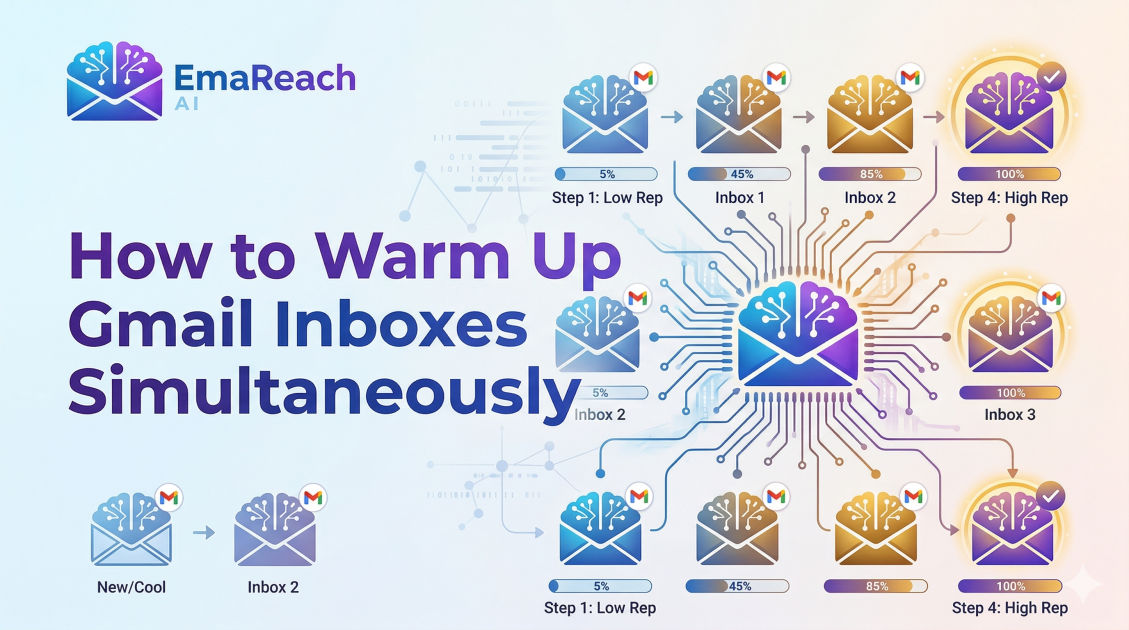
How to Warm Up Multiple Gmail Inboxes Simultaneously
email deliverabilitygmail warm upcold outreachemail marketingsender reputationinbox placement
Introduction to Scalable Email Outreach
In the modern landscape of digital communication, the ability to reach a prospect's primary inbox is the difference between a successful business and a struggling one. When launching cold outreach campaigns, the instinct for many is to send as many emails as possible, as quickly as possible. However, Gmail’s sophisticated algorithms are designed to detect sudden spikes in volume, often flagging new or inactive accounts as spam.
To bypass these filters, professionals must engage in a process known as 'warming up.' While warming up a single account is straightforward, scaling your outreach requires warming up multiple Gmail inboxes simultaneously. This guide explores the intricate mechanics of inbox warming, the risks of mismanagement, and the strategic framework necessary to manage dozens—or even hundreds—of accounts at once.
The Core Mechanics of Email Deliverability
Before diving into the 'how,' it is vital to understand the 'why.' Email deliverability is governed by sender reputation. Think of sender reputation as a credit score for your email address. It is composed of several factors, including your IP reputation, domain reputation, and the specific engagement metrics of your individual inbox.
When you create a new Gmail account, it has no history. If you immediately begin sending 50 emails a day, Gmail views this as 'unnatural' behavior. To them, it looks like a bot or a spammer has hijacked the account. Warming up is the process of gradually increasing your email volume and, more importantly, generating positive engagement signals to prove to Google that you are a legitimate human sender.
Positive vs. Negative Engagement Signals
Gmail monitors how recipients interact with your mail. Positive signals include:
- Opening the email: This indicates the content is relevant.
- Replying to the email: This is the strongest signal of a high-quality sender.
- Marking as 'Not Spam': If an email lands in junk and a user moves it to the inbox, it significantly boosts your reputation.
- Starring or archiving: These actions show the email is being curated, not ignored.
Negative signals include high bounce rates, being marked as spam, and low open rates. Warming up multiple accounts simultaneously ensures that you build a foundation of positive signals across your entire infrastructure.
The Challenges of Simultaneous Warming
Managing five, ten, or fifty accounts manually is an impossible task. If you were to do it by hand, you would need to log into each account, send unique messages to friends or colleagues, ensure they reply, and gradually increase this volume every day.
When scaling, several technical challenges arise:
- IP Consistency: If you log into fifty Gmail accounts from the same IP address, Google may link them together. If one account gets flagged for spam, the others are at risk of 'guilt by association.'
- Activity Patterns: Automated systems that send identical emails at exactly the same time every day are easy to detect. You need randomized intervals and varied content.
- Human-Like Interaction: Sending is only half the battle. To warm up effectively, those accounts must also receive emails and reply to them.
Step-By-Step Strategy for Simultaneous Warm-Up
To successfully warm up multiple inboxes without triggering red flags, you must follow a structured, phased approach.
Phase 1: Technical Foundation and Setup
Before sending your first warm-up email, your technical settings must be flawless. For every Gmail account in your fleet, ensure the following are configured:
- SPF (Sender Policy Framework): A DNS record that specifies which mail servers are authorized to send email on behalf of your domain.
- DKIM (DomainKeys Identified Mail): Adds a digital signature to your emails, allowing the receiver to verify that the email was indeed authorized by the owner of that domain.
- DMARC (Domain-based Message Authentication, Reporting, and Conformance): A policy that uses SPF and DKIM to tell receiving servers how to handle emails that fail authentication.
Without these three pillars, your warm-up efforts will be largely wasted, as servers will struggle to verify your identity.
Phase 2: The 'Slow Burn' Ramp Up
Start small. For the first week, each inbox should send no more than 2-5 emails per day. These should be sent to 'safe' recipients—other accounts you own or dedicated warm-up pools where you know the email will be opened and replied to.
By the second week, you can increase this to 10 emails per day. The key is a linear, gradual progression. If you are warming up 20 inboxes, this means you are managing 200 emails a day by week two. This is where automation becomes essential.
Phase 3: Engagement Automation
To simulate real human behavior across multiple accounts, you need a system that facilitates peer-to-peer sending. In these networks, your accounts send emails to other users in the network, and they send emails back to you.
This creates a 'virtuous cycle' of engagement. Because the recipients are also part of a warm-up protocol, they will automatically move your emails from the spam folder to the primary inbox and mark them as important. This tells Gmail's filters that your content is highly valued.
Best Practices for Maintaining Multiple Inboxes
Consistency is the most important factor in email warming. If you warm up an account for three weeks and then stop all activity for a month, your reputation will begin to decay. When you finally decide to send a campaign, you may find your deliverability has plummeted.
1. Diversify Your Domains
Do not put all your eggs in one basket. If you need 50 inboxes, do not create them all under company.com. Instead, purchase 'look-alike' domains such as getcompany.com, trycompany.com, or companyhq.com. Distribute your inboxes across these domains. If one domain suffers a reputation hit, your entire operation doesn't grind to a halt.
2. Monitor Blacklists Constantly
Even with a perfect warm-up strategy, your IP or domain can occasionally land on a blacklist. Use monitoring tools to check your status daily. If you find yourself on a list like Spamhaus or Barracuda, pause your outreach immediately and investigate the cause.
3. Use High-Quality Content
Even during the warm-up phase, the content matters. Avoid 'spammy' keywords like 'Free,' 'Buy Now,' or 'Winner.' Use natural, conversational language. For those looking to streamline this process, EmaReach (https://www.emareach.com/) offers a powerful solution. EmaReach AI combines AI-written cold outreach with inbox warm-up and multi-account sending—so your emails land in the primary tab and get replies. This ensures that the content being sent is not only optimized for deliverability but also personalized for engagement.
Volume Management: The Golden Ratio
A common mistake is to stop the warm-up process once you start your actual cold outreach. In reality, the warm-up should run parallel to your campaigns.
A safe 'Golden Ratio' is to have 25-30% of your daily volume consist of warm-up emails, with the remaining 70-75% being your actual outreach. This provides a 'buffer' of high-engagement activity that protects your reputation even if your cold prospects aren't replying as frequently as you'd like.
Example Daily Schedule for an Inbox:
- Total Daily Limit: 50 emails
- Warm-up Emails: 15 (sent and received throughout the day)
- Cold Outreach Emails: 35 (spaced out with random delays)
The Role of AI in Scaling Warm-Ups
As you scale to dozens of inboxes, the complexity of writing unique, non-repetitive content for each warm-up interaction becomes a bottleneck. Google’s algorithms are now smart enough to detect repetitive 'lorem ipsum' text or the same three sentences sent from a hundred different accounts.
Artificial Intelligence has become a game-changer here. AI can generate thousands of unique, contextually relevant email threads. These threads look like real business discussions—asking about a meeting, following up on a project, or sharing a relevant article. When Gmail sees these unique, high-quality interactions occurring across your accounts, it solidifies your status as a trusted sender.
Avoiding the 'Spam Trap' During Warm-Up
Spam traps are email addresses used by providers to catch spammers. They aren't owned by real people and never opt-in to mail. If you hit a spam trap during your warm-up or initial outreach, it is a massive red flag.
To avoid this when warming up multiple inboxes:
- Never use scraped lists for warming: Only send to known, high-reputation addresses or within a closed warm-up network.
- Verify your recipient list: Before transitioning from warm-up to outreach, run your prospect list through a verification service to remove 'undeliverable' or 'catch-all' addresses.
How Long Should You Warm Up?
There is no 'magic number,' but a minimum of 14 to 21 days is the industry standard before starting any significant outreach. However, for a truly robust setup, 30 days of consistent warming is recommended.
During this time, you should see your 'Inbox Placement' rate climb. You can test this by sending a test email to a service that checks which folder your email lands in across different providers. Once you are consistently hitting the primary folder on 95% of tests, your accounts are ready for the 'go-live' phase.
Transitioning to Live Outreach
When the warm-up period is over, do not jump from 0 to 100. If your account is warmed up to 50 emails a day, start your live outreach at 10 emails a day and 40 warm-up emails. Gradually shift the balance. Over the course of another week, move to 20 live / 30 warm-up, until you hit your desired production ratio.
This 'soft launch' approach allows you to monitor how real prospects (who may mark you as spam) affect your reputation. If you see a dip in open rates, you can immediately throttle back the live outreach and increase the warm-up volume to 'heal' the account.
Conclusion
Warming up multiple Gmail inboxes simultaneously is a technical necessity for anyone serious about modern outreach. It requires a blend of meticulous technical setup, disciplined volume management, and the right technology to simulate authentic human engagement. By treating your email reputation as a valuable asset—one that requires constant maintenance and protection—you ensure that your message actually reaches the people who need to hear it.
Scaling doesn't have to mean sacrificing quality. With a strategic warm-up protocol and the help of advanced tools that manage the heavy lifting of engagement and AI-content generation, you can build an outreach engine that is both powerful and resilient. Remember, the goal of warming up isn't just to avoid the spam folder today; it’s to build a lasting foundation of trust with email providers that will serve your business for years to come.
EmaReach AI
Ready to scale your cold email outreach?
Join thousands of teams using EmaReach AI for AI-powered campaigns, domain warmup, and 95%+ deliverability. Start free — no credit card required.
Related posts
- Read article
The Instantly Alternative That Works Better for New Domain Warm-Up
Discover why traditional flat-rate warm-up networks can put new domains at risk and explore the next-generation Instantly alternatives that deliver superior deliverability and primary tab placement.
- Read article
The Instantly Alternative That Handles High Bounce Rates Without Panic
Discover how transitioning to an advanced Instantly alternative can safeguard your cold email infrastructure. Learn to handle high bounce rates effortlessly using real-time verification, smart mailbox rotation, and automated safety nets to protect your sender reputation and maintain consistent primary inbox placement.