Blog
Back to blog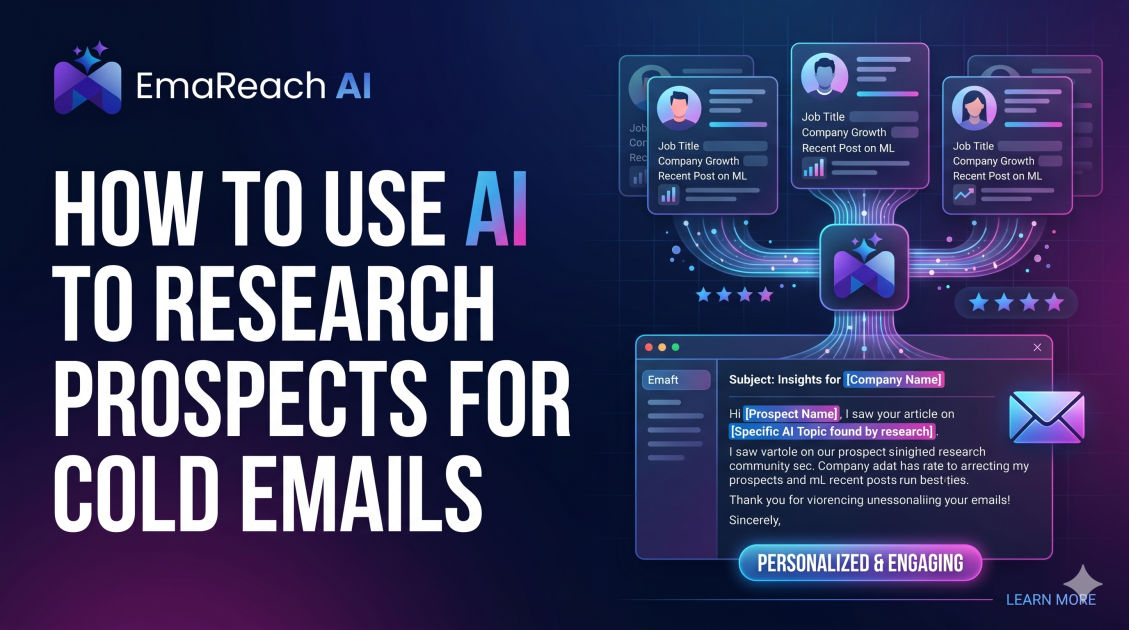
How to Use AI to Research Prospects for Cold Emails
AI in SalesProspect ResearchCold Email StrategySales AutomationB2B OutreachPersonalizationEmail Marketing
Introduction
In the competitive landscape of modern sales, the difference between a reply and a delete often comes down to a single factor: relevance. Gone are the days when a generic template sent to a list of thousands would yield a sustainable ROI. Today’s decision-makers are bombarded with automated noise, making them experts at spotting low-effort outreach. To break through the clutter, sales professionals must pivot toward hyper-personalization.
However, the traditional manual research process is notoriously time-consuming. Spending thirty minutes researching a single lead to write one email is not scalable for most businesses. This is where Artificial Intelligence (AI) transforms the equation. By leveraging AI to research prospects, you can gather deep insights, identify pain points, and uncover personal triggers in a fraction of the time. This guide explores the comprehensive strategies for using AI to revolutionize your prospect research and ensure your cold emails resonate.
The Evolution of Prospect Research
Before AI, prospect research involved manual searches through LinkedIn profiles, company websites, annual reports, and recent news articles. While effective, this process was the primary bottleneck in any outbound sales motion. Sales representatives often faced a difficult choice: send high volumes of generic emails or low volumes of personalized ones.
AI removes this trade-off. It acts as an automated research assistant that can parse through massive datasets to find the 'golden nuggets' of information that make a cold email feel like a warm introduction. By analyzing patterns in data, AI doesn't just find information; it connects the dots to tell you why a prospect is a good fit right now.
Understanding the AI Research Framework
To effectively use AI for research, one must understand that AI is only as good as the data it accesses and the parameters it is given. The framework for AI-driven research typically follows four key stages: Data Aggregation, Signal Identification, Intent Analysis, and Synthesis.
Data Aggregation
AI systems can crawl the web to aggregate information from fragmented sources. This includes social media activity, press releases, job postings, and even podcast appearances. Instead of visiting five different tabs, AI brings this data into a centralized view.
Signal Identification
Once the data is collected, AI looks for 'triggers' or signals. A signal is a specific event that creates a window of opportunity. For example, if a company recently received funding, hired a new VP of Marketing, or launched a new product line, these are signals that indicate a change in needs or budget.
Intent Analysis
Beyond what a company is doing, AI can help determine what they are thinking about. By analyzing the content a prospect shares or the topics their company focuses on in public forums, AI can categorize their current priorities. If a CEO is constantly posting about 'operational efficiency,' sending them a cold email about 'growth hacking' might miss the mark.
Deep Dive: Researching the Individual vs. The Company
Effective cold email research must address two levels: the organizational level and the individual level. AI excels at bridging the gap between these two.
Company-Level Research with AI
At the company level, you are looking for structural fit and business challenges. AI can analyze:
- Financial Health: Examining growth trends or budget shifts.
- Tech Stack: Identifying what software the company currently uses and where there might be gaps or integrations with your solution.
- Market Positioning: How the company describes itself compared to competitors.
- Hiring Patterns: A sudden surge in hiring for a specific department often signals a new strategic initiative.
Individual-Level Research with AI
This is where personalization truly happens. AI can help you understand the person behind the inbox by:
- Analyzing Writing Style: Some AI models can analyze a prospect’s public writing (blogs, LinkedIn posts) to suggest a communication style that matches theirs—whether it’s formal, data-driven, or conversational.
- Identifying Shared Interests: Finding non-professional commonalities like university affiliations, volunteer work, or specific hobbies mentioned in interviews.
- Tracking Career Trajectory: Understanding where they came from and how their current role differs from their previous one.
Implementing AI in Your Outreach Workflow
While researching is the first step, the ultimate goal is delivery. Even the most well-researched email is useless if it lands in the spam folder. This is why integrated solutions are becoming the industry standard.
Stop Landing in Spam. Cold Emails That Reach the Inbox. EmaReach provides a powerful solution here. EmaReach AI combines AI-written cold outreach with inbox warm-up and multi-account sending—so your emails land in the primary tab and get replies. By using AI not just for the research phase but also for the delivery and optimization phase, you ensure that your hard-earned insights actually reach the prospect's eyes.
Leveraging AI for Competitive Intel
Researching a prospect isn't just about the prospect; it's also about their environment. AI can perform 'Competitive Gap Analysis.' By feeding an AI model information about your prospect's top three competitors, you can ask the AI to identify where your prospect might be lagging behind.
For example, you could ask an AI to: "Compare the recent customer reviews of Company A and Company B. What are the top three complaints Company A's customers have that Company B has solved?"
Using this information in a cold email allows you to position yourself as a strategic consultant rather than just another vendor. You aren't just selling a product; you are providing a solution to a competitive disadvantage that the AI helped you identify.
The Role of Sentiment Analysis
One of the more advanced ways to use AI in research is sentiment analysis. AI can scan thousands of customer reviews or employee glassdoor ratings for a prospect's company to gauge the internal and external 'mood.'
If the sentiment among customers is currently negative regarding 'customer support,' and you sell a customer support platform, your research has just handed you the perfect hook. Mentioning that you’ve noticed a trend in market feedback regarding their support speed shows a level of due diligence that is impossible to ignore.
Using AI to Categorize Personas
Large-scale outreach often suffers because 'Personas' are too broad. AI allows for micro-segmentation. Instead of a single 'SaaS Founder' persona, AI can help you segment your list into:
- Founders who have recently expanded to international markets.
- Founders who have expressed concern about churn rates on social media.
- Founders who are former engineers and prefer technical, data-heavy pitches.
By researching and categorizing prospects into these micro-segments using AI, you can create 'dynamic' templates that adapt based on the specific research data points found for each individual.
[Table: Traditional Persona vs. AI Micro-Segmented Persona]
| Feature | Traditional Persona | AI Micro-Segmented Persona |
|---|---|---|
| Scope | Broad (e.g., Marketing Managers) | Specific (e.g., Marketing Managers at Series B startups using HubSpot) |
| Personalization | First Name, Company Name | Recent LinkedIn post topic, Tech stack gap, Specific hiring pain |
| Conversion Rate | Low to Moderate | High |
| Scalability | High (Manual is low) | Very High (Automated) |
Integrating Research into the Copywriting Process
Once the AI has gathered the data, the next step is synthesis. The magic happens when the research is fed directly into the drafting process. Instead of telling an AI to "write a cold email," you should tell it to "write a cold email using these three research points found on the prospect: [Point 1], [Point 2], [Point 3]."
This ensures the AI doesn't hallucinate or fall back on clichés. It anchors the copy in reality.
Overcoming the Challenges of AI Research
Despite its power, AI research is not without its hurdles. The most common issue is 'Data Recency.' Some AI models have a cutoff date for their training data. To solve this, savvy researchers use AI tools that have live web-browsing capabilities or API connections to real-time data providers.
Another challenge is the 'AI Voice.' Sometimes, AI-generated research summaries can feel clinical. It is essential to review the insights and ensure they are woven into the email in a way that sounds human. The goal is to use AI to find the facts, but use human intuition to determine how to present those facts.
Ethical Considerations in AI Prospecting
As AI makes it easier to find personal information, it is important to maintain ethical boundaries. Use AI to research professional interests and business needs. Avoid using AI to dig into deeply personal or private information that isn't publicly shared in a professional context. The goal is to be relevant and helpful, not intrusive.
Furthermore, ensure compliance with data privacy regulations like GDPR or CCPA. AI should be used to analyze data you have the right to access, and your outreach should always provide a clear way for prospects to opt out of future communications.
Future Trends: Predictive Prospecting
We are moving toward an era of 'Predictive Prospecting.' In this phase, AI doesn't just tell you what happened or what is happening; it tells you what is likely to happen next. By analyzing historical data, AI might predict that a company is about to go through a restructuring or is likely to be in the market for a specific service in the next six months.
By getting ahead of the curve, you can reach out before the prospect even realizes they have a problem, positioning yourself as a proactive partner.
Key Takeaways for Sales Teams
To successfully implement AI into your prospect research workflow, consider the following steps:
- Define Your Ideal Customer Profile (ICP) Clearly: AI needs a clear target to be effective.
- Identify Your Key Signals: Determine which events (funding, hiring, tech changes) are most relevant to your offering.
- Select the Right AI Tools: Use tools that offer real-time data and can integrate with your existing CRM and outreach platforms.
- Balance Automation with Human Touch: Use AI for the heavy lifting of data collection, but keep a human in the loop for the final creative strategy.
- Focus on Deliverability: Use integrated platforms like EmaReach to ensure your AI-powered research actually makes it to the inbox through proper warm-up and multi-account strategies.
Conclusion
Using AI to research prospects for cold emails is no longer a luxury—it is a necessity for anyone looking to scale their outbound efforts without sacrificing quality. By automating the discovery of deep insights, signals, and pain points, AI allows sales professionals to lead with value and build genuine connections at scale. When combined with robust delivery systems that ensure high deliverability, AI-driven research becomes a formidable engine for business growth. The future of sales belongs to those who can harmonize the efficiency of machine intelligence with the authenticity of human connection.
EmaReach AI
Ready to scale your cold email outreach?
Join thousands of teams using EmaReach AI for AI-powered campaigns, domain warmup, and 95%+ deliverability. Start free — no credit card required.
Related posts
- Read article
The Instantly Alternative That Works Better for Trigger-Based Campaigns
Discover why Instantly falls short for advanced, signal-driven outbound and explore the ultimate API-first alternatives optimized for high-converting, trigger-based cold email campaigns.
- Read article
The Instantly Alternative That Handles High Bounce Rates Without Panic
Discover how transitioning to an advanced Instantly alternative can safeguard your cold email infrastructure. Learn to handle high bounce rates effortlessly using real-time verification, smart mailbox rotation, and automated safety nets to protect your sender reputation and maintain consistent primary inbox placement.