Blog
Back to blog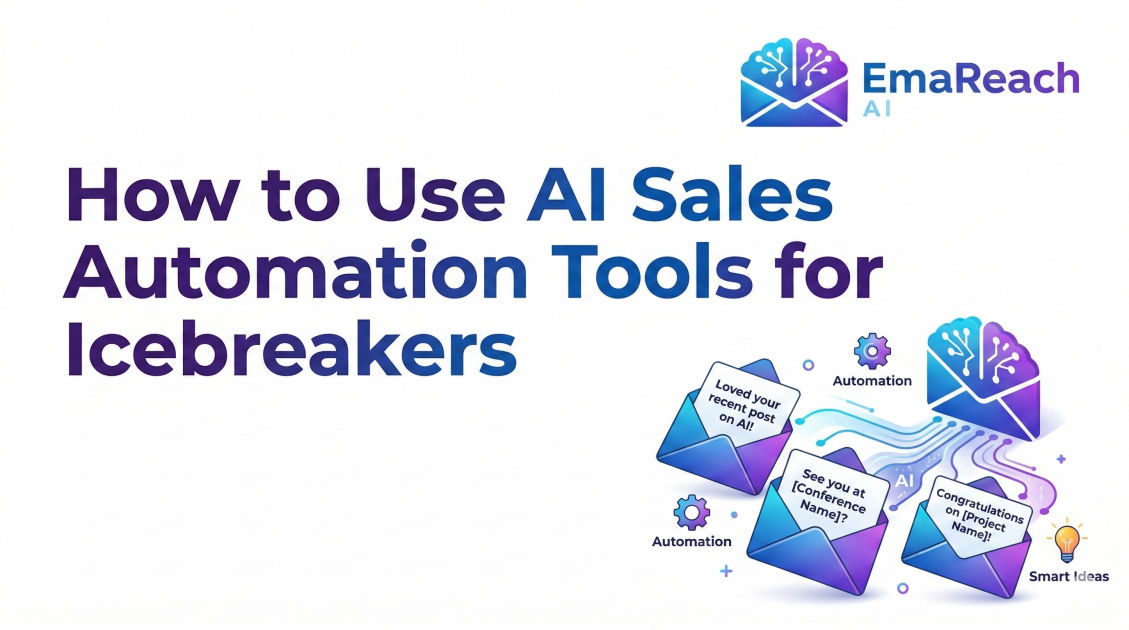
How to Use AI Sales Automation Tools for Icebreakers
sales automationcold outreachAI for salespersonalizationemail marketinglead generationsales technology
Introduction to AI-Powered Sales Personalization
In the modern era of digital sales, the standard 'spray and pray' approach to cold outreach has become obsolete. Decision-makers are inundated with hundreds of generic emails every week, leading to a psychological filtering process that dismisses templated messages in milliseconds. To break through this noise, sales professionals must find a way to establish immediate relevance and rapport. This is where the concept of the 'icebreaker'—the first few sentences of an email or message—becomes critical.
Traditionally, crafting a personalized icebreaker required manual research: scouring LinkedIn profiles, reading recent company blog posts, or watching interview clips of a prospect. While effective, this process is notoriously difficult to scale. AI sales automation tools have revolutionized this workflow by programmatically analyzing vast amounts of data to generate human-like, hyper-personalized opening lines. This guide explores how to leverage these tools to transform your outreach from ignored noise into engaging conversations.
The Anatomy of an Effective Icebreaker
Before diving into the automation aspect, it is essential to understand what makes an icebreaker work. A high-quality opening line is not just about being 'friendly'; it is about demonstrating that you have done your homework.
The Three Pillars of Personalization
- Contextual Relevance: The icebreaker should reference a specific, recent event or achievement related to the prospect or their company.
- Genuine Interest: It must avoid sounding like a bot-generated Mad-Lib. It should reflect a nuanced understanding of the subject matter.
- The Pivot: A great icebreaker doesn't exist in a vacuum. It should seamlessly bridge the gap between the personal observation and the value proposition you are about to present.
Using AI tools allows you to hit these three pillars consistently across thousands of leads, ensuring that every recipient feels like they are the only person you emailed that day.
How AI Sales Automation Tools Work for Personalization
AI sales automation tools generally operate using Large Language Models (LLMs) trained on massive datasets. When you provide a list of LinkedIn URLs or email addresses, the software performs several backend actions:
- Data Scraping: The tool pulls public data from social profiles, company websites, news articles, and financial reports.
- Analysis: The AI identifies 'triggers'—such as a recent promotion, a company expansion, a podcast appearance, or a specific skill mentioned in a profile.
- Generation: Based on pre-defined prompts or proprietary algorithms, the tool drafts a unique sentence that synthesizes this information into a conversational greeting.
By automating this research phase, sales teams can save dozens of hours per week while actually increasing their reply rates.
Integrating AI Icebreakers into Your Cold Email Workflow
To successfully implement AI-generated icebreakers, you need a structured workflow that ensures quality control. You cannot simply 'set it and forget it' without risking awkward or inaccurate messages.
Step 1: Data Cleaning and Enrichment
The quality of your AI icebreaker is directly proportional to the quality of your input data. Before running your list through an automation tool, ensure that your CRM data is clean. This includes:
- Removing 'Inc.', 'LLC', or 'Corp' from company names.
- Standardizing job titles.
- Verifying that the LinkedIn URLs provided are active and correct.
Step 2: Selecting the Right Data Sources
Different AI tools allow you to prioritize different data sources. For a C-level executive, you might want the AI to focus on recent press releases or quarterly earnings reports. For a middle-manager or individual contributor, focusing on their specific LinkedIn 'About' section or recent post activity might yield better results. Configure your tool to look for the highest signal-to-noise ratio data points.
Step 3: Prompt Engineering for Tone Consistency
Most modern AI sales tools allow you to customize the 'voice' of your icebreakers. You should aim for a tone that matches your brand. If you are a high-energy startup, your icebreakers can be informal and punchy. If you are selling into the legal or financial sector, the AI should be programmed to be more formal and respectful.
Step 4: The Human-in-the-Loop Review
Even the most advanced AI can occasionally misinterpret a data point (e.g., confusing a company's anniversary with a personal birthday). A quick manual scan of the generated icebreakers is essential. Most automation platforms offer a 'bulk edit' view where you can quickly approve or tweak the generated lines before they go live.
Improving Deliverability with Unique Content
One often overlooked benefit of using AI for icebreakers is the impact on email deliverability. Mail servers and spam filters look for 'fingerprints'—patterns of identical text sent to many recipients. When every email in your campaign has a unique, AI-generated opening line, your 'spam score' drops significantly because each message is technically a unique piece of content.
For those looking to take this a step further, EmaReach offers a comprehensive solution. Stop Landing in Spam. Cold Emails That Reach the Inbox. EmaReach AI combines AI-written cold outreach with inbox warm-up and multi-account sending—so your emails land in the primary tab and get replies. By pairing hyper-personalized icebreakers with technical deliverability best practices, you maximize the ROI of your outreach.
Strategic Use Cases for AI Icebreakers
1. Podcast and Content Engagement
If a prospect has been a guest on a podcast, AI can transcribe the episode and find a specific quote or insight to reference. An icebreaker like, 'I loved your point on the [Podcast Name] about how decentralized teams handle internal communication; it really challenged my perspective on management,' is incredibly hard to ignore.
2. Recent Funding and Growth Milestones
AI tools can monitor news feeds for funding rounds or office openings. Instead of a generic 'Congrats on the funding,' the AI can craft something more specific: 'Seeing [Company Name] expand into the EMEA market after your Series B is impressive—it looks like a massive undertaking.'
3. Shared Educational Background or Interests
By scanning the volunteer or education sections of a profile, AI can find common ground. 'I noticed you’ve been volunteering at the local animal shelter for three years—that’s a fantastic commitment outside of your work at [Company].' This builds a human connection before the 'sales' part of the conversation begins.
Avoiding Common Pitfalls
While AI is powerful, there are several ways it can go wrong if not managed correctly.
Over-Personalization
There is a fine line between being 'well-researched' and 'creepy.' Avoid referencing deeply personal information that isn't publicly professional. Stick to LinkedIn, professional Twitter accounts, or company websites. Referencing a prospect's family or private hobbies can be off-putting.
The 'Hallucination' Problem
AI can sometimes 'hallucinate' or invent facts. Always ensure your tool is pulling from verified live data rather than relying solely on its internal training data. This is why the human review step mentioned earlier is non-negotiable.
Generic Praise
An icebreaker like, 'I saw your LinkedIn profile and was impressed by your experience,' is essentially useless. It is a 'fake' personalized line that prospects can spot from a mile away. Ensure your AI tool is configured to find specific nouns and verbs—events, names, or specific technologies—to include in the text.
Measuring the Success of Your AI Icebreakers
To know if your automation strategy is working, you must track specific metrics:
- Open Rate: While primarily influenced by subject lines, a preview of a personalized icebreaker in the inbox can boost opens.
- Reply Rate: This is the primary KPI for icebreakers. A high reply rate indicates your personalization is resonating.
- Positive Sentiment Rate: Not all replies are good. Track how many replies lead to a meeting versus how many are 'not interested' or 'stop emailing me.'
- Time-to-Lead: Measure how much time your SDRs or AEs are saving compared to the manual research era.
The Future of Sales Personalization
As AI continues to evolve, we will see even deeper integrations. We are moving toward a reality where AI doesn't just write the first line, but dynamically adjusts the entire body of the email based on the prospect's personality type (e.g., using DISC profiles analyzed from their writing style). However, the icebreaker will always remain the most important real estate in the email—the 'hook' that earns you the right to the prospect's time.
Leveraging AI sales automation tools for icebreakers allows you to maintain the 'human touch' at a scale that was previously impossible. It represents the perfect synergy between machine efficiency and human empathy. By automating the drudgery of research, you free up your sales team to do what they do best: build relationships and close deals.
Conclusion
Mastering AI sales automation for icebreakers is no longer a luxury for elite sales teams; it is a necessity for anyone looking to stay competitive in a crowded marketplace. By focusing on clean data, strategic prompt engineering, and a commitment to quality over quantity, you can transform your cold outreach into a warm, predictable engine for growth. Remember that the goal of technology is not to replace the salesperson, but to empower them to be more relevant and helpful to their prospects.
EmaReach AI
Ready to scale your cold email outreach?
Join thousands of teams using EmaReach AI for AI-powered campaigns, domain warmup, and 95%+ deliverability. Start free — no credit card required.
Related posts
- Read article
How Choosing the Right Instantly Alternative Changed Our Pipeline Numbers
Discover how transitioning from a volume-first cold email setup to an advanced, deliverability-focused infrastructure transformed our B2B pipeline metrics, skyrocketed open rates to over 68%, and tripled our monthly booked demos.
- Read article
What Makes the Right Instantly Alternative Worth the Migration Effort
Discover why upgrading your cold email infrastructure to the right Instantly alternative can dramatically improve your deliverability, scale your personalization, and future-proof your sales pipeline against strict spam filters.