Blog
Back to blog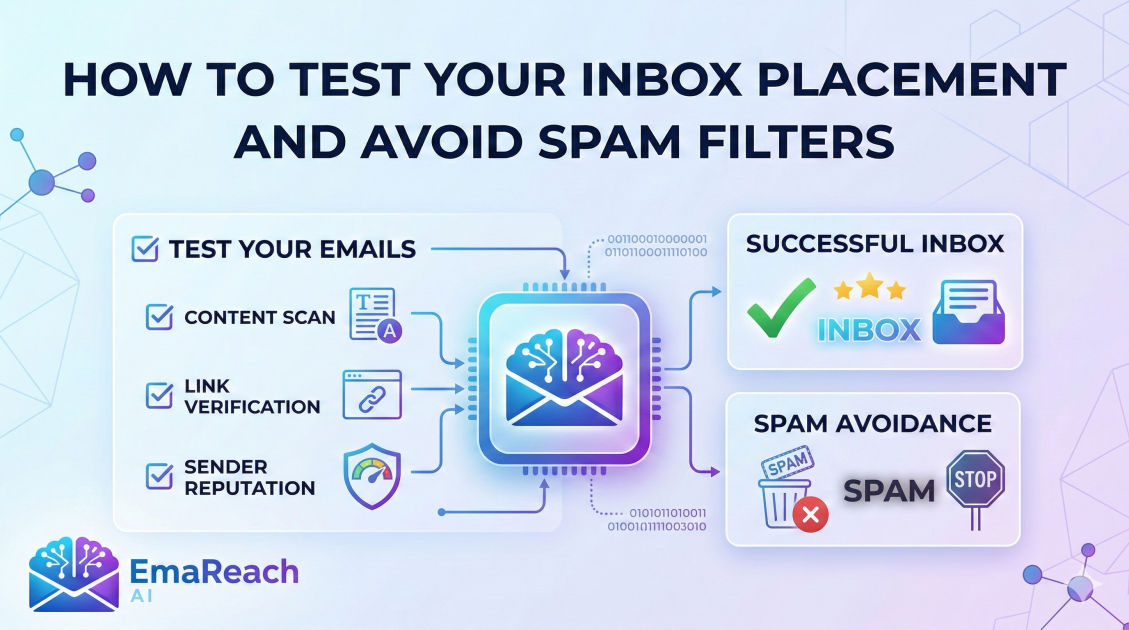
How to Test Your Inbox Placement and Avoid Spam Filters
email deliverabilityspam filtersinbox placementcold emailemail marketingDMARCSPF
Introduction
In the world of digital communication, the difference between a successful campaign and a failed one often comes down to a single factor: inbox placement. You can spend weeks crafting the perfect subject line, designing a beautiful layout, and segmenting your audience with surgical precision, but if your email lands in the spam folder, your efforts are effectively invisible.
Inbox placement is the metric that determines whether your email reaches the recipient's primary inbox or is diverted to the junk or promotions folders. Unlike simple delivery rates—which only tell you if the receiving server accepted the email—inbox placement reveals the actual visibility of your message. Navigating the complex algorithms of Mailbox Provider (MBP) filters requires a proactive approach to testing and a deep understanding of technical health, content quality, and sender reputation.
Understanding the Mechanics of Spam Filters
Modern spam filters are no longer just simple keyword scanners. They are sophisticated, AI-driven engines that evaluate hundreds of signals in real-time. To avoid them, you must understand the three pillars of email filtering:
1. Reputation-Based Filtering
This is the most critical layer. ISPs (Internet Service Providers) like Google, Outlook, and Yahoo maintain a 'score' for your sending IP address and your domain. If you have a history of high bounce rates or if recipients frequently mark your emails as spam, your reputation drops. Once your reputation is tarnished, even the most helpful, non-spammy email will be automatically diverted to the junk folder.
2. Technical Authentication
Think of authentication as your digital passport. If your emails aren't properly signed, filters assume you are a malicious actor or a spoofing bot. The three essential protocols are SPF (Sender Policy Framework), DKIM (DomainKeys Identified Mail), and DMARC (Domain-based Message Authentication, Reporting, and Conformance). Missing or misconfigured records are the fastest way to trigger a spam filter.
3. Content and Engagement Analysis
Filters look for patterns. This includes everything from the ratio of images to text, the presence of 'trigger words' (like 'guaranteed cash' or 'limited time offer'), and the hidden metadata in your HTML code. Furthermore, modern filters look at engagement history. If users rarely open your emails or quickly delete them without reading, the filter learns that your content is low-value and will begin filtering it out for other users.
How to Test Your Inbox Placement
Testing is not a one-time event; it is a recurring necessity for any serious sender. To get an accurate picture of where your emails are landing, you need to employ several different methodologies.
Seed List Testing
A seed list is a controlled group of email addresses across various providers (Gmail, Outlook, iCloud, etc.) that you send your campaign to before hitting 'send' on your main list. By checking these accounts, you can see exactly where the email landed.
- Pros: Real-world results across different providers.
- Cons: Small seed lists may not reflect the behavior of a massive subscriber base.
Deliverability Seed Tools
Specialized software provides automated seed lists and detailed reports. These tools analyze your technical setup and provide a 'placement percentage' across different ISPs. For those engaged in high-volume outreach, using a platform like EmaReach can be a game-changer. EmaReach combines AI-written cold outreach with inbox warm-up and multi-account sending, ensuring that your emails land in the primary tab rather than the promotions or spam folders.
Content Scoring (SpamAssassin Tests)
Before sending, run your email through a spam score checker. These tools simulate how an open-source filter like SpamAssassin would view your message. They look for broken links, missing ALT text for images, and suspicious coding practices. Aim for a score as close to zero as possible.
The Technical Checklist for High Deliverability
To ensure your placement remains high, you must treat your technical setup as the foundation of your strategy.
Domain and IP Warm-up
If you are sending from a new domain or a new IP address, you cannot immediately send 10,000 emails. This is a massive red flag for spam filters. You must 'warm up' the address by starting with a small volume of highly engaged recipients and gradually increasing the volume over several weeks. This builds a positive reputation with ISPs.
Proper DNS Records
- SPF: Specifies which mail servers are authorized to send email on behalf of your domain.
- DKIM: Adds a digital signature to your emails, proving they weren't tampered with in transit.
- DMARC: Gives instructions to the receiving server on what to do if the SPF or DKIM fails (e.g., 'reject' or 'quarantine').
List Hygiene and Management
A clean list is a healthy list. If you continue to send to 'dead' addresses or people who never open your mail, your deliverability will suffer. Implement a sunset policy: if a subscriber hasn't engaged in six months, remove them or move them to a re-engagement campaign. Use a double opt-in process to ensure that every email on your list belongs to a real person who actually wants to hear from you.
Content Best Practices to Avoid Filters
Once the technical aspects are locked down, your content must pass the 'sniff test' of both automated filters and human recipients.
The Image-to-Text Ratio
Spammers often hide their text inside images to bypass keyword filters. Consequently, filters are wary of emails that are essentially one large image. Aim for a ratio of 60% text to 40% images. Ensure every image has descriptive ALT text, as this helps filters understand the context of the visual content.
Link Quality and Shorthand
Never use public link shorteners (like bit.ly or tinyurl) in your emails. Because these are frequently used by spammers to hide malicious destinations, many filters block them on sight. Instead, use your own domain for tracking links. Also, ensure you are not linking to blacklisted domains or sites with poor reputations.
Avoiding Trigger Words
While modern filters are smarter than they used to be, 'spammy' language still carries weight. Avoid excessive use of symbols ($$$ or !!!), all-caps subject lines, and words associated with high-pressure sales or scams. Focus on providing value and using natural, conversational language.
Monitoring and Maintaining Long-Term Success
Inbox placement is dynamic. A sender who has 100% placement today could drop to 50% tomorrow due to a single bad campaign or a sudden influx of spam complaints. Continuous monitoring is the only way to stay ahead of the curve.
Track Individual ISP Performance
Don't just look at your overall open rate. If your open rate is 30% on Gmail but only 2% on Outlook, you have an Outlook-specific deliverability problem. This usually points to a blocklist or a reputation issue with that specific provider.
Monitor Blacklists
There are hundreds of public blacklists (like Spamhaus or Barracuda). While some are more influential than others, being listed on any of them can hurt your placement. Set up automated alerts to notify you if your domain or IP appears on a blacklist so you can take immediate remediation steps.
Focus on Human Engagement
At the end of the day, ISPs want to deliver mail that their users want to read. The best way to avoid the spam folder is to send high-quality, relevant content to people who asked for it. High reply rates, 'marking as not spam,' and moving emails to folders are the strongest positive signals you can send to a filter.
Platforms that automate this process, such as EmaReach, help bridge the gap by ensuring your cold outreach feels personalized and human, which naturally boosts these positive engagement signals. Stop landing in spam and start focusing on cold emails that reach the inbox through intelligent warm-up and multi-account strategies.
Conclusion
Mastering inbox placement is a blend of technical discipline and content strategy. By consistently testing your placement, maintaining a pristine sender reputation, and strictly adhering to authentication protocols, you can ensure your messages reach their intended destination. Remember that deliverability is a marathon, not a sprint. Every email you send contributes to your long-term standing with ISPs. Treat your recipients' inboxes with respect, keep your technical house in order, and use the right tools to monitor your progress, and you will find that the spam folder is a place your emails never have to visit.
EmaReach AI
Ready to scale your cold email outreach?
Join thousands of teams using EmaReach AI for AI-powered campaigns, domain warmup, and 95%+ deliverability. Start free — no credit card required.
Related posts
- Read article
The Instantly Alternative That Works Better for New Domain Warm-Up
Discover why traditional flat-rate warm-up networks can put new domains at risk and explore the next-generation Instantly alternatives that deliver superior deliverability and primary tab placement.
- Read article
The Instantly Alternative That Handles High Bounce Rates Without Panic
Discover how transitioning to an advanced Instantly alternative can safeguard your cold email infrastructure. Learn to handle high bounce rates effortlessly using real-time verification, smart mailbox rotation, and automated safety nets to protect your sender reputation and maintain consistent primary inbox placement.