Blog
Back to blog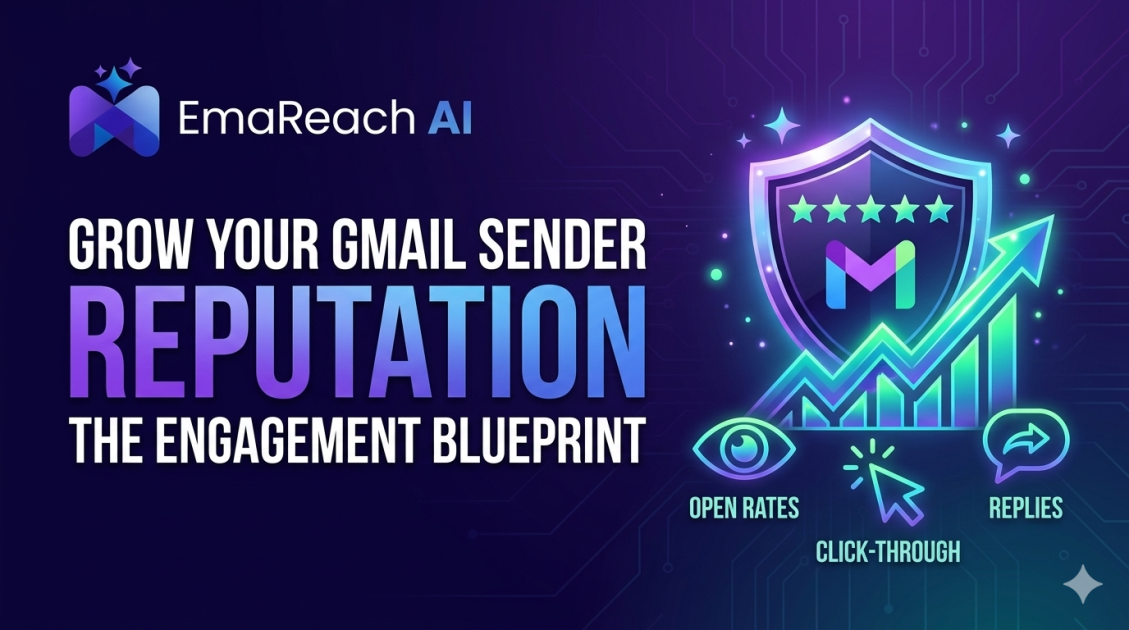
How to Grow Gmail Sender Reputation Through Better Engagement
Gmail deliverabilitysender reputationemail engagementcold emailinbox warm-upemail marketingspam prevention
Introduction to Gmail Sender Reputation
Gmail remains the dominant force in the email landscape, and for any business or individual engaged in outreach, understanding Gmail's filtering logic is essential. At the heart of this logic lies the concept of sender reputation. Unlike traditional filters that relied solely on blacklists or keyword scanning, Gmail’s modern infrastructure utilizes complex machine learning algorithms that prioritize one thing above all else: user engagement.
Sender reputation is a score assigned to your domain and IP address by mailbox providers. This score determines whether your message lands in the primary inbox, the promotions tab, or the dreaded spam folder. While technical setups like SPF, DKIM, and DMARC are the foundation, the true fuel for a healthy reputation is how recipients interact with your emails. If Gmail sees that people open, read, and reply to your messages, your reputation grows. If they ignore or report them, it collapses.
The Shift from Technical to Behavioral Signals
In the past, maintaining deliverability was largely a technical game. If you authenticated your domain and avoided 'spammy' words, you were generally safe. Today, Gmail views email as a two-way conversation. It tracks behavioral signals at scale to determine the value of a sender.
Positive signals include high open rates, long read times, replies, and moving an email from the promotions tab to the primary inbox. Negative signals involve high bounce rates, low open rates, and the most damaging of all—marking an email as spam. To grow your reputation, you must pivot your strategy from 'sending' to 'engaging.'
Why Human-First Engagement Matters
Automation has made it easy to send thousands of emails at the click of a button, but it has also made it harder to reach the inbox. Gmail’s algorithms are now sophisticated enough to detect automated patterns that lack human-like variation. This is where a 'Human-First' approach becomes a competitive advantage.
When your outreach feels personal and generates genuine back-and-forth communication, it sends a powerful signal to Google. High-quality engagement proves that you are a legitimate sender providing value. To achieve this at scale, many professionals leverage advanced platforms. For instance, EmaReach helps you stop landing in spam by ensuring your cold emails reach the inbox. It combines AI-written outreach with natural inbox warm-up and multi-account sending, ensuring your emails land in the primary tab where they belong.
Strategies for Increasing Open Rates
The first step in the engagement ladder is the open. Without an open, no other engagement can happen. However, an open isn't just a metric; it’s a vote of confidence.
Crafting Irresistible Subject Lines
Your subject line is the gatekeeper. To improve Gmail reputation, avoid clickbait. If a user opens an email and immediately closes it because the subject line was misleading, Gmail tracks that 'short dwell time' as a negative signal. Instead, use subject lines that are relevant, concise, and personalized. Questions or mentions of specific pain points often yield the best results.
Optimizing the Preview Text
The snippet of text that appears after the subject line is often overlooked. Use this space to provide a 'hook' that complements your subject line. This increases the likelihood of an open, especially on mobile devices where preview text is prominent.
Driving Deep Engagement: Replies and Forwarding
Gmail places an incredibly high weight on replies. A reply is the ultimate proof of a successful interaction. It signals to the system that the recipient not only received the mail but found it important enough to respond.
The Power of the Question
To encourage replies, end your emails with a clear, low-friction question. Instead of a long paragraph asking for a meeting, ask a simple 'yes/no' question or a request for a brief opinion. The easier it is to reply, the more likely the recipient will do it, boosting your reputation score.
Internal Forwarding
When an email is forwarded within an organization, Gmail views this as a high-value signal. It suggests that the content is being shared and discussed. Creating 'shareable' content—such as a unique data point or an insightful industry observation—can naturally trigger this behavior.
Managing List Hygiene and Negative Signals
Nothing kills a Gmail sender reputation faster than sending emails to people who don't want them. High spam complaint rates are the fastest route to a permanent domain block.
Regular List Cleaning
You should periodically remove 'ghost' subscribers—those who haven't opened an email in several months. While it may seem counterintuitive to shrink your list, having a smaller list of highly engaged users is far better for your reputation than a large list of inactive ones. High inactivity tells Gmail your content is irrelevant.
Making Unsubscribe Easy
It is better for a user to unsubscribe than to mark your email as spam. Ensure your unsubscribe link is clear and easy to find. If you hide it, frustrated users will simply hit the spam button, which heavily penalizes your domain.
The Role of Inbox Warm-up
For new domains or those looking to recover from a poor reputation, a 'warm-up' period is essential. This process involves gradually increasing your sending volume while ensuring a high percentage of those emails are opened and replied to.
Doing this manually is nearly impossible for most businesses. Using a tool like EmaReach allows you to automate this 'human-like' activity. By simulating organic engagement across a network of real accounts, it builds the trust necessary to handle larger outbound campaigns without triggering Gmail’s defensive filters.
Segmentation as an Engagement Tool
One-size-fits-all emails are a relic of the past. Segmentation allows you to send more relevant content to specific groups, which naturally leads to better engagement.
- Behavioral Segmentation: Send specific follow-ups to those who opened your previous email but didn't reply.
- Firmographic Segmentation: Tailor your messaging based on the recipient's industry or company size.
- Interest-Based Segmentation: Group users by the specific topics or resources they have interacted with on your site.
By narrowing the focus, the relevance of your message increases, and as relevance goes up, so does your Gmail sender reputation.
Avoiding the Promotions Tab
While the Promotions tab is better than the spam folder, the Primary tab is where the highest engagement happens. Gmail moves emails to 'Promotions' when it detects heavy use of imagery, multiple links, and 'salesy' language.
To stay in the Primary tab:
- Use plain-text or minimalist HTML designs.
- Limit yourself to one or two links.
- Avoid 'heavy' attachments.
- Write like you are sending an email to a friend or colleague.
Consistency and Frequency
Spiky sending patterns—sending nothing for weeks and then blasting 5,000 emails—are a major red flag for Gmail. Consistency is key. Establish a regular sending cadence that your audience expects. If you send too frequently, you risk 'email fatigue' and spam reports. If you send too rarely, your audience might forget who you are, leading to lower engagement when you finally do reach out.
Monitoring Your Progress with Google Postmaster Tools
To truly understand how Gmail perceives you, you must use Google Postmaster Tools. This resource provides direct data from Google on your IP reputation, domain reputation, and encryption levels.
Monitoring these dashboards allows you to see the immediate impact of your engagement strategies. If you see a dip in domain reputation, it’s a signal to pause, clean your lists, and focus on high-quality, high-engagement outreach to rebuild that trust.
Conclusion
Growing your Gmail sender reputation is a marathon, not a sprint. It requires a fundamental shift in perspective: viewing your recipients as human beings rather than just data points in a CRM. By prioritizing high-quality content, encouraging genuine interaction, and maintaining a clean list, you create a positive feedback loop that Gmail’s algorithms will reward.
Technical configurations provide the permission to send, but engagement provides the power to deliver. When you combine these best practices with robust systems that support deliverability, such as EmaReach, you ensure that your voice is heard in the crowded landscape of the modern inbox. Focus on the relationship, and the reputation will follow naturally.
EmaReach AI
Ready to scale your cold email outreach?
Join thousands of teams using EmaReach AI for AI-powered campaigns, domain warmup, and 95%+ deliverability. Start free — no credit card required.
Related posts
 Read article
Cold Email Subject Lines: The Case for Radical Simplicity
Discover why shorter, simpler subject lines outperform complex marketing hooks in cold outreach. Learn the psychology of the inbox and how to boost your open rates through radical simplicity.

How to A/B Test Cold Email Subject Lines the Right Way
Learn how to scientifically A/B test your cold email subject lines to maximize open rates and engagement. This comprehensive guide covers statistical significance, variable isolation, and psychological triggers for better outreach results.