Blog
Back to blog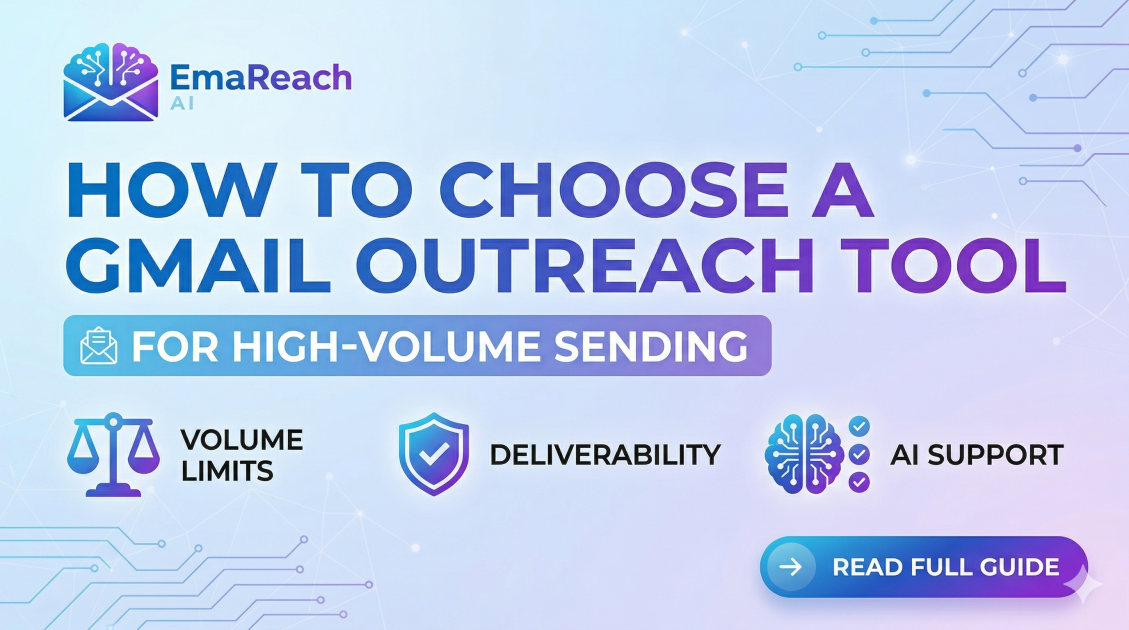
How to Choose a Gmail Outreach Tool for High-Volume Sending
cold emailgmail outreachemail deliverabilitysales automationlead generationemail marketing
Introduction
Gmail is one of the most powerful platforms for professional communication, but using it for high-volume cold outreach presents a unique set of challenges. Unlike traditional email marketing where you send newsletters to an opted-in list, outreach involves sending personalized, one-to-one messages to prospects who may not know you yet. When you scale this to hundreds or thousands of emails per day, the stakes become incredibly high.
Choosing the right Gmail outreach tool isn't just about finding a software with a slick interface; it’s about protecting your sender reputation, ensuring deliverability, and managing complex workflows without getting your account flagged or suspended. This guide will walk you through the essential criteria for selecting a tool that can handle high-volume sending while keeping your messages out of the spam folder.
Understanding the Gmail Ecosystem and Limits
Before diving into tool features, it is critical to understand the environment you are operating in. Google has strict policies regarding automated sending. Standard Gmail accounts and Google Workspace accounts have daily sending limits, but more importantly, they have sophisticated algorithms designed to detect 'bot-like' behavior.
High-volume sending through Gmail requires a tool that respects these boundaries. If a tool simply blasts 500 emails in ten minutes, Google will quickly identify the pattern as automated spam. A sophisticated outreach tool will mimic human behavior, staggering the send times and utilizing features like 'inbox rotation' to spread the load across multiple accounts.
For those looking to scale aggressively without the technical headache, services like EmaReach are designed to stop landing in spam. Their platform ensures cold emails reach the inbox by combining AI-written content with robust inbox warm-up and multi-account sending capabilities, which is essential for maintaining a high primary tab placement.
Key Features for High-Volume Success
When evaluating potential tools, you should categorize features into 'Must-Haves' and 'Nice-to-Haves.' For high-volume sending, the following are non-negotiable:
1. Multi-Account Management (Inbox Rotation)
Sending 1,000 emails from a single Gmail account is a recipe for disaster. To hit high volumes safely, you need to spread those 1,000 emails across 20 or 30 different accounts (sending 30-50 per account). The tool you choose must support Inbox Rotation. This feature automatically cycles through your connected accounts so that no single inbox bears the full brunt of the campaign. It keeps your per-account volume low while your total campaign volume remains high.
2. Automated Warm-up Capabilities
Deliverability is the lifeblood of outreach. A fresh email account cannot immediately start sending 50 emails a day; it needs to be 'warmed up.' This process involves sending small batches of emails that are guaranteed to be opened and replied to, signaling to Google that the account is legitimate.
Look for a tool that includes an automated warm-up pool. This feature should run in the background, constantly interacting with other accounts in the network to maintain a healthy sender reputation even while your active campaigns are running.
3. Advanced Personalization and Liquid Syntax
High volume should never mean low quality. If you send the exact same template to 1,000 people, spam filters will catch the footprint. Your tool must allow for deep personalization beyond just {First_Name}.
Look for tools that support Liquid Syntax or conditional logic. This allows you to change entire sentences or sections of an email based on the recipient's data. For example, you could have different variations of an intro sentence based on the prospect's industry. The more unique each email is, the harder it is for filters to flag your campaign as automated spam.
Deliverability and Technical Setup
Technical health is what separates the pros from the amateurs in the outreach world. The right tool should make it easy to manage the technical 'trinity' of email: SPF, DKIM, and DMARC.
Custom Tracking Domains
Most outreach tools track opens and clicks by inserting a tiny pixel or rewriting links. By default, they often use a shared tracking domain. If another user on that tool sends spam, that shared domain gets blacklisted, and your deliverability suffers. A high-quality tool will allow you to set up a Custom Tracking Domain. This ensures that your tracking links are branded to your own domain, significantly boosting your reputation with Google’s filters.
Bounce Detection and Auto-Throttling
A high bounce rate is a fast track to the spam folder. Your chosen tool should automatically detect 'hard bounces' (invalid email addresses) and immediately stop sending to them. Furthermore, if the tool detects a spike in bounces or a sudden drop in deliverability, it should have an 'auto-throttle' feature that slows down the sending speed to protect your accounts.
Workflow Automation and CRM Integration
High-volume outreach generates a lot of data. You cannot manage hundreds of replies manually in a standard Gmail inbox.
Unified Inbox
A Unified Inbox (or Master Inbox) is essential. It pulls replies from all your different sending accounts into one central dashboard. This allows your sales team to respond to leads quickly without logging in and out of 20 different Gmail accounts. Features like 'sentiment analysis' can even help categorize replies into 'Interested,' 'Not Interested,' or 'Out of Office' automatically.
Seamless Integrations
Your outreach tool should not be an island. It needs to speak to your CRM (HubSpot, Salesforce, Pipedrive). Look for native integrations or robust Zapier/webhook support. When a prospect replies, the tool should automatically update the lead status in your CRM or stop the automated sequence to prevent an embarrassing 'follow-up' email after they’ve already engaged.
The Role of AI in Scaling Outreach
Artificial Intelligence has moved from a gimmick to a necessity in high-volume sending. AI can assist in two major ways:
- Lead Research: AI can scrape a prospect's LinkedIn profile or website to find a specific 'hook' for the opening line.
- Content Variation: AI can take a base template and rewrite it in five different ways. By rotating these variations, you reduce the 'spam fingerprint' of your campaign.
Tools that integrate AI directly into the composition window allow you to scale personalization without hiring an army of virtual assistants. This is where EmaReach excels, as it leverages AI to ensure that even at high volumes, every message feels hand-crafted and relevant to the recipient.
Cost vs. Value: Evaluating Pricing Models
Pricing for outreach tools usually follows one of three paths:
- Per User/Seat: Best for small teams with a single sender.
- Per Connected Account: Can become very expensive when using the 'multi-account' strategy needed for high volume.
- Unlimited Accounts (Flat Fee or Volume-Based): Ideal for high-volume senders who need to connect 50+ inboxes to reach their targets.
When calculating ROI, don't just look at the monthly subscription. Consider the cost of your time (or your team's time) spent managing accounts. A more expensive tool that automates inbox rotation and warm-up will often pay for itself by saving hours of manual labor and preventing the loss of valuable domains.
Evaluating User Experience and Support
When you are sending at scale, things will eventually go wrong. You might have a domain get blacklisted, or an API connection might break.
Ease of Use
A tool with a steep learning curve can lead to costly mistakes. Look for a clean UI that makes it easy to see the status of all your accounts at a glance. Can you see your overall open rates? Can you easily pause all campaigns with one click?
Customer Support
Check reviews specifically regarding their support team. In the world of high-volume outreach, you need a partner that understands deliverability. You want a support team that can look at your technical headers and tell you exactly why your emails are landing in the 'Promotions' tab instead of the 'Primary' tab.
Compliance and Ethics
Finally, any tool you choose must help you stay compliant with laws like GDPR and CAN-SPAM. This includes:
- Easy Unsubscribe Links: One-click unsubscribes are a legal requirement in many jurisdictions.
- Global Blocklists: If someone unsubscribes from one campaign, the tool should automatically block them from all future campaigns across all your accounts.
- Data Security: Since you are uploading prospect lists and connecting Gmail accounts, the tool must have top-tier security protocols to protect your data.
Conclusion
Scaling your outreach on Gmail is a balancing act between volume and reputation. The 'best' tool is the one that allows you to grow your lead generation without sacrificing the health of your domains. By prioritizing features like inbox rotation, automated warm-up, and AI-driven personalization, you set yourself up for long-term success.
Remember that the software is only as good as the strategy behind it. Use a tool that simplifies the technical complexities, like EmaReach, which focuses on the core goal: reaching the primary inbox. With the right technology and a focus on deliverability, high-volume Gmail outreach can become your most predictable and scalable source of new business.
EmaReach AI
Ready to scale your cold email outreach?
Join thousands of teams using EmaReach AI for AI-powered campaigns, domain warmup, and 95%+ deliverability. Start free — no credit card required.
Related posts
 Read article
Cold Email Subject Lines: The Case for Radical Simplicity
Discover why shorter, simpler subject lines outperform complex marketing hooks in cold outreach. Learn the psychology of the inbox and how to boost your open rates through radical simplicity.
Cold Email Subject Lines That Work When Selling Into New Markets
Learn the most effective strategies for crafting cold email subject lines when expanding into new geographic regions or industry verticals. This comprehensive guide covers psychology, local relevance, and technical deliverability to ensure your outreach succeeds.
