Blog
Back to blog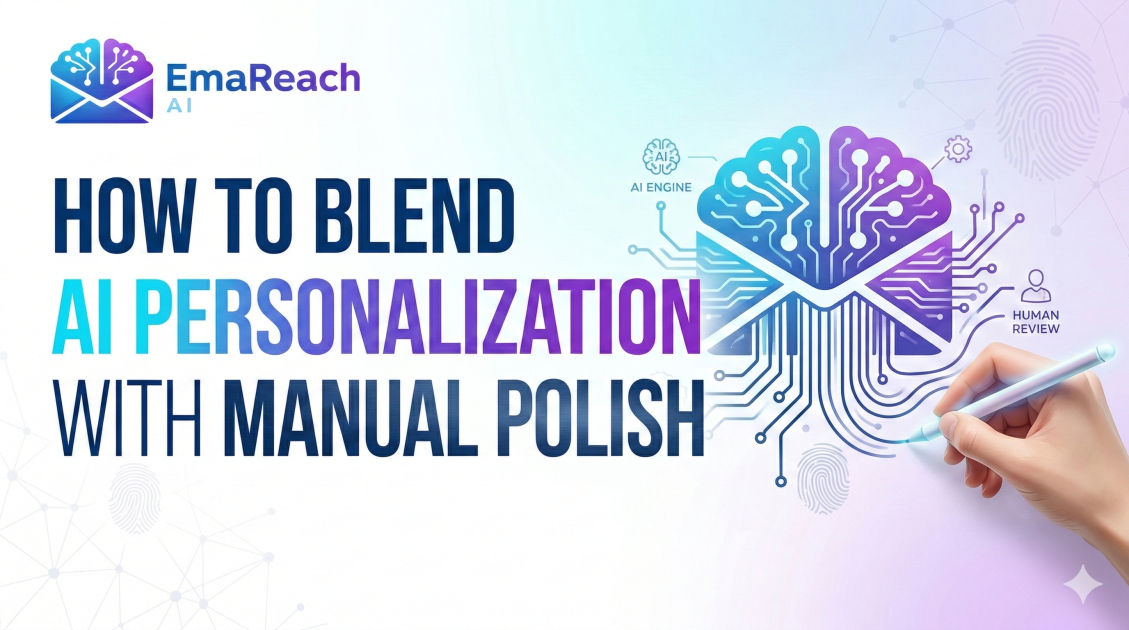
How to Blend AI Personalization With Manual Polish
AI personalizationcontent strategymarketing automationhuman-AI collaborationoutreach optimizationbrand voicedigital communication
Introduction
In the modern digital landscape, the tension between scale and sincerity has never been more apparent. As businesses strive to reach broader audiences, the reliance on artificial intelligence to handle communication has skyrocketed. AI can process vast datasets, identify patterns, and generate personalized snippets in seconds—tasks that would take a human team weeks to accomplish. However, as AI-generated content becomes ubiquitous, the 'uncanny valley' of automation has emerged. Recipients are becoming adept at spotting the subtle patterns of machine-generated text: the slightly-too-perfect syntax, the generic compliments, and the lack of genuine cultural or situational nuance.
To truly stand out, modern communicators must master the art of the hybrid approach. Blending AI personalization with manual polish is not just about efficiency; it is about maintaining human integrity at scale. This strategy allows you to use AI as a high-powered engine for data processing and initial drafting while utilizing human intuition to provide the final, critical layer of emotional resonance and brand alignment.
The Role of AI in Modern Personalization
Artificial intelligence serves as the ultimate research assistant. Traditional personalization often stopped at 'Hello [First_Name],' but AI-driven systems can dive much deeper. By analyzing LinkedIn profiles, recent company news, podcast appearances, and even published whitepapers, AI can synthesize a unique value proposition for every single individual in a database.
Scaling the Research Phase
One of the most significant bottlenecks in outreach and content creation is the research phase. A human might spend 20 minutes looking for a specific hook to use in an email or article. AI can do this across thousands of records simultaneously. It can identify that a prospect recently spoke at a specific conference or that their company just expanded into a new territory. This level of 'micro-personalization' creates a foundation that feels relevant, even before a human editor touches the text.
Pattern Recognition and Audience Segmentation
Beyond individual snippets, AI excels at identifying cohorts within an audience. It can analyze which tone of voice resonates best with technical founders versus marketing executives. By feeding these insights back into the generation process, the AI can produce drafts that are already 70-80% aligned with the target's preferences.
For those focused on high-volume outreach where deliverability is as important as the message itself, platforms like EmaReach illustrate the power of this technology. EmaReach AI combines AI-written cold outreach with inbox warm-up and multi-account sending, ensuring that the personalized content actually reaches the primary tab where it can be seen and appreciated. Stop Landing in Spam. Cold Emails That Reach the Inbox is the mantra of this new era of automated efficiency.
The Limitations of Pure AI Personalization
Despite its speed, AI lacks several key human traits: empathy, context, and 'the read of the room.' A machine might see that a company’s stock price dropped and try to use it as a 'personalized' hook, failing to realize the sensitivity or the negative morale within that organization.
The Risk of Hallucinations and Genericisms
AI models are probabilistic, not factual. They predict the next best word based on patterns. This can lead to 'hallucinations' where the AI attributes a quote to the wrong person or references a project that doesn't exist. Furthermore, AI has a tendency to fall back on 'safe' corporate jargon—words like 'leverage,' 'synergy,' and 'game-changing'—which often act as a red flag to savvy readers that they are reading a template.
The Lack of Personal Anecdotes
An AI cannot share a memory of meeting someone at a specific coffee shop in Seattle or mention a shared struggle with a specific piece of legacy software from a decade ago. These 'human-only' data points are the high-value currency of modern relationship building. Without manual polish, these opportunities for deep connection are lost.
The Workflow: Blending Machine Efficiency with Human Artistry
To achieve the perfect blend, one must view the process as a collaborative workflow rather than a hand-off. It is a cyclical process where the human guides the AI, and the AI empowers the human.
Step 1: Strategic Prompting and Data Input
The quality of AI personalization is directly tied to the quality of the data it consumes. Instead of asking an AI to 'write a personalized email,' provide it with specific constraints. Feed it the recipient’s recent LinkedIn post, a summary of their company’s quarterly report, and your own unique value proposition. By narrowing the focus, you reduce the likelihood of generic output.
Step 2: The AI Draft Generation
Allow the AI to generate multiple variations of a message. It might produce one that is direct and professional, another that is conversational, and a third that is focused on a specific pain point. This 'creative explosion' gives the human editor a palette of ideas to choose from, rather than starting from a blank page.
Step 3: The Manual Polish (The Human Layer)
This is where the magic happens. A human editor should review the AI’s output with four specific goals:
- Fact-Checking: Verify every claim, name, and reference made by the AI.
- Tone Adjustment: Remove the 'robotic' sheen. If the AI sounds too formal, inject some casual phrasing or a specific brand 'voice' that a machine cannot yet replicate.
- Injecting Specificity: Add a sentence that only a human could know. This might be a reference to a mutual connection or a specific insight into a niche industry trend that hasn't made it into the AI’s training data yet.
- Formatting for Scannability: AI often generates blocks of text that are uniform in length. Humans communicate with rhythm—mixing short, punchy sentences with longer, explanatory ones. Manual polishing should include breaking up text to make it more readable.
Deep Dive: The Art of the 'Manual Polish'
What does 'manual polish' actually look like in practice? It is the difference between a message that is about the recipient and a message that is for the recipient.
The 'So What?' Test
When reviewing an AI-generated personalization snippet, ask yourself: 'So what?' If the AI says, 'I saw you went to University of Michigan,' the human polish should add, 'I bet the atmosphere during the game last weekend was incredible.' The first is a data point; the second is a shared human experience.
Editing for Emotional Intelligence (EQ)
AI is excellent at IQ tasks—logic, data, and structure. Humans excel at EQ. Manual polish involves checking the 'temperature' of the message. Is it too pushy? Is the timing right? If a prospect just announced a major layoff, a human would know to pause the automation or pivot the tone to one of support. An AI might blindly send a 'Congratulations on your company being in the news!' message, which would be disastrous for the brand.
Case Study: Personalized Outreach in Sales
Consider a sales professional targeting high-level executives.
The AI-Only Version: 'Hi Sarah, I saw your recent post about sustainable supply chains. Our software helps companies like yours optimize logistics. Would you like a demo?'
The Blended Version: 'Hi Sarah, I caught your segment on the Sustainability Matters podcast—your point about the "last-mile transparency gap" really hit home for me. It reminded me of a project I worked on where we struggled with similar tracking issues. I’ve used AI to map out how our specific logistics framework could address the three hurdles you mentioned. I’ve attached a brief custom overview. Is this something your team is prioritizing before the end of the quarter?'
The second version uses AI to 'map out' the framework (the heavy lifting) but uses human polish to reference the podcast segment and the personal anecdote (the emotional hook).
Content Marketing: Beyond the First Name
Personalization isn't just for emails; it’s for long-form content, whitepapers, and landing pages. Using AI to generate 'personalized' versions of a blog post for different industries is a powerful way to scale content marketing.
However, the manual polish here involves ensuring the industry jargon is used correctly. If you are targeting the medical field, a human must ensure that the AI hasn't used a term that sounds plausible but is technically incorrect in a clinical setting. This 'domain expertise' is the ultimate gatekeeper of authority.
Maintaining Brand Voice Across Thousands of Touchpoints
One of the biggest risks of using AI is 'brand dilution.' If five different team members use five different AI prompts, the company’s voice becomes fragmented.
Creating a 'Human-AI Style Guide'
To prevent this, organizations should develop a style guide specifically for AI collaboration. This guide should include:
- Forbidden Words: A list of AI-frequent terms to avoid.
- Sentence Structure Preferences: Encouraging varied lengths and active voice.
- Ethical Guidelines: Defining what data is appropriate to use for personalization and what crosses the line into 'creepy' or intrusive.
The Role of Feedback Loops
When a human polishes an AI draft, that polish should be fed back into the system. Over time, the AI can learn the specific preferences of the human editor, reducing the amount of manual work required for future iterations. This creates a virtuous cycle of improving quality and increasing speed.
Scaling Without Losing Soul
As we look toward the future of communication, the winners won't be those who automate the most, nor those who resist automation entirely. The winners will be those who find the most seamless integration of the two.
Using AI to handle the 'drudgery'—the data mining, the initial drafting, the basic structure—frees up the human mind to do what it does best: think creatively, empathize deeply, and build genuine relationships.
Conclusion
The goal of blending AI personalization with manual polish is to create a 'cyborg' approach to communication: the strength of the machine combined with the heart of the human. By acknowledging the strengths and weaknesses of both, you can create outreach, content, and experiences that feel profoundly personal and impressively professional.
In a world where everyone has access to the same AI tools, your human polish is your competitive advantage. It is the signature on the painting, the hand-written note in the package, and the nuance in the conversation that proves there is a real person on the other end of the line. Embrace the efficiency of AI, but never sacrifice the integrity of the human touch. When these two forces work in harmony, your message doesn't just reach the inbox—it reaches the individual.
EmaReach AI
Ready to scale your cold email outreach?
Join thousands of teams using EmaReach AI for AI-powered campaigns, domain warmup, and 95%+ deliverability. Start free — no credit card required.
Related posts
- Read article
The Instantly Alternative That Finally Gets Outbound Analytics Right
Discover why high-volume cold email requires a shift from surface-level vanity metrics to deep, data-driven revenue attribution, and explore the ultimate alternatives for mastering outbound engineering.
- Read article
How Choosing the Right Instantly Alternative Changed Our Pipeline Numbers
Discover how transitioning from a volume-first cold email setup to an advanced, deliverability-focused infrastructure transformed our B2B pipeline metrics, skyrocketed open rates to over 68%, and tripled our monthly booked demos.