Blog
Back to blog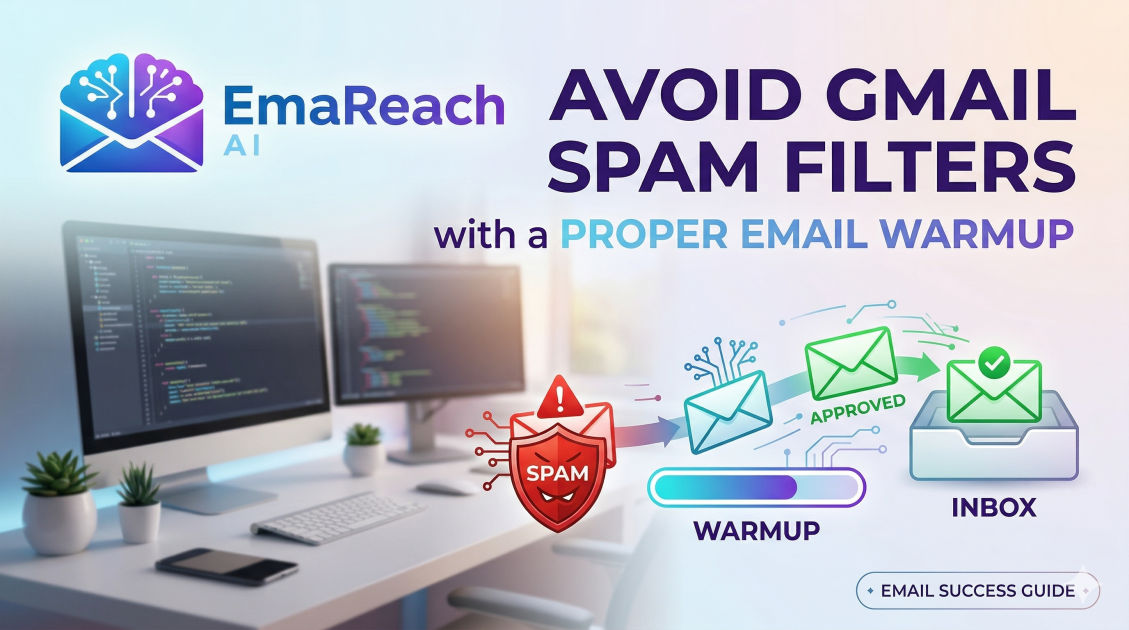
How to Avoid Gmail Spam Filters with a Proper Warmup
email warmupgmail spam filtersdeliverabilitycold emailemail marketingsender reputation
Introduction to Email Deliverability and Gmail’s Ecosystem
In the modern landscape of digital communication, the bridge between a sender and a recipient is guarded by increasingly sophisticated gatekeepers. For anyone utilizing Gmail for outreach, marketing, or professional networking, the greatest hurdle isn't writing the content—it's ensuring the content actually arrives in the primary inbox. Gmail, powered by Google's advanced machine learning algorithms, processes billions of data points to determine whether an email is a legitimate communication or unsolicited noise.
Landing in the spam folder is the digital equivalent of being silenced. When your emails are flagged, your open rates plummet, your domain reputation suffers, and your ROI vanishes. To navigate this, one must understand the concept of 'Email Warmup.' This process is the systematic method of building a positive sender reputation with Gmail’s filters, proving that you are a human sender providing value rather than a bot blasting thousands of addresses.
Understanding the Gmail Spam Filter Mechanism
Gmail’s filtering system is not a static list of 'bad words.' It is a dynamic, behavioral-based engine that evaluates three primary pillars: technical authentication, sender reputation, and engagement metrics.
The Role of Reputation
Your sender reputation is essentially a credit score for your email address and domain. If you suddenly send 500 emails from a brand-new account, Gmail views this as high-risk behavior. Legitimate users typically start slow, sending a few emails a day and gradually increasing their volume as their network grows.
Engagement Metrics: The Secret Sauce
Gmail monitors how recipients interact with your mail. Do they open it? Do they click links? More importantly, do they move your email from the 'Promotions' or 'Spam' tab to the 'Primary' inbox? Positive interactions signal to Google that your content is wanted. Conversely, if users delete your mail without opening it or—worst of all—mark it as spam, your reputation takes a significant hit.
Why New Gmail Accounts Need a Warmup Period
When you create a new Gmail or Google Workspace account, you are operating with a 'neutral' reputation. In the eyes of an ISP (Internet Service Provider), neutral is often treated with the same suspicion as 'bad.'
Without a warmup period, your initial burst of emails will likely be throttled. Gmail might deliver the first five, put the next ten in the Promotions tab, and send the rest straight to Spam to see how the first few recipients react. A proper warmup simulates natural human growth, allowing you to bypass these initial 'probationary' filters.
Phase 1: Technical Foundations and Authentication
Before you send a single warmup email, your technical infrastructure must be flawless. If your 'ID' isn't verified, Gmail won't even bother looking at your content.
SPF (Sender Policy Framework)
SPF is a DNS record that specifies which mail servers are authorized to send email on behalf of your domain. Without this, anyone could spoof your address, and Gmail's filters will likely reject your mail immediately.
DKIM (DomainKeys Identified Mail)
DKIM adds a digital signature to your emails. This allows the receiver to verify that the email was indeed authorized by the owner of that domain and that it wasn't altered during transit.
DMARC (Domain-based Message Authentication, Reporting, and Conformance)
DMARC ties SPF and DKIM together. It provides instructions to the receiving mail server on what to do if the authentication fails (e.g., do nothing, quarantine, or reject). Having a DMARC policy in place is a massive trust signal for Google.
Phase 2: The Manual Warmup Process
If you prefer a hands-on approach, a manual warmup involves using your own network to validate your account. This is time-consuming but highly effective for low-volume senders.
- Start Small: On day one, send 5-10 emails to people you know—friends, colleagues, or your own alternative email addresses.
- Encourage Replies: The goal isn't just to send; it's to receive. Ask a question that requires a response. A 1:1 sent-to-received ratio is the gold standard for reputation building.
- Vary Your Content: Don't send the same template to everyone. Gmail's 'fingerprinting' technology can detect repetitive patterns. Write unique, conversational text for each recipient.
- Consistency Over Intensity: It is better to send 10 emails every day for a week than to send 70 emails on a single Monday. Sudden spikes in volume are a major red flag for spam filters.
Phase 3: Scaling with Automated Warmup Tools
For professionals running cold outreach or high-volume sales campaigns, manual warmup is rarely sustainable. This is where automated solutions come into play. These tools connect your inbox to a network of other real inboxes, automatically sending, opening, and replying to messages to simulate high engagement.
When choosing a strategy, consider EmaReach. It offers a comprehensive solution to stop landing in spam by combining AI-written cold outreach with an integrated inbox warm-up feature and multi-account sending. This ensures your emails land in the primary tab and get actual replies by mimicking human behavior at scale.
How Automated Warmup Works
- Auto-Replies: The system ensures your sent emails get a response, which is a powerful deliverability signal.
- Spam Removal: If one of your warmup emails lands in the spam folder, the tool automatically moves it to the inbox and marks it as 'not spam.' This tells Gmail’s AI that it made a mistake and that your emails are valuable.
- Marking as Important: The tool can mark your emails with the 'important' tag (the yellow chevron in Gmail), further boosting your sender score.
The Ideal Warmup Schedule
A proper warmup typically takes 3 to 4 weeks. Here is a sample trajectory for a Google Workspace account:
- Week 1: 5–15 emails per day. Focus purely on high-engagement replies from trusted sources.
- Week 2: 15–30 emails per day. Introduce some outbound content to recipients who haven't interacted with you before.
- Week 3: 30–60 emails per day. Monitor your 'Spam' rate closely using Google Postmaster Tools.
- Week 4: 60–100 emails per day. Once you hit this level with high deliverability, you can begin your actual outreach campaigns.
Advanced Strategies to Maintain Your Reputation
Warmup isn't a 'one and done' task. It is a continuous maintenance process. Even an established domain can see its reputation tank if it starts receiving high complaint rates.
Monitor Google Postmaster Tools
This is a free service provided by Google that gives you a direct look at how Gmail views your domain. It tracks your IP reputation, domain reputation, and spam rate. If your domain reputation drops from 'High' to 'Medium,' it's time to pause your campaigns and increase your warmup volume.
Personalization and Spin Syntax
To avoid Gmail's pattern recognition, use spin syntax or AI-driven personalization. If every email you send has the same subject line and body text, the filter will eventually identify it as a bulk broadcast. Changing even 20% of the content between emails can significantly improve your odds of hitting the primary inbox.
Managing Your Bounce Rate
High bounce rates (sending to non-existent email addresses) are a fast track to the spam folder. Always use a list cleaning service to verify your leads before sending. A bounce rate above 2% is a signal to Google that you are using a low-quality, scraped list.
Common Pitfalls to Avoid During Warmup
- Using a 'Burner' Domain Improperly: While it's smart to use a secondary domain for outreach (e.g., using
getcompany.cominstead ofcompany.com), that secondary domain still needs the same level of warmup and authentication. - Including Too Many Links: In the early stages of warmup, avoid heavy link usage. Especially avoid tracking links from 'blacklisted' domains. In fact, for the first two weeks, it's best to send plain text emails with no links at all.
- Neglecting Unsubscribe Options: While it sounds counterintuitive, making it easy to unsubscribe reduces the likelihood that a recipient will hit the 'Mark as Spam' button. A 'Spam' report is ten times more damaging than an 'Unsubscribe.'
The Psychology of the Inbox: Why Human Behavior Matters
Gmail’s ultimate goal is to provide a clean, relevant experience for its users. Their AI is trained to recognize the 'footprint' of a human. Humans make typos, they reply at weird hours, they archive threads they've finished with, and they don't send exactly 50 emails at 9:00 AM every morning.
Modern warmup strategies succeed because they embrace this randomness. By introducing 'noise' into your sending patterns—varying the time of day, the length of the message, and the frequency of sending—you blend into the sea of legitimate traffic.
Conclusion
Mastering the Gmail warmup is the most critical step in any modern email strategy. By meticulously setting up your technical authentication, gradually increasing your volume, and ensuring high engagement through automated or manual means, you build a protective shield around your domain.
Remember that deliverability is not a static achievement but an ongoing effort. Treat your sender reputation with the same care you treat your credit score. Avoid shortcuts, focus on providing value to your recipients, and use the right tools to maintain the 'human' signal that Gmail’s filters crave. When you do this correctly, you stop fighting the filters and start reaching the people who matter most to your business.
EmaReach AI
Ready to scale your cold email outreach?
Join thousands of teams using EmaReach AI for AI-powered campaigns, domain warmup, and 95%+ deliverability. Start free — no credit card required.
Related posts
- Read article
Beyond Instantly: The Cold Email Platforms Worth Taking Seriously
Discover the top advanced cold email platforms that go beyond basic multi-inbox rotation. Learn how to optimize your technical infrastructure, leverage advanced personalization, and scale your B2B sales pipeline safely without landing in the spam folder.
- Read article
Instantly vs EmaReach: Comparing Inbox Rotation Features
A deep dive into inbox rotation strategies comparing Instantly and EmaReach. Learn how these tools handle scaling, deliverability, and spam avoidance to optimize your cold outreach.