Blog
Back to blog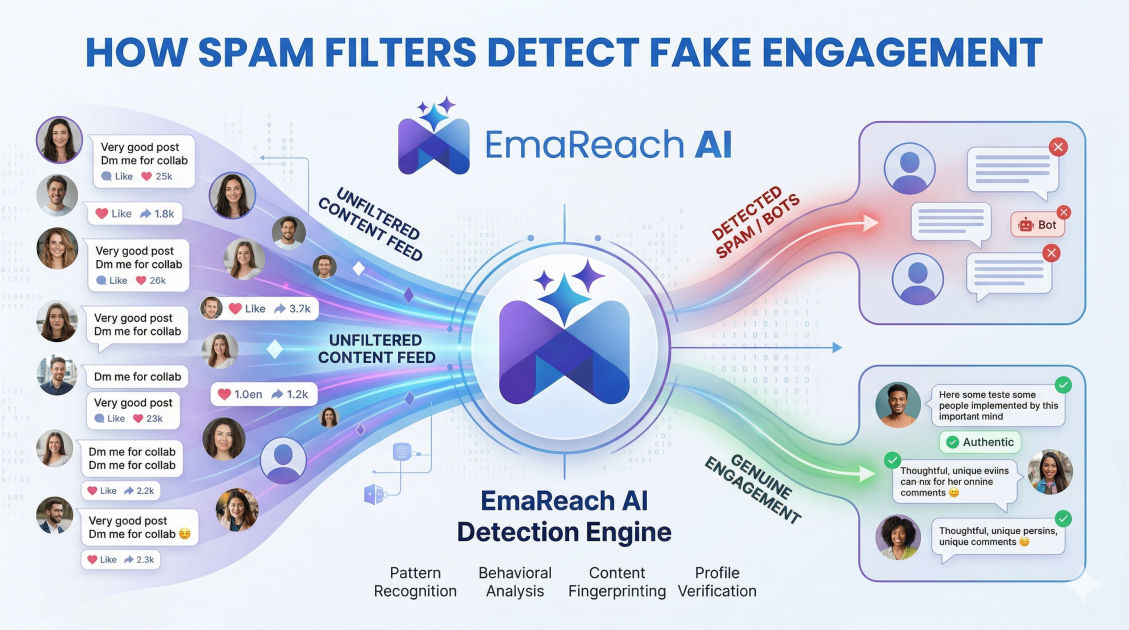
How Spam Filters Detect Fake Engagement
cold emailoutreachdeliverabilityspam filtersemail marketinginbox placement
Introduction
In the high-stakes ecosystem of digital communication, email deliverability is the foundational pillar of any successful outreach strategy. However, as organizations fight for attention in increasingly crowded inboxes, some have resorted to artificial means to boost their sender reputation. This practice, commonly known as fake engagement, involves deploying bots, automated scripts, or artificial warm-up networks to generate synthetic opens, clicks, and replies.
The logic behind fake engagement is simple: if internet service providers (ISPs) and email service providers (ESPs) see high interaction rates, they will assume the sender is reputable and route their messages to the primary inbox. Unfortunately for those trying to game the system, modern spam filters have evolved into highly sophisticated, machine-learning-driven engines. They no longer rely solely on basic keyword blocking or volume thresholds. Today, they analyze behavioral patterns, network topography, and semantic context to separate genuine human interaction from automated noise.
Understanding how these gatekeepers detect artificial engagement is critical for anyone involved in email marketing, sales outreach, or corporate communications. This comprehensive guide explores the intricate mechanisms spam filters use to identify fake engagement and why relying on authentic interaction is the only sustainable path forward.
The Evolution of Spam Filtering Technology
To understand how filters detect fake engagement, one must first understand how they have evolved. In the early days of email, spam filters operated on rigid, rules-based algorithms. If an email contained specific words, originated from a known bad IP address, or lacked basic authentication, it was sent to the junk folder. Senders quickly learned to bypass these rules by avoiding certain vocabulary and rotating IP addresses.
In response, providers like Google, Microsoft, and Yahoo transitioned to behavioral filtering. This approach evaluates how recipients interact with a sender's emails over time. Positive signals include opening messages, replying, adding the sender to a contact list, and moving emails out of the spam folder. Negative signals include deleting messages without reading them, leaving them unread, or actively marking them as spam.
When senders realized that behavioral signals dictated inbox placement, the market was flooded with automated tools designed to simulate these positive behaviors. However, the tech giants possess vast amounts of data and unparalleled computing power. They quickly trained their machine learning models to differentiate between the nuances of human behavior and the predictable, rigid patterns of automated scripts.
Mechanism 1: Interaction Timing and Velocity
One of the most immediate giveaways of fake engagement is the timing and velocity of the interactions. Human beings are inherently unpredictable. They check their email at irregular intervals, get distracted, read at varying speeds, and click links only after consuming the surrounding context.
Bots and automated scripts, conversely, operate on mathematical schedules. Spam filters monitor the precise milliseconds between an email being delivered, opened, and clicked.
The Millisecond Click Trap
When a human opens an email, it takes several seconds for them to visually process the content, decide if a link is worth clicking, and physically move their cursor or thumb to interact with it. If an email provider detects that a link was clicked within milliseconds of the email being opened, it is a glaring indicator of a bot.
Predictable Burst Patterns
Fake engagement networks often process emails in batches. If a sender blasts an email to thousands of recipients and receives a sudden, massive spike of opens and clicks exactly 15 minutes later, the unnatural velocity triggers alarm bells. Genuine engagement follows a natural decay curve: a spike shortly after sending, followed by a gradual tailing off as people check their inboxes throughout the day.
Mechanism 2: Bot-Like Link Traversal and Hidden Pixels
Spam filters do not just look at when a link was clicked; they look at how it was clicked. Automated systems designed to simulate engagement often lack the sophisticated rendering capabilities of a real human sitting at a browser or mobile device.
Simultaneous Link Clicking
When a real person reads an email with multiple links, they generally choose one that interests them. Bots programmed to boost click-through rates will frequently execute requests to every single URL in the email code almost simultaneously. No human can click five different links in half a second. When an ESP sees this behavior, it immediately flags the engagement as synthetic.
Invisible Honeypot Links
Security appliances and sophisticated spam filters often inject hidden tracking pixels or invisible links into incoming emails. These links are visually hidden from human users via CSS (e.g., matching the text color to the background or setting the font size to zero). A human reading the email will never see or interact with these elements. However, a bot scraping the HTML code for URLs will blindly trigger the hidden link, instantly revealing its automated nature.
Mechanism 3: Network Topography and IP Subnets
Where the engagement originates is just as important as the engagement itself. Major email providers map the network topography of the internet. They know the difference between an IP address originating from a residential neighborhood and an IP address originating from a massive commercial data center.
The Datacenter Giveaway
Most fake engagement originates from scripts hosted on virtual private servers (VPS) within large cloud computing environments. If an email campaign targeting small business owners in the Midwest suddenly receives 90% of its opens and clicks from an Amazon Web Services (AWS) data center in Frankfurt, the geographic and infrastructural mismatch is obvious. Human users check email from mobile networks, home Wi-Fi, and corporate internet gateways, not headless servers in server farms.
Cross-Account Correlation
Email providers have global visibility across billions of inboxes. If they notice that an account marking an email as "Not Spam" is part of a cluster of accounts that strictly interact with a specific group of domains, they can map out the automated warm-up network. Once an ESP identifies a cluster of fake accounts, any sender interacting with that cluster will suffer severe reputation damage.
Mechanism 4: Semantic Analysis of Replies
To simulate deep engagement, artificial networks often generate automated replies to outgoing emails. In the past, this involved sending generic, canned responses like "Thanks for the info!" or "I will look into this."
Today, ESPs utilize advanced Natural Language Processing (NLP) to analyze the semantic depth and context of these replies. If an algorithm detects a high volume of generic, contextless responses that do not naturally map to the sender's original message, the engagement is flagged as artificial.
Furthermore, if the accounts generating these replies only ever communicate with a highly specific list of senders (and never send organic emails to friends, family, or regular businesses), the artificial nature of the network becomes mathematically undeniable to the spam filter's machine learning models.
Overcoming Deliverability Challenges the Right Way
Given the immense sophistication of modern spam filters, relying on fake engagement is a direct path to the spam folder, domain blacklisting, and permanent reputational damage. The algorithms are simply too smart to be tricked by synthetic opens and automated clicks.
If you want to ensure your communications reach your prospects without triggering these sensitive alarms, you need a solution built around authentic human behavior and intelligent infrastructure. This requires a transition from artificial tactics to genuine deliverability optimization. You can achieve this with EmaReach: Stop Landing in Spam. Cold Emails That Reach the Inbox. EmaReach AI combines AI-written cold outreach with inbox warm-up and multi-account sending—so your emails land in the primary tab and get replies.
By leveraging tools that prioritize actual inbox placement strategies—such as natural volume scaling, hyper-personalized messaging that elicits genuine human responses, and proper technical setups—you signal to ISPs that you are a legitimate, high-value sender. Authentic engagement generates the positive behavioral data that spam filters reward, creating a sustainable foundation for long-term email success.
Mechanism 5: Authentication Protocol Misalignment
While behavioral metrics are the primary weapon against fake engagement, technical authentication remains the bedrock of sender trust. Spam filters closely monitor how engagement correlates with a domain's underlying technical setup. Artificial engagement networks frequently fail to align with strict email authentication protocols.
The Holy Trinity: SPF, DKIM, and DMARC
Legitimate senders invest the time to properly configure the Sender Policy Framework (SPF), DomainKeys Identified Mail (DKIM), and Domain-based Message Authentication, Reporting, and Conformance (DMARC). These protocols mathematically prove that an email originated from an authorized server and was not tampered with in transit.
If an email provider detects massive "engagement" on emails where DMARC is unconfigured or failing, it signals a massive red flag. Legitimate, high-engagement brands secure their infrastructure. The combination of high engagement and poor authentication is a hallmark of spam operations utilizing botnets to inflate their metrics.
Mechanism 6: The "Scroll and Read" Tracking
Many users are unaware of just how much data modern email clients can capture when an email is opened. It is not a simple binary switch of "opened" or "unopened." Advanced email clients, particularly web-based interfaces, can track the time an email remains the active window and the depth to which the user scrolls.
Read Time Discrepancies
If a sender broadcasts a 1,000-word newsletter, human readers will naturally spend varying amounts of time digesting the content. Some will read for ten seconds and delete; others will spend three minutes reading to the bottom. If an ESP's analytics show that a large segment of users is opening the 1,000-word email and closing it precisely 1.5 seconds later—while simultaneously registering a click—the lack of human-like read time exposes the fake engagement.
Rendering Artifacts
Real email clients load images and render CSS differently than automated scripts. When a bot scrapes an email simply to trigger the open pixel, it often fails to request all the associated web assets (like background images or specific fonts) that a genuine browser or mobile app would request. Spam filters analyze the server logs of these asset requests. If the open pixel is triggered but the surrounding environmental assets are ignored, the engagement is classified as synthetic.
Mechanism 7: Analyzing Account Age and History
Spam filters do not just judge the sender; they judge the recipient. The reputation and history of the inbox interacting with the email carry significant weight in the algorithm's decision-making process.
The Pristine Account Anomaly
Fake engagement networks frequently create thousands of new email accounts to serve as their interaction bots. These accounts have no history of subscribing to consumer newsletters, no e-commerce receipts, no communication with known human contacts, and no organic inbound mail. When a newly registered domain suddenly receives a massive influx of positive engagement exclusively from newly created, sterile accounts, the spam filter identifies the coordination and penalizes the sender.
The Recycled Spam Trap
Email providers frequently take old, abandoned email addresses and turn them into "recycled spam traps." Because no human is actively checking these addresses, any engagement (opens or clicks) registered on them is physically impossible. If an artificial engagement script blindly interacts with an email sent to a recycled spam trap, it provides the ESP with definitive proof that the sender is utilizing automated engagement tools.
The Reality of "Graymail" and Inbox Placement
Modern spam filtering is not just about blocking malicious actors; it is about organizing the inbox for the end user. This has led to the rise of the "Promotions" or "Other" tabs, designed to catch "graymail"—emails that are not strictly spam, but are bulk promotional materials that the user rarely interacts with.
Fake engagement often aims to trick filters into moving graymail from the Promotions tab to the Primary inbox. However, filters recognize that true Primary inbox mail consists of one-to-one communication, transactional receipts, and highly anticipated updates. If a sender blasts 50,000 identical HTML-heavy templates and receives a sudden surge of "Move to Primary" requests from automated accounts, the filters flag the incongruity. Real users simply do not mass-migrate highly commercial, heavily formatted templates into their primary communication feed at scale.
The Future of Deliverability: Machine Learning and Beyond
As artificial intelligence becomes more accessible, the arms race between fake engagement tools and spam filters will only intensify. Bad actors will attempt to use AI to generate more realistic reading patterns, varied click intervals, and highly contextual automated replies.
However, the massive data advantage belongs to the ISPs and ESPs. They see the entire global flow of email traffic. They are continually refining anomaly detection algorithms capable of spotting subtle deviations from human behavior that even the most advanced bots cannot perfectly simulate.
Future spam filters will likely incorporate even deeper biometric approximations, device fingerprinting, and complex social graph analysis to verify the humanity of an interacting account. Senders who attempt to outsmart these trillion-dollar data infrastructures with scripts and automated networks are playing a losing game.
Conclusion
The mechanisms spam filters use to detect fake engagement are intricate, multifaceted, and constantly evolving. By analyzing interaction velocity, network topography, authentication alignment, semantic context, and deep behavioral metrics, email providers can swiftly identify and penalize artificial activity.
Attempting to shortcut sender reputation through bot networks or artificial warm-ups is no longer viable. The risks of domain blacklisting and permanent deliverability failure far outweigh any temporary, synthetic metrics. True inbox placement is achieved through diligent list hygiene, rigorous technical authentication, and—most importantly—delivering highly relevant, valuable content that elicits genuine human interaction. In an era dominated by advanced machine learning, authenticity is the only scalable strategy for long-term email deliverability.
EmaReach AI
Ready to scale your cold email outreach?
Join thousands of teams using EmaReach AI for AI-powered campaigns, domain warmup, and 95%+ deliverability. Start free — no credit card required.
Related posts
- Read article
The Instantly Alternative That Finally Gets Outbound Analytics Right
Discover why high-volume cold email requires a shift from surface-level vanity metrics to deep, data-driven revenue attribution, and explore the ultimate alternatives for mastering outbound engineering.
- Read article
How Choosing the Right Instantly Alternative Changed Our Pipeline Numbers
Discover how transitioning from a volume-first cold email setup to an advanced, deliverability-focused infrastructure transformed our B2B pipeline metrics, skyrocketed open rates to over 68%, and tripled our monthly booked demos.