Blog
Back to blog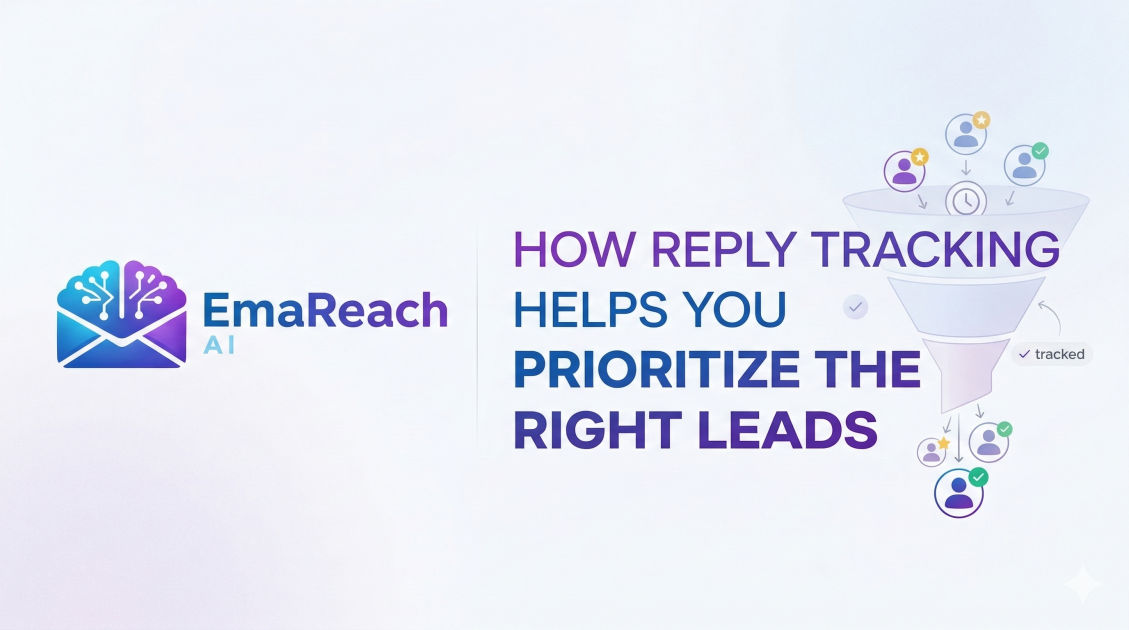
How Reply Tracking Helps You Prioritize the Right Leads
lead prioritizationreply trackingsales automationcold email strategylead scoringsales intelligence
Introduction
In the high-stakes world of modern sales and business development, the challenge is rarely a lack of data—it is an abundance of noise. Sales teams today can generate hundreds, if not thousands, of outbound touchpoints every week. However, sending the email is only the first step. The real magic happens when a prospect engages. But not all engagement is created equal.
Reply tracking has emerged as a critical pillar of sales intelligence. It is the process of monitoring, capturing, and analyzing incoming responses to your outreach campaigns. While simple in concept, its execution determines whether a sales representative spends their day chasing dead ends or closing high-value deals. By implementing robust reply tracking, organizations can shift from a volume-based approach to a value-based strategy, ensuring that the most promising leads never fall through the cracks.
The Fundamental Shift from Delivery to Dialogue
For years, the primary metrics for outreach success were open rates and click-through rates. While these metrics provide a glimpse into interest, they are often misleading. An 'open' could simply be a curious recipient or even an automated security filter. A 'reply,' however, represents a definitive shift from passive consumption to active dialogue.
When you track replies effectively, you stop looking at your lead list as a static spreadsheet and start seeing it as a living conversation. Reply tracking allows you to categorize prospects based on the sentiment and urgency of their response. This shift is essential for prioritization. Without it, a lead who says "Tell me more next Tuesday" is treated with the same urgency as one who says "Unsubscribe," or worse, the same as someone who hasn't responded at all.
Understanding the Mechanics of Reply Tracking
To prioritize leads, you must first understand how reply tracking works at a technical and operational level. At its core, reply tracking uses software to monitor your inbox for responses tied to specific outbound campaigns.
Modern systems go beyond mere detection. They use sophisticated algorithms to:
- Match Replies to Sequences: Ensuring that when a prospect hits 'Reply,' the system knows exactly which message sparked the interest.
- Sentiment Analysis: Categorizing the reply as positive, neutral, or negative.
- Status Automation: Automatically pausing further automated follow-ups once a reply is detected to prevent awkward, redundant messaging.
For those looking to maximize this process, using a platform like EmaReach (https://www.emareach.com/) can be transformative. EmaReach ensures your emails reach the primary tab and get replies by combining AI-written outreach with inbox warm-up, making the subsequent tracking much more fruitful.
Categorizing Lead Quality Through Response Patterns
Not every reply is a 'yes,' and not every 'no' is a permanent rejection. Reply tracking helps you segment your leads into actionable categories:
1. The Hot Lead (High Intent)
These are the replies that ask for a demo, inquire about pricing, or provide a specific pain point they are looking to solve. Tracking these allows for an immediate 'speed-to-lead' response, which is often the deciding factor in winning a deal.
2. The Information Seeker (Medium Intent)
These prospects respond with questions like "How do you compare to X?" or "Do you have a case study for my industry?" Reply tracking flags these as leads that require educational nurturing rather than a hard sell.
3. The 'Not Now' (Future Intent)
One of the most undervalued benefits of reply tracking is capturing the "Check back in six months" response. By tracking these and integrating them with your CRM, you build a future pipeline that is far more likely to convert than cold outreach.
4. The Referral
Often, a prospect will reply stating they aren't the right person but suggesting a colleague. Proper tracking ensures you can pivot the campaign to the new stakeholder without losing the context of the original outreach.
Data-Driven Prioritization: The Lead Scoring Advantage
Reply tracking feeds directly into lead scoring models. By assigning numerical values to different types of replies, sales managers can create a prioritized 'Daily Action List' for their reps.
Imagine a scenario where a rep has 50 leads to follow up with.
- Lead A opened the email three times but didn't reply.
- Lead B replied asking for a whitepaper.
- Lead C replied saying, "I'm interested, but we don't have a budget until next quarter."
Through reply tracking, Lead B becomes the immediate priority for a personal touch, Lead C is scheduled for a long-term nurture, and Lead A remains in the automated flow. This level of granularity prevents 'prospecting fatigue' and keeps the sales team focused on the highest-probability outcomes.
Enhancing Deliverability and Reputation
There is a hidden benefit to reply tracking that impacts the very foundation of your outreach: deliverability. Mail service providers (MSPs) like Google and Outlook look at your 'reply-to-send' ratio to determine if you are a legitimate sender or a spammer.
When you track replies and optimize your content to encourage them, you naturally improve your sender reputation. A high reply rate signals to inbox providers that your content is valuable to their users. This creates a virtuous cycle: better reply tracking leads to better content, which leads to higher reply rates, which leads to your emails consistently hitting the inbox rather than the spam folder.
Closing the Loop with CRM Integration
Reply tracking is most powerful when it isn't an island. It must be synced with your Customer Relationship Management (CRM) system. When a reply is tracked, it should trigger a series of events:
- Lead Status Update: Moving the prospect from 'Contacted' to 'Engaged.'
- Task Creation: Assigning a manual follow-up task to the account executive.
- Data Enrichment: Capturing the phone number or alternative email address often found in a prospect's signature.
This integration ensures that the 'prioritization' isn't just a mental note made by a salesperson, but a documented organizational process. It allows leadership to see exactly where leads are stalling in the funnel.
The Psychology of the Follow-Up
Psychologically, reply tracking empowers sales reps. Cold calling and cold emailing can be grueling. Knowing exactly who has engaged and what they said provides a massive boost in confidence. Instead of a 'cold' call, the rep is making a 'warm' follow-up.
"Hi [Name], I'm calling regarding the question you asked in your email this morning about our integration capabilities," is a significantly more powerful opening than a standard pitch. Reply tracking provides the context needed to make these human connections.
Common Pitfalls to Avoid in Reply Tracking
While the advantages are clear, there are several traps organizations fall into when implementing reply tracking:
- Ignoring 'Out of Office' Replies: A sophisticated tracking system must distinguish between a human reply and an automated OOO message. Treating an OOO as a 'lead' wastes time; however, tracking the date they return is a goldmine for timing your next touchpoint.
- Failing to Track Negative Sentiment: A prospect saying "Remove me from your list" is still a reply. If you don't track this and keep emailing them, you risk being reported for spam, which damages your entire domain's reach.
- Slow Response Times: Tracking a reply is useless if the team takes three days to respond. The value of a reply decays rapidly. Real-time notifications are a non-negotiable component of effective tracking.
Implementing a Reply-First Strategy
To truly prioritize the right leads, your entire strategy should be built around the goal of generating a response. This means moving away from long, feature-heavy pitches toward short, question-based emails.
Ask yourself: "Does this email make it easy for the prospect to reply?"
Once the replies start coming in, the tracking system acts as your air traffic controller, guiding each lead to the appropriate next step. Whether it’s a calendar invite, a supplemental resource, or a respectful removal from the list, every reply is a data point that sharpens your sales focus.
Conclusion
In an era where buyers are inundated with generic outreach, the ability to listen is more valuable than the ability to speak. Reply tracking is the digital equivalent of active listening. It allows you to filter out the noise of 'opens' and 'clicks' and focus your energy on the prospects who are actually talking back.
By systematically capturing responses, analyzing sentiment, and automating the subsequent workflows, you ensure that your sales team is always working on the leads that have the highest potential to convert. Ultimately, reply tracking isn't just about managing emails—it's about respecting your prospects' time and your own resources, leading to a more efficient, professional, and successful sales organization.
EmaReach AI
Ready to scale your cold email outreach?
Join thousands of teams using EmaReach AI for AI-powered campaigns, domain warmup, and 95%+ deliverability. Start free — no credit card required.
Related posts
- Read article
The Instantly Alternative That Finally Gets Outbound Analytics Right
Discover why high-volume cold email requires a shift from surface-level vanity metrics to deep, data-driven revenue attribution, and explore the ultimate alternatives for mastering outbound engineering.
- Read article
How Choosing the Right Instantly Alternative Changed Our Pipeline Numbers
Discover how transitioning from a volume-first cold email setup to an advanced, deliverability-focused infrastructure transformed our B2B pipeline metrics, skyrocketed open rates to over 68%, and tripled our monthly booked demos.