Blog
Back to blog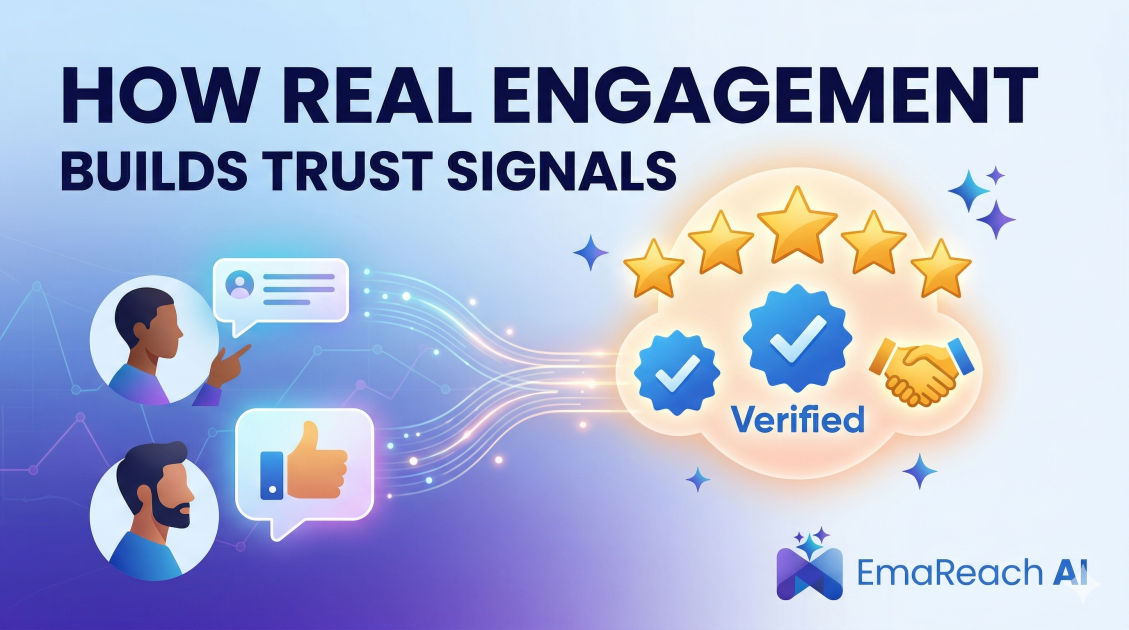
How Real Engagement Builds Trust Signals
digital marketingtrust signalsuser engagementemail deliverabilitybrand authoritysocial proofonline reputation
Introduction: The Shift from Metrics to Meaning
In the digital landscape, the concept of trust has evolved from a nebulous feeling into a quantifiable set of data points known as trust signals. For years, businesses focused on vanity metrics—likes, follows, and raw page views—believing these were the primary indicators of success. However, as algorithms have become more sophisticated and consumer skepticism has grown, the focus has shifted toward real engagement.
Real engagement is the difference between a user passively scrolling past your content and a user actively participating in a conversation with your brand. It is the bridge between a cold lead and a loyal advocate. When a user interacts meaningfully with your digital presence, they aren't just consuming information; they are sending a powerful signal to both other users and the algorithms that govern visibility: "This brand is trustworthy."
In this comprehensive guide, we will explore how authentic interactions serve as the foundation for trust signals and how you can leverage these mechanics to build a more resilient, authoritative brand.
Understanding the Anatomy of Trust Signals
Before diving into the 'how,' we must define what trust signals actually are. In a digital context, a trust signal is an evidence-based cue that reduces the perceived risk of a transaction or interaction. These signals can be internal (social proof on your website) or external (how platforms like Google or email providers perceive your domain).
The Two Layers of Trust
- Human Trust: This is the psychological comfort a person feels when they see active comments, honest reviews, and a responsive brand voice. It is what makes a customer hit the "Buy" button.
- Algorithmic Trust: This is the technical reputation assigned to your digital identity by machine learning models. Whether it is an SEO ranking or email deliverability, algorithms look for patterns of positive engagement to decide if your content is worth showing to others.
Real engagement feeds both layers simultaneously. When people comment, share, and reply, they satisfy the human need for social proof while providing the data points necessary for algorithmic validation.
The Relationship Between Engagement and Email Deliverability
Nowhere is the power of trust signals more evident than in the realm of email communication. The modern inbox is a highly guarded fortress. Internet Service Providers (ISPs) use complex engagement filters to determine whether an email belongs in the Primary tab, the Promotions tab, or the dreaded Spam folder.
Why Passive Sending Fails
If you send thousands of emails and nobody opens them, moves them to folders, or—worse—marks them as spam, you are building a negative trust signal. The ISP assumes you are a broadcaster of noise rather than a provider of value. To reverse this, you need real engagement: replies, star-ratings, and manual white-listing.
This is where specialized strategic assistance becomes vital. For those struggling to maintain high delivery rates, services like EmaReach are transformative. Stop Landing in Spam. Cold Emails That Reach the Inbox. EmaReach AI combines AI-written cold outreach with inbox warm-up and multi-account sending—so your emails land in the primary tab and get replies. By automating the engagement loop, you build the trust signals necessary for long-term outreach success.
The Feedback Loop of the Inbox
When a recipient replies to your email, it signals to the mail server that a two-way relationship exists. This is the ultimate trust signal. It tells the algorithm that your domain is not a source of unsolicited junk, but a hub of meaningful dialogue. Maintaining this "reputation score" requires consistent, high-quality interaction that mimics human behavior.
Social Media: Beyond the Like Button
On social platforms, the "Like" has become the lowest common denominator. It requires minimal effort and provides a weak trust signal. To build a truly authoritative presence, brands must strive for Deep Engagement.
1. The Power of the Long-Form Comment
When a user takes the time to write a thoughtful response to a post, it signals to other onlookers that the content is thought-provoking. For the platform’s algorithm, it indicates high dwell time and relevance. Brands that reply to these comments in a non-automated, human way further solidify that trust.
2. Shares and Saves
A share is a public endorsement; a save is a private bookmark for future utility. Both are high-weight trust signals. They suggest that your content isn't just a fleeting thought, but a resource. When your audience treats your content as a resource, your brand moves from being a vendor to an authority.
3. Community Moderation and Peer-to-Peer Interaction
True trust is built when your followers start talking to each other in your comment sections. This creates a community ecosystem where the brand acts as the facilitator. A self-sustaining community is one of the strongest trust signals a business can possess, as it proves that the brand's value proposition is validated by a collective, not just an individual.
Content Depth and Dwell Time as Trust Metrics
Search engines have moved far beyond keyword density. They now prioritize user intent and satisfaction. One of the primary ways they measure this is through dwell time—the duration a user spends on a page after clicking a link.
Creating "Sticky" Content
High engagement on a blog or article isn't just about reading; it’s about interaction. Interactive elements such as:
- Embedded videos that users play.
- Internal links that users follow.
- Polls or surveys within the text.
These actions are recorded as positive signals. They suggest that the user found what they were looking for and trusted the site enough to explore further. Conversely, a "bounce" (leaving immediately) is a signal of distrust or irrelevance. By focusing on real engagement within your content, you are essentially telling search engines that your domain is a high-trust destination.
Transparency: The Core of Engagement
You cannot have real engagement without transparency. Trust is a fragile commodity; it takes months to build and seconds to destroy. Authentic engagement requires a level of vulnerability from the brand.
Handling Negative Feedback
One of the most powerful trust signals is how a brand handles a public complaint. A generic, robotic response creates a barrier of distrust. A personalized, empathetic, and solution-oriented reply, however, can turn a negative interaction into a public display of integrity. Observers see the brand taking responsibility, which increases their trust in the brand's post-purchase support.
Showcasing the "Behind the Scenes"
Engagement often peaks when brands show the humans behind the logo. Raw, unpolished content often garners more trust than highly produced corporate videos because it feels real. Realness invites engagement because people relate to people, not to legal entities.
The Technical Side: Engagement Data and Schema
While the emotional side of engagement is critical, we cannot ignore the technical implementation. Trust signals can be magnified using Schema Markup and Structured Data. By properly labeling your reviews, author bios, and community ratings, you make it easier for search engines to recognize and display your trust signals in the form of Rich Snippets.
Review Aggregation
Reviews are the most recognizable form of engagement-based trust signals. However, having reviews on your own site is not enough. Third-party validation (Google Business, Trustpilot, etc.) provides an unbiased layer of proof. Aggregating these through engagement widgets on your site ensures that the user is constantly reminded of your reliability throughout their journey.
Practical Steps to Foster Real Engagement
Building trust signals through engagement is a marathon, not a sprint. Here is an actionable framework to begin the process:
Step 1: Audit Your Current Interaction Points
Where are your customers currently talking? Is it in the comments of your ads, on Twitter, or via email? Identify the platforms where your audience is most vocal and prioritize your presence there.
Step 2: Transition from Broadcasting to Dialogue
Stop posting "at" your audience and start talking "with" them. End your posts with open-ended questions. Run polls that actually influence your product roadmap. When people see that their engagement has a tangible impact, they are more likely to stay engaged.
Step 3: Optimize for Quality over Quantity
In the context of trust signals, 10 deep, meaningful conversations are worth more than 1,000 mindless likes. Focus on nurturing your "super-users"—those who consistently engage. Their activity acts as a lighthouse for new prospects.
Step 4: Secure Your Outreach Infrastructure
If your primary engagement happens through direct outreach, ensure your technical foundation is rock solid. As mentioned earlier, using tools like EmaReach to manage your inbox reputation ensures that your invitations to engage actually reach the intended recipient. Without deliverability, your engagement strategy never even gets off the ground.
The Future of Trust: AI and Authenticity
As AI-generated content becomes more prevalent, the value of real human engagement will skyrocket. Algorithms will become even more adept at sniffing out synthetic interaction. The brands that survive and thrive will be those that use AI to facilitate human connection, rather than replace it.
Trust will be the primary currency of the future digital economy. Those who invest in building genuine engagement today will find themselves with a surplus of trust signals that no amount of paid advertising can replicate.
Conclusion: The Long-Term Value of Trust
Building trust signals through real engagement is not just a marketing tactic; it is a fundamental business strategy. It requires a shift in mindset from seeing users as data points to seeing them as partners in a brand's journey.
By prioritizing meaningful interactions, being transparent in communication, and maintaining a high-quality technical presence—especially in critical channels like email—you create a virtuous cycle. Engagement builds trust, trust builds authority, and authority builds a sustainable business. In an era of noise and skepticism, your ability to generate real engagement is your most competitive advantage. Focus on the human element, support it with the right technical tools, and the trust signals will follow naturally.
EmaReach AI
Ready to scale your cold email outreach?
Join thousands of teams using EmaReach AI for AI-powered campaigns, domain warmup, and 95%+ deliverability. Start free — no credit card required.
Related posts
- Read article
The Instantly Alternative That Finally Gets Outbound Analytics Right
Discover why high-volume cold email requires a shift from surface-level vanity metrics to deep, data-driven revenue attribution, and explore the ultimate alternatives for mastering outbound engineering.
- Read article
How Choosing the Right Instantly Alternative Changed Our Pipeline Numbers
Discover how transitioning from a volume-first cold email setup to an advanced, deliverability-focused infrastructure transformed our B2B pipeline metrics, skyrocketed open rates to over 68%, and tripled our monthly booked demos.