Blog
Back to blog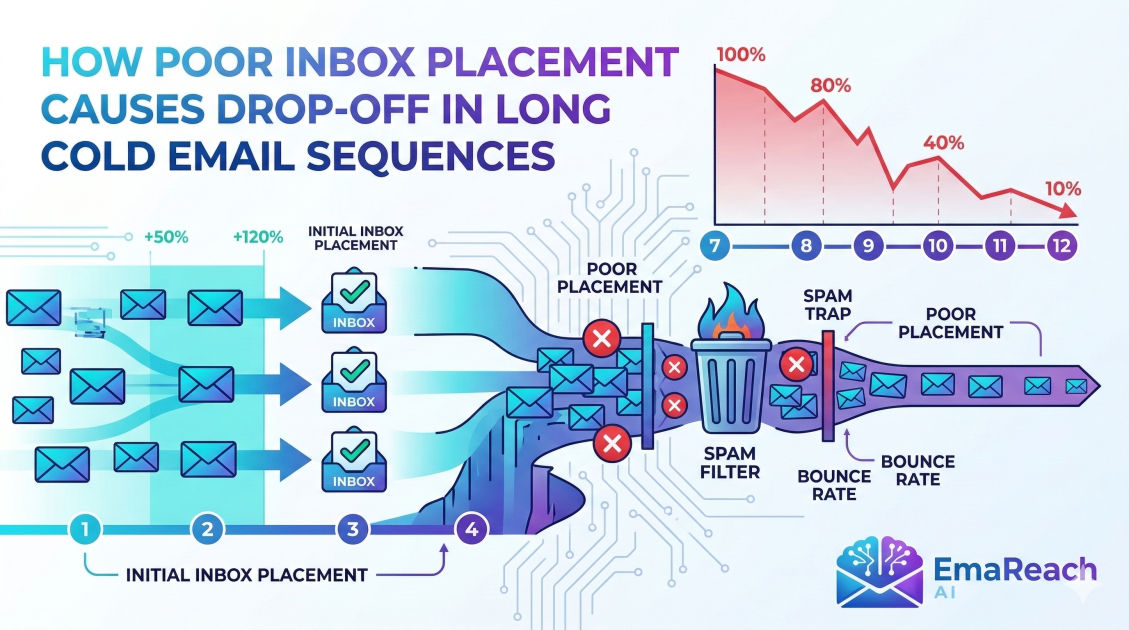
How Poor Inbox Placement Causes Drop-Off in Long Cold Email Sequences
cold emailemail deliverabilityoutreach strategyinbox placementsales automationlead generation
The Hidden Leak in Your Outreach Funnel
In the world of B2B sales, the long cold email sequence is often hailed as the gold standard for lead generation. Logic dictates that the more touchpoints you have, the higher your chances of conversion. However, many sales teams notice a baffling trend: engagement rates don't just taper off—they fall off a cliff after the second or third email. While many blame 'prospect fatigue' or poor copywriting, the culprit is often more technical and more insidious: poor inbox placement.
When your emails fail to land in the primary inbox, your entire multi-touch strategy collapses. This article explores the mechanics of how deliverability decay ruins long sequences and what you can do to ensure your messages actually reach their intended audience.
Understanding the Mechanics of Inbox Placement
Inbox placement refers to where your email ends up once it reaches the recipient's mail server. It isn't a binary 'delivered or not delivered' scenario. Your email can land in several locations:
- The Primary Inbox: The holy grail where users spend 99% of their time.
- The Promotions/Social Tabs: Often ignored or checked only once a week.
- The Spam Folder: Where emails go to die.
- The Black Hole: Where the server rejects the email entirely without notifying the sender or the recipient.
For a long sequence to work, you need consistent primary inbox placement. If Step 1 lands in the inbox but Step 4 lands in Spam, the narrative thread of your sequence is broken, and your ROI plummets.
Why Long Sequences Are Particularly Vulnerable
Long sequences (typically 5 to 9 emails) are designed to build familiarity. However, every additional email sent is a new 'test' by the recipient's Internet Service Provider (ISP). ISPs like Google and Microsoft use sophisticated algorithms to track sender behavior over time.
The Negative Feedback Loop
If a prospect doesn't open your first three emails, the ISP's filters begin to assume that your content is irrelevant. By the time you send email five, the algorithm may have already decided to move your messages to the 'Promotions' tab or the 'Spam' folder. This creates a 'drop-off' that has nothing to do with your offer and everything to do with the algorithm's perception of your value.
Volume and Velocity Triggers
Sending a high volume of emails from a single account in a short period is a major red flag. If you have 500 prospects in a 7-step sequence, you aren't just sending 500 emails; you are sending 3,500 emails over a few weeks. Without proper 'warm-up' and infrastructure, this sudden spike in volume signals 'bot behavior' to ISPs, leading to a steady decline in placement quality as the sequence progresses.
The Psychology of the 'Broken Thread'
Multi-step sequences rely on a concept called 'contextual continuity.' You might reference a previous email or a specific resource shared in an earlier touchpoint.
When inbox placement is poor, the prospect might see Step 3 but never saw Step 1 or 2. To them, your email looks like a random, out-of-context intrusion rather than a persistent follow-up. This lack of context leads to higher 'Report Spam' rates, which further damages your sender reputation and ensures that subsequent emails in the sequence never stand a chance.
Technical Factors That Erase Your Progress
Sender Reputation Decay
Your sender reputation is a score assigned to your domain and IP address. It is fluid. If your sequence starts with a high bounce rate or low engagement, your reputation decays in real-time. A sequence that starts with a 90% inbox placement rate can end with a 10% placement rate if the early stages trigger enough negative signals.
Content Filtering Evolution
Modern spam filters don't just look for words like 'free' or 'buy now.' They use machine learning to analyze the 'fingerprint' of your email. If you use the same tracking links, images, or even the same sentence structures across seven emails to thousands of people, filters identify the pattern. The further a prospect is in your sequence, the more 'data' the ISP has to identify your emails as automated outreach.
How to Bridge the Gap: Ensuring Full-Sequence Delivery
To prevent drop-off, you must treat deliverability as a continuous process, not a one-time setup. This is where specialized infrastructure becomes essential. EmaReach helps solve this by ensuring your cold emails reach the inbox through AI-driven warm-up and multi-account sending. By distributing the load, you prevent the volume spikes that kill long sequences.
1. Implement Inbox Rotation
Instead of sending all 7 steps of a sequence from one email address, distribute the sequence across multiple 'sender' accounts. This keeps the volume per account low and prevents any single account from being flagged for 'excessive' sequencing.
2. Use Plain Text Over HTML
Heavy HTML, multiple images, and tracking pixels are 'weight' that can pull your email down into the Spam folder. Long sequences benefit from a 'human' feel. Plain text emails generally have higher placement rates because they look like a one-to-one message from a colleague rather than a marketing blast.
3. Personalization Beyond the First Name
ISPs look for uniqueness. If 1,000 people receive the exact same 500-word email, it is flagged as a template. By using AI to vary the body of the email for each recipient, you break the pattern-recognition triggers of spam filters.
The Impact of Non-Responders on Your Future Outreach
A major cause of sequence drop-off is the 'non-responder drag.' When you continue to email people who have not opened your previous 4 messages, you are effectively telling the ISP, "I am sending mail to people who don't want it."
This negative engagement is a primary driver of poor inbox placement. To maintain the health of a long sequence, it is often better to have an 'early exit' strategy. If a prospect hasn't engaged by email four, it may be safer to stop the sequence to protect your domain reputation for the prospects who are opening your mail.
Infrastructure: The Foundation of Long-Term Success
You can have the best copy in the world, but it is worthless if it isn't read. Ensuring your technical setup is flawless is the first step in preventing sequence drop-off.
- SPF, DKIM, and DMARC: These are non-negotiable authentication protocols. Without them, your long sequence will likely fail by the second step.
- Custom Tracking Domains: If you use the default tracking domain provided by your email software, you are sharing a reputation with every other user on that platform. A custom tracking domain ensures your 'link reputation' is yours alone.
- Warm-up Pools: Your email accounts should always be part of a 'warm-up' group where they interact with other real accounts. This maintains a healthy ratio of sent-to-received mail, which is a key metric ISPs use to determine inbox placement.
Conclusion
Poor inbox placement is the silent killer of the long cold email sequence. It turns a well-thought-out multi-touch campaign into a series of disconnected, invisible messages. When engagement drops off mid-sequence, look beyond the copy. Check your sender reputation, analyze your volume, and ensure your technical infrastructure is built for the long haul. By focusing on deliverability as much as you focus on sales tactics, you ensure that your message doesn't just get sent—it gets seen.
To truly master the art of the long sequence, you need a system that adapts. EmaReach provides the AI-written outreach and inbox warm-up necessary to ensure that your fifth, sixth, and seventh follow-ups have the same chance of landing in the primary inbox as your first. Stop landing in spam and start reaching the people who matter.
EmaReach AI
Ready to scale your cold email outreach?
Join thousands of teams using EmaReach AI for AI-powered campaigns, domain warmup, and 95%+ deliverability. Start free — no credit card required.
Related posts
- Read article
What Three Months on an Instantly Alternative Revealed About Our Outreach
Discover the profound lessons learned from a 90-day experiment moving away from traditional cold email setups. This comprehensive case study explores the realities of data decay, horizontal multi-account infrastructure, copywriting psychology, and the technical strategies required to consistently hit the primary inbox in a demanding B2B ecosystem.
- Read article
Why Some Teams Return to Instantly After Trying Every Alternative
Discover why modern sales teams and agencies frequently abandon multi-channel alternatives to return to Instantly. This post explores how unlimited inbox rotation, infrastructure stability, and operational efficiency draw outbound professionals back to their core email engine.