Blog
Back to blog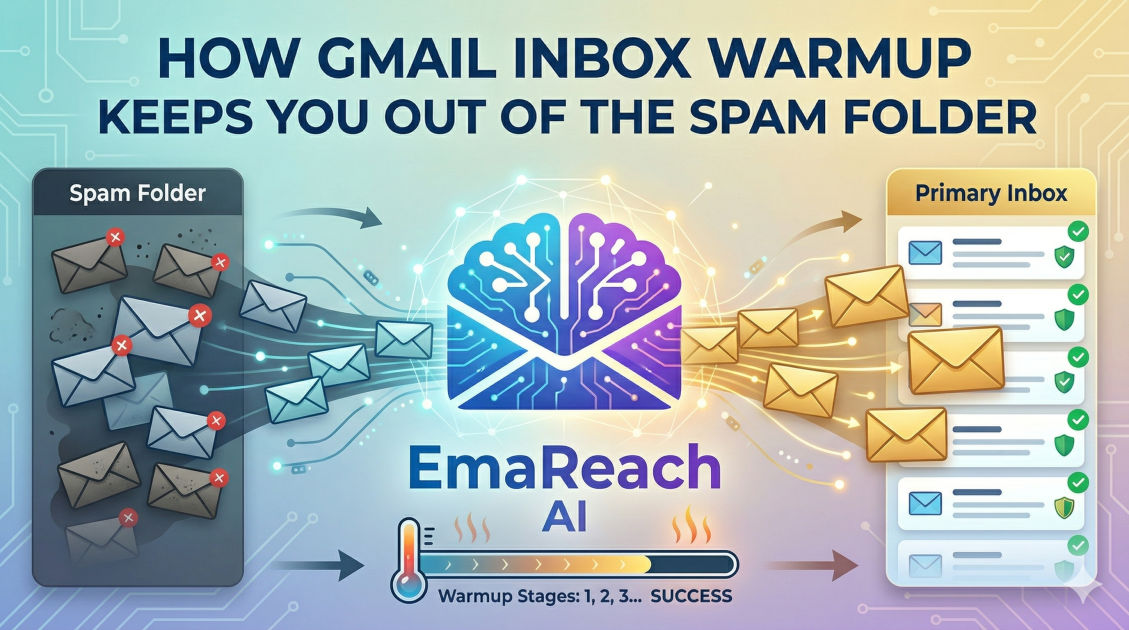
How Gmail Inbox Warmup Keeps You Out of the Spam Folder
email deliverabilityinbox warmupcold emailspam filterssender reputationoutreach strategy
Introduction
For anyone relying on email outreach, the spam folder is the ultimate black hole. You can spend hours crafting the perfect subject line, hyper-personalizing the opening sentence, and building an irresistible offer, but none of it matters if your target audience never sees your message. When your emails are silently routed to the spam or promotions tab, your engagement metrics plummet, and your outreach campaigns fail before they even begin.
One of the most critical, yet frequently overlooked, pillars of email marketing and cold outreach is email deliverability. At the heart of a strong deliverability strategy is a process known as "inbox warmup." Specifically, understanding how dominant internet service providers (ISPs) like Google handle incoming mail is essential.
Gmail's spam filtering algorithms are incredibly sophisticated, relying heavily on artificial intelligence and behavioral tracking to determine whether an incoming email deserves a spot in the primary inbox. If your domain or IP address lacks a proven track record of positive engagement, Gmail will inherently distrust your messages. This comprehensive guide explores exactly how Gmail inbox warmup works, why new domains are inherently suspicious to ISPs, and the specific mechanics you must master to keep your campaigns out of the spam folder permanently.
The Mechanics of Email Deliverability and Sender Reputation
Before diving into the specifics of warming up an inbox, it is crucial to understand the foundation of email deliverability: sender reputation. Sender reputation is essentially a credit score for your email domain and the IP address from which you send messages. Just as a bank uses a credit score to determine whether to approve a loan, mailbox providers like Gmail use your sender reputation to decide whether to accept, reject, or filter your emails.
Your sender reputation is built on several key factors:
- Volume Consistency: Do you send a steady stream of emails, or do you exhibit erratic, massive spikes in volume?
- Bounce Rates: Are you sending emails to valid, existing addresses, or are your emails constantly bouncing back?
- Spam Complaints: How often do recipients actively click the "Report Spam" button on your messages?
- Engagement Rates: Do recipients open your emails, reply to them, forward them, or mark them as important?
- Authentication: Have you properly configured your domain's DNS records (SPF, DKIM, and DMARC) to prove you are who you say you are?
If you start sending thousands of cold emails from a brand-new domain with zero established reputation, Gmail's filters will immediately flag this as anomalous, spam-like behavior. This is where inbox warmup becomes an absolute necessity.
What is Gmail Inbox Warmup?
Gmail inbox warmup is the deliberate, gradual process of establishing a positive sender reputation for a new or inactive email account and domain. It involves slowly increasing the volume of outgoing emails over a period of several weeks while simultaneously ensuring that those emails receive high levels of positive engagement.
The goal of warmup is not just to send emails, but to simulate natural, human email behavior. When an average professional sets up a new email account, they do not immediately blast out five thousand identical messages in a single afternoon. They send a few emails to colleagues, receive replies, subscribe to a few newsletters, and gradually build up their communication volume. Inbox warmup meticulously replicates this organic growth pattern to signal to Gmail's algorithms that you are a legitimate, trustworthy sender.
Why New Email Domains Are Instantly Suspicious
When you register a new domain name for your business or outreach efforts, that domain enters a temporary probationary period often referred to as the "sandbox." Because spammers frequently purchase cheap, disposable domains, blast out millions of malicious emails, and then abandon the domains once they are blacklisted, ISPs treat all newly registered domains with extreme caution.
During this sandbox phase, Gmail scrutinizes every single email you send. If your initial behavior resembles that of a spammer—such as sending high volumes of unsolicited mail with low open rates and zero replies—your domain's reputation will be irreparably damaged within days. Once your domain is flagged and categorized as a spam source, recovering that reputation is an incredibly difficult, time-consuming process. It is far easier to build a pristine reputation from scratch through systematic warmup than it is to dig a domain out of an ISP's blacklist.
How Gmail's Algorithms Evaluate Senders
Google utilizes advanced machine learning models to analyze billions of emails every day. These models look far beyond simple keyword triggers (like "free," "guarantee," or "urgent") and focus heavily on user engagement. To successfully navigate Gmail's filters, you must understand the specific actions that positively and negatively impact your sender score.
Positive Engagement Signals
When a recipient interacts with your email in a positive way, Gmail takes note. The most powerful positive signals include:
- Opening the Email: While open rates are less precise due to recent privacy updates, they still serve as a baseline indicator of interest.
- Replying: A direct reply is one of the strongest indicators that your email was expected and welcomed.
- Rescuing from Spam: If your email lands in the spam folder and the recipient manually clicks "Report not spam" and moves it to the primary inbox, your reputation receives a massive boost.
- Marking as Important: Starring an email or categorizing it as important signals high value to the algorithm.
- Forwarding: Sharing the email with others indicates highly relevant content.
Negative Engagement Signals
Conversely, negative interactions will swiftly destroy your deliverability:
- Reporting as Spam: This is the most damaging action a user can take against your domain.
- Deleting Without Opening: Consistently ignored emails tell Gmail that your messages are low-quality or irrelevant.
- Hard Bounces: Attempting to email addresses that do not exist signals that you have a low-quality, purchased, or scraped email list.
Inbox warmup strategies focus on artificially generating high volumes of these positive signals while completely eliminating the negative ones.
The Technical Prerequisites: Authentication
Before you even begin the warmup process, you must ensure your technical foundation is flawless. Sending emails without proper domain authentication is the fastest way to the spam folder, regardless of your warmup efforts. You must correctly configure three key DNS records:
- SPF (Sender Policy Framework): This record specifies which IP addresses and mail servers are authorized to send email on behalf of your domain. It prevents spammers from spoofing your domain.
- DKIM (DomainKeys Identified Mail): This adds a digital cryptographic signature to your emails, ensuring that the message was not altered in transit between the sender and the recipient.
- DMARC (Domain-based Message Authentication, Reporting, and Conformance): This policy tells receiving servers what to do if an email fails SPF or DKIM checks (e.g., quarantine it or reject it entirely). A strict DMARC policy demonstrates that you take your domain security seriously.
Without these protocols actively in place, Gmail will view your warmup efforts with deep suspicion.
The Anatomy of an Effective Warmup Strategy
A successful inbox warmup campaign is a marathon, not a sprint. The exact timeline can vary depending on your ultimate volume goals, but a standard warmup phase lasts between three to four weeks.
Week 1: Establishing the Baseline
During the first week, volume must be kept extremely low. You might start by sending just 5 to 10 emails per day. The focus here is entirely on perfect engagement. Every email sent should be opened, and a significant percentage should receive a reply. If any messages are filtered to spam, they must be manually retrieved and moved to the primary inbox. This creates the initial layer of trust.
Week 2: Gradual Acceleration
In the second week, the volume can be cautiously increased by a few emails each day, perhaps reaching 20 to 30 emails daily by the end of the week. The ratio of replies should remain high. During this phase, it is crucial to vary the send times throughout the day rather than blasting all emails at once, simulating natural human behavior.
Week 3: Scaling and Consistency
By week three, the sending volume can increase more noticeably, pushing toward 50 to 75 emails per day. At this stage, Gmail's algorithms have accumulated enough data to recognize your domain as a consistent, responsible sender. The engagement metrics must still be closely monitored to ensure the deliverability rate remains near 100%.
Week 4 and Beyond: The Maintenance Phase
Once you reach your target daily sending volume, the initial warmup phase is complete. However, the warmup process never truly ends. Even while running active cold email campaigns, you must maintain a baseline of guaranteed positive engagement to offset any natural spam complaints or ignored emails that occur during real-world outreach.
Manual vs. Automated Inbox Warmup
Historically, email marketers had to perform the warmup process manually. This involved creating dozens of seed accounts across different providers (Gmail, Outlook, Yahoo), sending emails back and forth, logging into each account, replying to messages, and meticulously tracking daily volume on spreadsheets. Manual warmup is highly effective but incredibly tedious, prone to human error, and virtually impossible to scale across multiple domains.
Today, the industry standard relies on automated warmup networks. These peer-to-peer networks consist of thousands of real email accounts interacting with each other algorithmically.
When scaling your outreach, relying solely on manual methods becomes impossible. This is where dedicated platforms step in. For instance, EmaReach combines AI-written cold outreach with inbox warm-up and multi-account sending—so your emails land in the primary tab and get replies. By automating the underlying technical interactions, you can ensure that your domain is constantly generating positive engagement signals (opens, replies, and spam-rescues) in the background while you focus on crafting the actual messaging for your prospects.
Automated tools intelligently manage the daily sending limits, randomize the timing of emails, and utilize complex algorithms to generate conversational replies that look indistinguishable from natural human dialogue to ISP filters.
Best Practices to Maintain Long-Term Deliverability
Warming up your inbox is merely the first step. To ensure your emails stay out of the spam folder over the long haul, you must adhere to strict deliverability best practices:
1. Maintain a Healthy Sender Ratio
Never stop your automated warmup, even when your campaigns are live. A common rule of thumb is to maintain a ratio where warmup emails constitute at least 30% to 40% of your total daily sending volume. This guaranteed positive engagement acts as an insurance policy against the inherently lower engagement rates of cold outreach.
2. Relentlessly Clean Your Email Lists
High bounce rates will instantly flag you as a spammer. Always use a reputable email verification service to validate your lead lists before launching a campaign. Remove catch-all emails and invalid addresses to keep your bounce rate safely below 2%.
3. Avoid Spam-Triggering Content
While engagement is the primary driver of deliverability, content still matters. Avoid excessive use of capitalization, multiple exclamation marks, massive images with little text, and overly sales-driven vocabulary in your subject lines. Keep your HTML clean and simple. Text-based emails or very lightly formatted HTML emails generally perform best for cold outreach.
4. Implement a Gradual Ramp-Up for Campaigns
When transitioning from the warmup phase to active sending, do not immediately jump from 50 warmup emails to 500 cold emails in a single day. Ramp up your active campaign volume just as carefully as you did during the initial warmup. Sudden spikes in volume will trigger Gmail's automated defense systems.
5. Monitor Your Postmaster Tools
Google provides a free service called Google Postmaster Tools. By verifying your domain, you gain access to critical data directly from Gmail regarding your domain reputation, IP reputation, spam rate, and delivery errors. Regularly monitoring these dashboards allows you to spot potential deliverability issues before they become catastrophic.
Conclusion
Securing a spot in the primary inbox is the foundation of any successful email outreach strategy. As email providers like Gmail continue to refine their artificial intelligence and prioritize user experience, the threshold for acceptable sender behavior will only become stricter. Inbox warmup is no longer an optional tactic or a shortcut; it is a mandatory process for anyone looking to maintain a healthy sender reputation. By systematically proving your legitimacy through gradual volume increases, consistent positive engagement, and strict technical authentication, you effectively train spam filters to trust your domain. Committing to a robust, continuous warmup strategy ensures that your carefully crafted messages bypass the spam folder and arrive exactly where they belong—directly in front of your target audience.
EmaReach AI
Ready to scale your cold email outreach?
Join thousands of teams using EmaReach AI for AI-powered campaigns, domain warmup, and 95%+ deliverability. Start free — no credit card required.
Related posts
 Read article
The Smartlead Alternative That Earns Trust Before It Earns Your Business
Discover why the legacy volume-first cold email playbook is broken and how next-generation alternatives prioritize deliverability, AI-driven personalization, and sender reputation to earn your trust and land consistently in the primary inbox.
The Smartlead Alternative That Outperforms on Inbox Placement Consistently
Discover how transitioning to a next-generation cold email infrastructure can dramatically improve your outbound deliverability. Learn how modern AI-driven personalization, humanized multi-account sending, and advanced behavioral warm-up networks outperform legacy platforms like Smartlead to consistently land your messages in the primary inbox.