Blog
Back to blog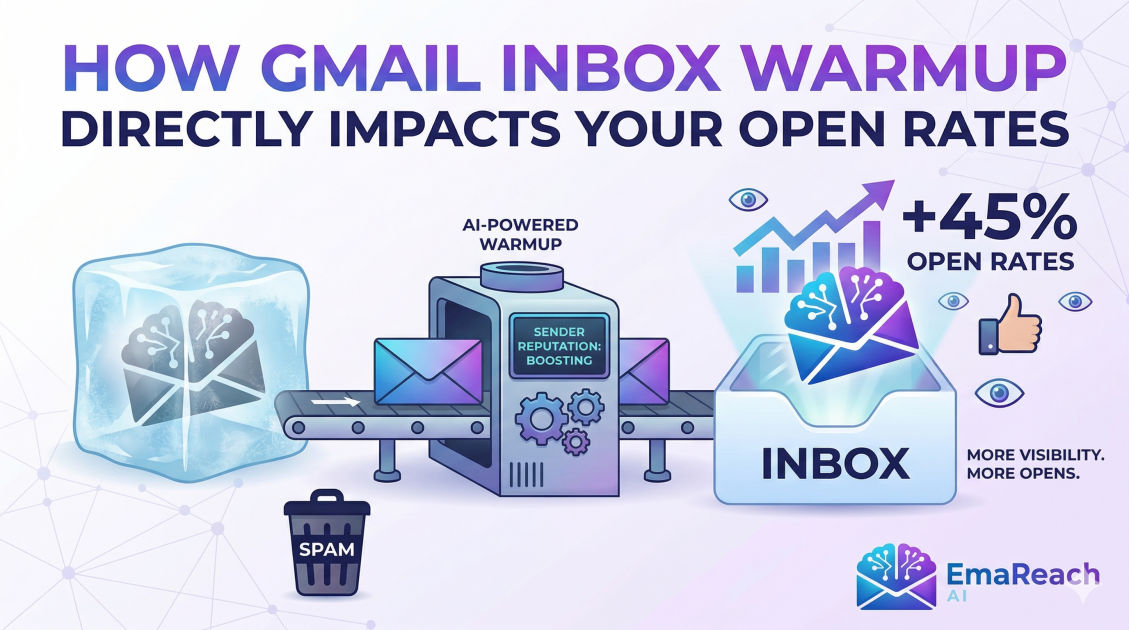
How Gmail Inbox Warmup Directly Impacts Your Open Rates
email deliverabilitygmail warmupopen ratescold emailsender reputationemail marketingoutreach strategy
Introduction
In the world of digital communication, the success of an email marketing campaign is often reduced to a single, pivotal metric: the open rate. While marketers spend hours agonizing over subject lines and CTA placements, a silent force operates behind the scenes, determining whether those emails ever see the light of day. This force is deliverability, and at its core lies the process of inbox warmup.
For those utilizing Gmail—the world’s most popular email provider—the stakes are particularly high. Google employs some of the most sophisticated machine learning algorithms in existence to protect its users from spam. If you launch a high-volume campaign from a new or inactive account without proper preparation, these algorithms will likely flag your activity as suspicious. The result? Your emails land in the dreaded spam folder, your open rates plummet, and your ROI vanishes.
This guide explores the intricate relationship between Gmail inbox warmup and open rates, providing a comprehensive roadmap for ensuring your messages reach the primary inbox.
Understanding the Gmail Ecosystem
To understand why warmup matters, one must first understand how Gmail views incoming mail. Gmail’s primary goal is to provide a clean, relevant experience for its users. To achieve this, it evaluates every sender based on a complex web of signals known as sender reputation.
The Concept of Sender Reputation
Sender reputation is essentially a credit score for your email address and domain. It is built over time based on your sending history. If you have a history of sending emails that people open, reply to, and move to their primary folders, Gmail trusts you. If your emails are consistently ignored, deleted without being opened, or marked as spam, your reputation takes a hit.
The "New Sender" Trap
When you create a new Gmail account or a professional Google Workspace account, you have no reputation. To a spam filter, "no reputation" is almost as risky as a "bad reputation." Spammers often burn through new accounts quickly, sending thousands of emails before the account gets shut down. Consequently, if a new account suddenly spikes in volume, Gmail’s defensive triggers are activated, routing those emails away from the inbox to protect the recipient.
What is Inbox Warmup?
Inbox warmup is the process of gradually increasing the volume of emails sent from a specific account to build a positive sender reputation. It mimics the behavior of a real human being. A real person doesn't create an account and immediately send 500 emails in an hour; they send a few, receive a few, and engage in back-and-forth conversations.
The Mechanics of Warmup
During a warmup period, you start by sending a handful of emails per day to "safe" recipients—usually accounts you own or those of colleagues who will definitely open them. Gradually, you increase this number over several weeks.
However, sending is only half the battle. True warmup involves engagement. When recipients open your emails, mark them as important, or reply to them, it sends a powerful signal to Gmail that your content is valuable. Modern warmup strategies often involve automated networks where accounts interact with each other to simulate this high-value engagement.
For those looking to automate this complex process, EmaReach offers a sophisticated solution. EmaReach AI combines AI-written cold outreach with automated inbox warm-up and multi-account sending, ensuring your emails land in the primary tab and get the replies they deserve.
The Direct Link Between Warmup and Open Rates
It is a simple mathematical reality: an email that is not delivered to the inbox cannot be opened. The relationship between warmup and open rates is mediated by Inbox Placement.
1. Avoiding the Spam Folder
The primary function of warmup is to keep you out of the spam folder. Statistics suggest that less than 3% of users ever check their spam folders, and even fewer open messages found there. By warming up your account, you demonstrate to Gmail that you are a legitimate sender, which significantly increases the percentage of your emails that land in the primary inbox rather than the junk pile.
2. Emerging from the "Promotions" Tab
Gmail’s tabbed interface (Primary, Social, Promotions) is another hurdle. While the Promotions tab is better than the Spam folder, open rates in Promotions are significantly lower than in the Primary tab. A rigorous warmup process that includes high engagement (replies and "not spam" marking) helps convince Gmail’s algorithms that your messages are person-to-person correspondence, often leading to better placement in the Primary tab.
3. Establishing Consistent Volume Patterns
Consistency is a hallmark of legitimacy. Spammers are erratic; legitimate businesses are consistent. Warmup helps you establish a "baseline" of activity. When you eventually launch a larger campaign, the jump in volume isn't as jarring to the filters because you’ve already built a foundation of steady, daily activity.
Factors Gmail Considers During Warmup
Gmail’s filters are multi-faceted. During the warmup phase, they are looking at several key metrics:
- Open Rates of Warmup Emails: High open rates tell Gmail your content is expected.
- Reply Rates: This is the "Gold Standard" of engagement. A reply indicates a two-way conversation, which is the strongest indicator of a non-spam account.
- Marked as Important: When a user clicks the yellow tag to mark an email as important, it boosts your reputation significantly.
- Low Complaint Rates: If even a few people mark your early emails as spam, your warmup efforts can be neutralized instantly.
- Negative Signals: Deleting an email without opening it or moving it to a different folder can act as a negative signal.
Step-by-Step Guide to Manual Gmail Warmup
While automation is preferred for scale, understanding the manual process is vital for comprehending the logic behind the strategy.
Phase 1: The Infancy Stage (Days 1-7)
- Volume: 5-10 emails per day.
- Recipients: Trusted friends, colleagues, or your own secondary accounts.
- Activity: Ensure every single email is opened. Reply to at least 50% of them. Use different subject lines and body text to avoid looking like a template.
Phase 2: The Growth Stage (Days 8-21)
- Volume: Increase by 5-10 emails every few days.
- Recipients: Start including some external contacts who are likely to engage.
- Activity: Continue to prioritize replies. If you are sending 30 emails a day, try to get 10-15 replies back. Ensure you are also receiving emails to this account and responding to them.
Phase 3: The Maintenance Stage (Day 22+)
- Volume: Reach your target daily volume (e.g., 50-100 per day for a standard account).
- Activity: Transition into your actual outreach, but monitor your metrics closely. If open rates start to dip, scale back the volume immediately and increase the ratio of "warmup" style engagement.
The Role of Technical Setup in Warmup Success
No amount of warmup can save a poorly configured domain. Before you even send your first warmup email, you must ensure your technical foundations are rock-solid. These three protocols are the "ID cards" of the email world:
SPF (Sender Policy Framework)
SPF is a DNS record that specifies which mail servers are authorized to send email on behalf of your domain. Without this, Gmail has no way of verifying that the email actually came from you.
DKIM (DomainKeys Identified Mail)
DKIM adds a digital signature to your emails. This allows the receiver to check that an email was indeed authorized by the owner of that domain and that it wasn't altered in transit.
DMARC (Domain-based Message Authentication, Reporting, and Conformance)
DMARC uses SPF and DKIM to give the receiving mail server instructions on what to do if an email fails authentication. Having a DMARC policy in place is a strong signal of a professional, secure sender.
Common Warmup Mistakes That Kill Open Rates
Even with the best intentions, many marketers sabotage their own efforts. Avoid these common pitfalls:
1. Stopping the Warmup Abruptly
Many people treat warmup as a "one and done" task. They warm up for two weeks, hit their target, and then stop the warmup activity entirely while switching to pure cold outreach. This causes a sudden shift in the type of engagement (from high replies to lower engagement), which can trigger spam filters. You should keep a baseline of warmup activity running even during live campaigns.
2. Using "Spammy" Content in Warmup
Even if you are sending to yourself, avoid using words like "Free," "Guarantee," "Cash," or excessive exclamation marks in your warmup emails. You want to train the filter to associate your domain with high-quality, professional language.
3. Scaling Too Fast
Doubling your volume overnight is a surefire way to get flagged. The key to Gmail warmup is a steady, linear, or slightly exponential incline, never a vertical spike.
4. Ignoring the Domain Age
If you are using a brand-new domain (e.g., yourcompany.com), the warmup needs to be even slower. New domains are under much higher scrutiny than an established domain that simply has a new inbox added to it.
How to Measure the Success of Your Warmup
How do you know when you’re "ready" to start your main outreach? Monitor these key indicators:
- Inbox Placement Tests: Use tools to send a test blast to a variety of seed addresses. If 100% of them land in the Primary tab, you are in a good position.
- Steady Open Rates: During the warmup, your open rates should be near 100% (since you are controlling the recipients). Once you start reaching out to prospects, an open rate above 40-50% is a strong sign that your warmup worked.
- Google Postmaster Tools: If you are sending at a high enough volume, Google Postmaster Tools provides data on your domain reputation directly from the source. Watching your reputation move from "Low" or "Medium" to "High" is the ultimate confirmation.
The Psychological Impact of High Open Rates
While this guide focuses on the technical side, the impact of warmup on your business is also psychological. When your emails land in the inbox and your open rates are high, your sales team stays motivated. High open rates provide the data necessary to A/B test subject lines effectively. Without a proper warmup, you might discard a brilliant subject line simply because the email never reached the prospect's eyes.
By investing time in a proper warmup, you are not just checking a technical box; you are ensuring that your creative efforts and strategic planning have the opportunity to yield results.
Conclusion
In the competitive landscape of modern outreach, Gmail inbox warmup is no longer optional—it is the foundation upon which successful campaigns are built. By understanding the nuances of sender reputation, respecting the algorithms of the Google ecosystem, and maintaining a disciplined approach to volume and engagement, you can bypass the spam filters that stifle your competitors.
Remember, the goal of warmup isn't just to trick an algorithm; it's to prove that you are a sender of value. When you prioritize the health of your inbox, your open rates will naturally follow, leading to more conversations, more conversions, and a healthier bottom line. Whether you choose to manage this manually or leverage the AI-driven power of a platform like EmaReach, the result remains the same: your voice is heard in a crowded digital world.
EmaReach AI
Ready to scale your cold email outreach?
Join thousands of teams using EmaReach AI for AI-powered campaigns, domain warmup, and 95%+ deliverability. Start free — no credit card required.
Related posts
 Read article
The Smartlead Alternative That Earns Trust Before It Earns Your Business
Discover why the legacy volume-first cold email playbook is broken and how next-generation alternatives prioritize deliverability, AI-driven personalization, and sender reputation to earn your trust and land consistently in the primary inbox.

What Moving Away From Smartlead Actually Does to Your Pipeline Numbers
Thinking of migrating your cold email infrastructure away from Smartlead? Discover the hidden operational costs, systemic deliverability risks, and long-term impacts on your pipeline revenue before making the switch.