Blog
Back to blog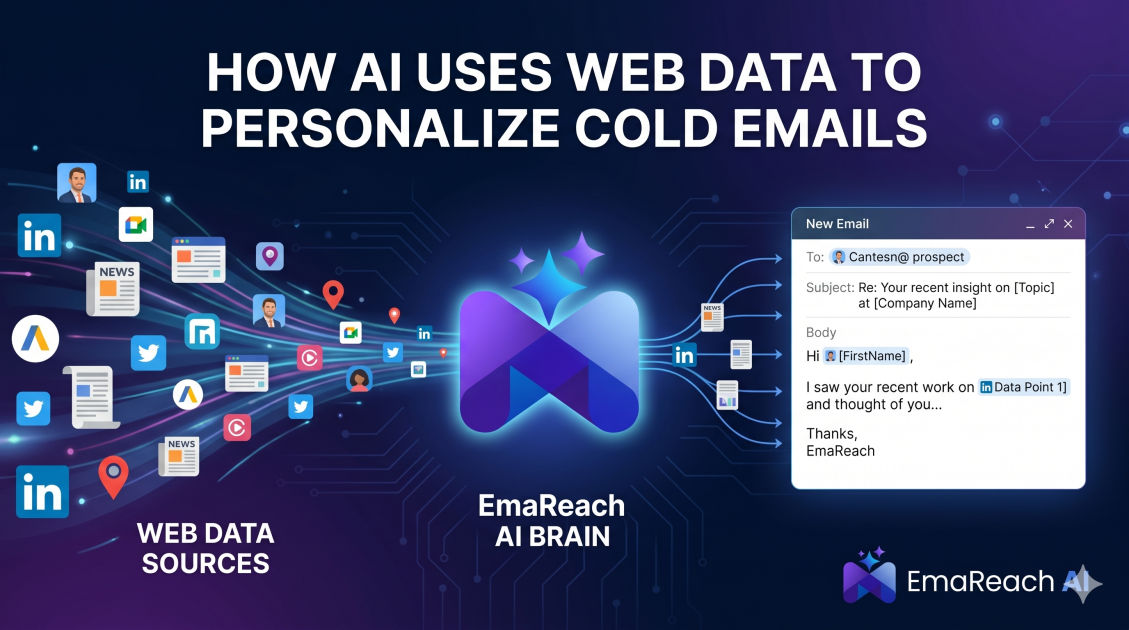
How AI Uses Web Data to Personalize Cold Emails
cold emailoutreachartificial intelligenceemail personalizationsales automationdeliverabilitylead generation
The Evolution of Outreach: From Templates to Intelligence
For decades, cold email was a numbers game. Success was defined by the sheer volume of messages sent, with the hope that a tiny fraction of recipients would find a generic template relevant enough to reply. However, as inboxes became more crowded and spam filters more sophisticated, the effectiveness of mass-produced, static emails plummeted.
Enter Artificial Intelligence. Today, the most successful outreach isn't built on volume, but on relevance. AI has transformed the landscape by enabling a level of personalization that was previously impossible at scale. By leveraging the vast ocean of data available across the open web, AI tools can now understand a prospect’s professional history, current challenges, and even their tone of voice before a single word of an email is written.
Personalization is no longer just about adding a {First_Name} tag. It is about demonstrating that you have done your homework. This article explores the intricate ways AI identifies, parses, and utilizes web data to create cold emails that feel like a 1-on-1 conversation.
The Anatomy of Web Data for Personalization
To understand how AI personalizes outreach, we must first look at the sources of data it taps into. The internet is a public ledger of professional activity, and AI acts as an automated researcher that never sleeps.
Professional Social Networks
Professional platforms like LinkedIn are the primary source of truth for AI personalization. AI models can scrape profiles to identify not just job titles, but specific achievements mentioned in a bio, recent promotions, and even the skills a person has been endorsed for. This allows the AI to craft a hook that references a specific career milestone, making the email immediately stand out as unique.
Company Websites and Press Releases
Beyond the individual, AI looks at the organization. By analyzing a company's 'About Us' page, product descriptions, and recent news sections, AI can determine the company's current trajectory. If a company recently launched a new product or expanded into a new market, the AI can weave this context into the email's value proposition, aligning the sender's solution with the prospect's current goals.
Corporate Financial Reports and Filings
For Enterprise-level outreach, AI can analyze quarterly earnings reports or SEC filings. It looks for 'forward-looking statements' where executives discuss upcoming challenges or investment areas. This deep-level data allows for a hyper-personalized approach where the email addresses a specific strategic objective mentioned by the CEO.
Public Tech Stacks
Many AI tools use 'technographics'—data about the software a company uses. By scanning the web for code snippets or job postings that mention specific technologies, AI can identify gaps in a prospect's current workflow. For instance, if the data shows a company uses a specific CRM but lacks a certain integration, the AI can tailor the cold email to highlight that exact missing piece.
How AI Processes This Data into Narrative
Collecting data is only half the battle. The real magic of modern AI lies in Natural Language Processing (NLP) and Large Language Models (LLM). These systems don't just 'fill in the blanks'; they synthesize information to create a coherent narrative.
Contextual Understanding
When an AI reads a blog post written by a prospect, it doesn't just look for keywords. It analyzes the sentiment, the key arguments made, and the overall perspective of the author. It then generates a summary or a compliment that is contextually accurate. This prevents the 'uncanny valley' effect where a bot tries to sound human but fails to grasp the nuance of the topic.
Intent Recognition
By analyzing signals across the web—such as a prospect asking a specific question on a forum or a company posting a job for a niche role—AI can infer intent. If a company is hiring ten new SDRs, the AI recognizes an 'intent' to scale their sales process. The resulting cold email will focus on scaling solutions rather than generic cost-saving measures.
Tone Matching
One of the more advanced applications of AI in cold email is the ability to mirror the recipient's writing style. If a prospect's public posts are brief and data-driven, the AI will generate a concise, factual email. If the prospect is more expressive and informal, the AI adjusts the prose accordingly. This mirroring creates a subconscious sense of rapport.
Improving Deliverability Through Relevance
One of the biggest hurdles in cold outreach is the spam filter. Modern ESPs (Email Service Providers) use engagement as a primary metric for deliverability. If your emails are consistently opened, read, and replied to, your sender reputation improves.
This is where the intersection of data and deliverability becomes critical. Personalized emails have significantly higher engagement rates than generic ones. By using AI to ensure every email is highly relevant to the recipient, you are essentially 'training' the spam filters to recognize you as a legitimate, high-value sender.
To truly master this balance, you need more than just a writing tool. Stop Landing in Spam. Cold Emails That Reach the Inbox. EmaReach AI combines AI-written cold outreach with inbox warm-up and multi-account sending—so your emails land in the primary tab and get replies. It bridges the gap between sophisticated data analysis and the technical infrastructure required for high-volume success.
The Step-by-Step AI Personalization Workflow
How does this look in practice? Here is the standard workflow an AI-driven system follows to move from a raw URL to a high-converting email:
1. Data Harvesting (Scraping)
The system starts with a list of domains or LinkedIn profiles. It uses web crawlers to gather information from various touchpoints: social media, the company blog, news mentions, and even podcasts where the prospect was a guest.
2. Information Categorization
The AI categorizes the gathered data into 'Icebreakers' (personal facts), 'Pain Points' (challenges identified in the data), and 'Value Hooks' (reasons why the sender's solution is relevant now).
3. Prompt Engineering
The categorized data is fed into a language model with specific instructions. These instructions define the brand voice, the desired length of the email, and the call to action. The prompt might say: "Use the fact that the prospect recently spoke at a Fintech conference to transition into our payment processing solution."
4. Drafting and Iteration
The AI generates multiple versions of the email. In many advanced systems, a secondary 'reviewer' AI checks the draft against a set of quality standards, ensuring there are no factual hallucinations and that the tone is appropriate.
5. Continuous Learning (The Feedback Loop)
As emails are sent, the AI tracks which pieces of data led to the highest reply rates. If referencing a recent 'Job Change' works better than referencing a 'Blog Post' for a specific industry, the AI learns to prioritize that data point in future campaigns.
Overcoming the Challenges of AI Personalization
While AI is powerful, it is not infallible. Using web data for personalization comes with specific challenges that need to be managed carefully.
Data Accuracy and Hallucinations
AI models can sometimes misinterpret data or 'hallucinate' facts. For example, it might confuse a company's founding date with the date a specific article was published. High-quality outreach systems mitigate this by using 'grounded' data—verifying information against multiple sources before including it in a draft.
Maintaining a Human Touch
The goal of AI is to augment human creativity, not replace it. If an email feels too automated or relies on 'creepy' levels of personal data (like mentioning a prospect's personal hobbies that aren't professionally relevant), it can backfire. The best AI personalization focuses on professional relevance rather than purely personal trivia.
Data Privacy and Ethics
In an era of GDPR and CCPA, how data is handled is paramount. AI-driven outreach must rely on publicly available web data and comply with 'legitimate interest' standards. Ethical AI tools ensure that they are scraping only what is necessary and respecting 'robots.txt' files and privacy settings on social platforms.
Strategies for Scaling Personalized Outreach
Scaling 1-on-1 personalization used to be a contradiction in terms. Now, it is a strategic advantage. Here are three ways to scale this process without losing the quality of the 'human' touch:
- Segmented AI Workflows: Don't use the same AI prompt for every industry. Create different 'personalization personas' for CEOs, Managers, and Individual Contributors.
- Trigger-Based Personalization: Set up AI to monitor the web for specific events (e.g., a company gets a new round of funding). When the event is detected, the AI automatically drafts an email and places it in a review queue.
- The 'Human-in-the-Loop' Model: For high-value accounts, use AI to do 90% of the research and drafting, then have a human salesperson spend 2 minutes 'polishing' the email. This combines AI's speed with human intuition.
The Future of AI and Web Data in Email
We are moving toward a 'Predictive Outreach' model. Instead of just reacting to what a prospect has done, AI will use historical web data to predict what a prospect is going to need.
Imagine an AI that sees a company is rapidly hiring engineers while their website's load speeds are simultaneously decreasing. The AI can infer a technical scaling issue before the prospect even acknowledges it. The cold email then arrives not just as a pitch, but as a timely solution to an emerging problem.
Furthermore, multi-channel integration will become the norm. The AI will not just draft an email; it will coordinate a LinkedIn message, a personalized video script, and a follow-up email, all based on the same pool of web-sourced insights. This creates a cohesive narrative across all touchpoints.
Conclusion
AI has fundamentally shifted the balance of power in cold outreach. By turning the vast, unorganized data of the web into actionable insights, it allows businesses to communicate with prospects as individuals rather than entries in a database.
The result is a more efficient sales process, higher conversion rates, and a better experience for the recipient, who no longer has to wade through irrelevant noise. As these technologies continue to evolve, the distinction between a 'cold' email and a 'warm' introduction will continue to blur, making relevance the ultimate currency in digital communication.
EmaReach AI
Ready to scale your cold email outreach?
Join thousands of teams using EmaReach AI for AI-powered campaigns, domain warmup, and 95%+ deliverability. Start free — no credit card required.
Related posts
- Read article
The Instantly Alternative That Finally Gets Outbound Analytics Right
Discover why high-volume cold email requires a shift from surface-level vanity metrics to deep, data-driven revenue attribution, and explore the ultimate alternatives for mastering outbound engineering.
- Read article
What You Gain and What You Give Up When Switching From Instantly
Thinking about migrating your cold email stack? This detailed guide breaks down the exact operational advantages you gain and the core features you sacrifice when switching away from Instantly's popular outreach platform.