Blog
Back to blog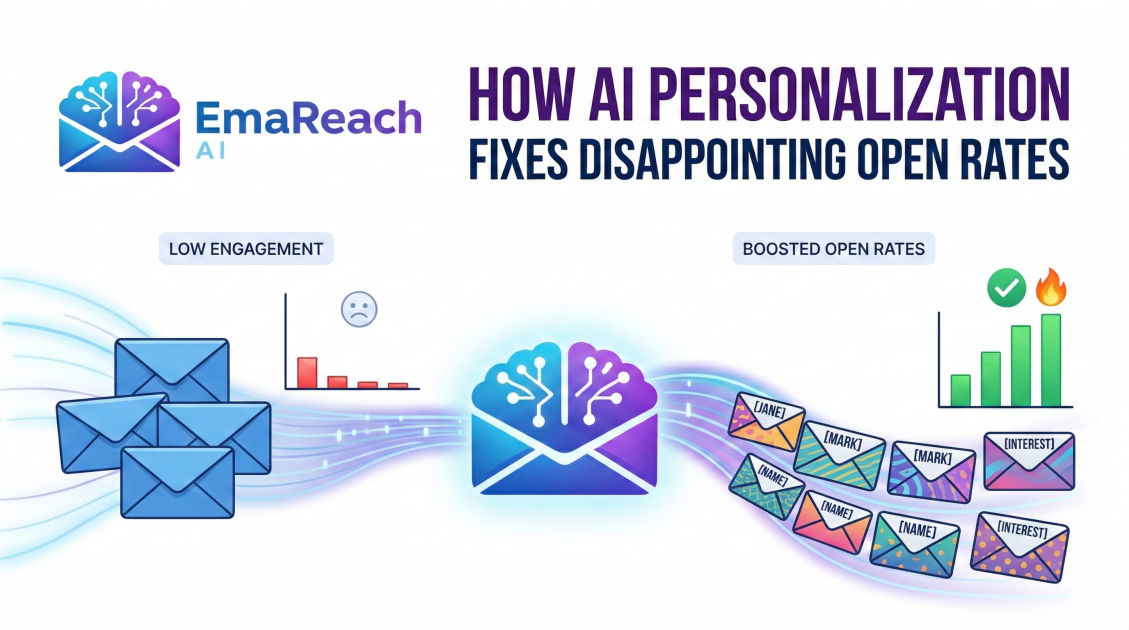
How AI Personalization Fixes Disappointing Open Rates
cold emailoutreachdeliverabilityai personalizationemail marketingmarketing automation
Introduction
Email marketing has long been heralded as one of the most effective channels for direct communication, customer acquisition, and relationship retention. However, a growing sentiment among marketers, founders, and sales professionals paints a slightly different, more frustrating picture: the era of easy attention is over. You spend hours crafting the perfect email, painstakingly outlining your value proposition, and hitting send to your meticulously built list, only to be met with a wall of silence. Disappointing open rates can feel like a direct rejection of your efforts, stalling your pipeline and leaving your conversion goals unmet.
The root of this problem rarely lies in the product or service you are offering. Instead, it stems from the increasingly cluttered environment of the modern inbox. When recipients are bombarded with hundreds of messages daily, their filtering mechanisms—both psychological and algorithmic—become ruthless. To break through this noise, traditional tactics are no longer sufficient. Enter Artificial Intelligence (AI) personalization, a transformative approach that shifts email outreach from a volume-based guessing game to a precise, data-driven science. By understanding and anticipating recipient behavior at an individual level, AI personalization effectively dismantles the barriers to entry, curing disappointing open rates and revitalizing your entire email strategy.
The Crisis of the Cluttered Inbox
To understand how AI fixes the problem, we first need to understand the anatomy of the problem itself. The modern inbox is a battleground for attention. Consumers and decision-makers alike are experiencing unprecedented levels of digital fatigue. The standard response to an unsolicited or mildly irrelevant email is an immediate swipe to the trash bin, or worse, the spam button.
For years, marketers relied on the "batch and blast" method. The logic was simple: send enough emails, and eventually, someone will open one. As response rates dwindled, the industry pivoted to basic personalization—inserting a {{First_Name}} or {{Company_Name}} token into the subject line. While this provided a temporary boost, it quickly became table stakes. Today, users instantly recognize automated, surface-level personalization. They know that a computer pulled their name from a spreadsheet, and this realization shatters the illusion of a genuine, one-to-one interaction.
Disappointing open rates are symptoms of irrelevance and poor timing. When an email fails to immediately signal high value to the specific person reading it, at the exact moment they are reading it, it fails to earn the open. This is where human capacity reaches its limit. A marketing team cannot manually write unique subject lines and calculate the optimal delivery time for ten thousand individual subscribers.
Moving Beyond Basic Merge Tags: What is True AI Personalization?
True AI personalization represents a paradigm shift from rules-based automation to predictive, machine-learning-driven engagement. It is not about simply inserting data points into a template; it is about leveraging complex algorithms to understand context, behavior, and preferences.
AI personalization tools analyze massive datasets—encompassing past email interactions, website browsing behavior, purchase history, and even demographic information—to build comprehensive profiles of each recipient. Machine learning models then use these profiles to predict what type of content, what tone of voice, and what specific psychological triggers are most likely to result in an open.
This level of sophisticated personalization tackles the open rate problem from multiple angles simultaneously. It ensures that the message is relevant, the timing is impeccable, and the presentation is perfectly aligned with the recipient's subconscious preferences.
The AI-Optimized First Impression: Dynamic Subject Lines
The subject line is the gatekeeper of your email. It carries the immense burden of convincing a distracted recipient to stop scrolling and engage. If your open rates are suffering, the subject line is the first suspect.
AI transforms subject line creation from a subjective brainstorming exercise into an objective, data-backed process. Natural Language Processing (NLP) and Natural Language Generation (NLG) algorithms can generate thousands of subject line variations in seconds. More importantly, these algorithms understand the emotional weight and cognitive impact of different words and sentence structures.
Some recipients are highly responsive to urgency ("Ending soon"). Others prefer curiosity-inducing subject lines ("The secret behind..."). Still, others appreciate direct, value-driven statements ("How to increase your ROI"). AI tracks these individual preferences over time. When a campaign is launched, the AI does not send a single, static subject line to the entire list. Instead, it dynamically inserts the specific subject line variation that has the highest mathematical probability of resonating with each individual recipient.
Furthermore, AI can analyze vast amounts of historical campaign data to identify trends that human marketers might miss. It can pinpoint exactly which words trigger spam filters, which character lengths perform best on mobile versus desktop, and which emojis enhance or detract from open rates based on the industry niche.
Predictive Send Time Optimization (STO): Precision Timing
Even the most compelling, perfectly written subject line will fail if it arrives at the wrong time. If your email lands in an inbox at 2:00 AM, it will be buried under dozens of other promotional emails by the time the recipient wakes up and checks their phone at 7:00 AM.
Predictive Send Time Optimization (STO) is one of the most powerful weapons in the AI personalization arsenal for combatting low open rates. Instead of relying on generic "best practices"—such as sending emails on Tuesday mornings—AI analyzes the specific behavioral patterns of every single person on your list.
The AI algorithm tracks when each user historically opens emails, clicks links, or makes purchases. It then builds a customized delivery schedule. If a particular recipient consistently opens emails during their evening commute at 6:15 PM, the AI will queue their specific email to arrive precisely at 6:14 PM. If another user prefers checking promotional emails during their lunch break at 12:30 PM, their email is held until that exact moment. By ensuring your email arrives right when the recipient is actively engaging with their inbox, STO pushes your message to the top of the pile, dramatically increasing visibility and, consequently, open rates.
Preheader Text: The Critical Second-in-Command
While the subject line gets most of the glory, the preheader text (the short preview snippet visible in most email clients) is the critical second-in-command. It provides the necessary context to seal the deal and earn the open. Often, marketers treat the preheader as an afterthought, allowing email clients to simply pull the first sentence of the email body, which often results in clumsy previews like "View this email in your browser."
AI personalization ensures that the preheader works in perfect harmony with the dynamic subject line. AI algorithms can analyze the body of the email and automatically generate highly optimized preview texts that act as a secondary hook. If the subject line establishes curiosity, the AI-generated preheader can provide a hint of value. If the subject line highlights a problem, the preheader can tease the solution. By optimizing this frequently neglected piece of real estate, AI ensures that the recipient's first impression is flawless and compelling from every angle.
Hyper-Segmentation and Behavioral Clustering
Segmentation is the foundation of relevance, but traditional segmentation is often too broad. Grouping recipients purely by their job title, location, or industry assumes that everyone in that category has the exact same needs and preferences at the exact same time. This assumption leads to generic messaging and, predictably, disappointing open rates.
AI introduces hyper-segmentation through advanced behavioral clustering. Machine learning algorithms process millions of data points to identify subtle, non-obvious patterns in your audience. The AI might discover a micro-segment of users who have browsed a specific product category three times in the last week, heavily prefer mobile over desktop, and are highly responsive to socially conscious messaging.
By identifying these complex clusters automatically, AI allows marketers to deploy highly targeted micro-campaigns. When an email speaks directly to a recipient's recent specific actions and deeply held preferences, the perceived relevance skyrockets. The recipient no longer feels like they are being marketed to; they feel understood. This dramatic increase in relevance is directly reflected in surging open rates.
Winning the Inbox War: AI and Deliverability
There is a silent killer of open rates that has nothing to do with subject lines or send times: the spam folder. If your emails are being filtered out of the primary inbox by the recipient's internet service provider (ISP), your open rate will inevitably plummet to zero. Deliverability is the bedrock upon which all successful email marketing is built.
AI plays a crucial role in maintaining high deliverability scores. Advanced AI systems continuously monitor the health of your email infrastructure. They track bounce rates, spam complaints, and engagement metrics in real-time, adjusting sending volumes and patterns to prevent your domain from being flagged by overzealous spam filters.
For outreach campaigns specifically, ensuring your technical foundation is pristine is non-negotiable. Stop Landing in Spam. Cold Emails That Reach the Inbox. EmaReach AI combines AI-written cold outreach with inbox warm-up and multi-account sending—so your emails land in the primary tab and get replies. Solutions like this utilize intelligent automation to gradually build sender reputation, mimicking human-like sending behavior. By actively maintaining the health of your sender profile and automatically resolving deliverability bottlenecks, AI ensures that your carefully personalized messages actually make it to the destination, giving them the chance to be opened in the first place.
Continuous Optimization: A/B Testing at Scale
In a traditional workflow, A/B testing is a slow and rigid process. Marketers test two variations of a subject line on a small percentage of their list, wait for the results, and then send the winning variation to the remainder. This approach is better than nothing, but it leaves significant money on the table.
AI redefines testing through a process known as multi-armed bandit testing. Instead of testing A versus B sequentially, AI can test dozens of variations simultaneously. As soon as the algorithm detects a statistically significant winner, it automatically begins shifting traffic toward that variation in real-time.
Furthermore, the AI understands that a "winner" might not be the winner for everyone. Variation A might perform best with executives, while Variation B dominates with middle management. AI automatically applies these nuanced learnings on the fly, ensuring that every individual segment receives the iteration most likely to drive an open. Because AI operates in a state of continuous learning, every campaign becomes smarter and more effective than the last, creating an upward trajectory for your baseline open rates.
The Transformation of Outreach Strategy
Implementing AI personalization requires a shift in how marketing and sales teams approach their communication strategies. It moves the focus away from sheer volume and manual guesswork, placing it squarely on data utilization and contextual relevance.
To successfully leverage AI for improving open rates, organizations must focus on data hygiene. AI models are only as effective as the data they are trained on. Consolidating customer data platforms, ensuring CRM systems are up-to-date, and tracking robust behavioral metrics are necessary first steps. Once the data infrastructure is solid, AI can be unleashed to analyze, predict, and optimize.
The ultimate goal is to create an email experience that feels serendipitous to the recipient. When an email arrives addressing a specific pain point they were just researching, at the exact time of day they have the mental bandwidth to read it, with a subject line tailored to their personality, the friction of opening the email disappears entirely.
Conclusion
Disappointing open rates are a loud, clear signal that your current email strategy is misaligned with the realities of the modern inbox. Continuing to rely on broad, unpersonalized "batch and blast" methods will only result in diminishing returns, damaged sender reputations, and missed revenue opportunities. The modern recipient demands relevance, and they enforce that demand with the delete button.
AI personalization is no longer an experimental luxury; it is the definitive solution to this crisis. By harnessing the power of predictive analytics, dynamic content generation, sophisticated send time optimization, and intelligent deliverability management, AI transforms email from a disruptive nuisance into a highly anticipated, valuable interaction. It fundamentally shifts the dynamic of outreach, allowing brands to connect with their audiences on an individualized level at an unprecedented scale. Mastering AI personalization is the crucial step to curing low open rates, escaping the spam folder, and unlocking the true potential of your email marketing and outreach efforts.
EmaReach AI
Ready to scale your cold email outreach?
Join thousands of teams using EmaReach AI for AI-powered campaigns, domain warmup, and 95%+ deliverability. Start free — no credit card required.
Related posts
- Read article
The Instantly Alternative That Finally Gets Outbound Analytics Right
Discover why high-volume cold email requires a shift from surface-level vanity metrics to deep, data-driven revenue attribution, and explore the ultimate alternatives for mastering outbound engineering.
- Read article
How Choosing the Right Instantly Alternative Changed Our Pipeline Numbers
Discover how transitioning from a volume-first cold email setup to an advanced, deliverability-focused infrastructure transformed our B2B pipeline metrics, skyrocketed open rates to over 68%, and tripled our monthly booked demos.