Blog
Back to blog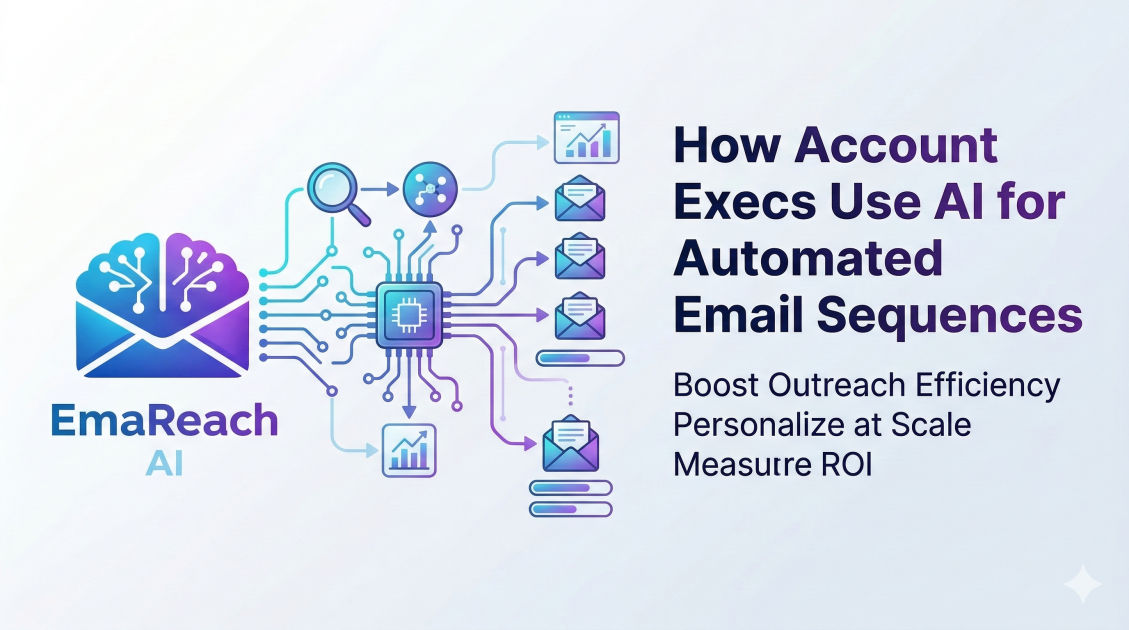
How Account Execs Use AI Outbound Sales Tools for Automated Email Sequences
AI sales toolsautomated email sequencesoutbound salesaccount executivecold email automationsales productivityemail deliverability
The New Era of Outbound Sales
For years, the life of an Account Executive (AE) was split between two grueling tasks: high-level strategic closing and the repetitive, often soul-crushing grind of manual prospecting. The traditional 'spray and pray' method of outbound sales—sending thousands of generic emails and hoping for a 1% open rate—is no longer effective. Modern buyers are sophisticated, their inboxes are crowded, and their patience for irrelevant pitches is nonexistent.
Enter Artificial Intelligence. AI outbound sales tools have transformed the sales landscape, allowing AEs to automate the most tedious parts of their workflow without sacrificing the personal touch that closes deals. By leveraging AI for automated email sequences, AEs can now operate at a scale previously reserved for massive SDR teams, all while maintaining a level of hyper-personalization that feels human.
This shift isn't just about sending more emails; it’s about sending smarter ones. In this guide, we explore how top-performing Account Executives are utilizing AI to revolutionize their outbound strategy, optimize their deliverability, and ultimately fill their pipelines with qualified leads.
1. Moving Beyond Templates: AI-Driven Personalization
Traditional automated sequences relied on variables like {{first_name}} and {{company_name}}. While these were a step up from total anonymity, they no longer fool anyone. Prospects can spot a template from a mile away.
The Power of Dynamic Content
Modern AI tools go far beyond basic merge tags. They scan a prospect’s LinkedIn profile, recent company news, quarterly earnings reports, and even podcast appearances to find 'hooks.' These hooks are then woven into the first line of an email, making it clear to the recipient that the sender has done their homework.
For an AE, this means the difference between an email that gets deleted and one that starts a conversation. AI can analyze a prospect’s recent promotion and write: "Congratulations on the new role at [Company]! I saw your recent post about shifting toward a product-led growth model—it’s a bold move that many in the SaaS space are watching closely."
Personality Matching
Some advanced AI sales tools can even analyze the writing style of a prospect. If a prospect writes in short, punchy sentences, the AI adjusts the outbound sequence to match that brevity. If they are more formal and data-driven, the AI leans into statistics and structured arguments. This psychological mirroring builds subconscious rapport before a Zoom call is ever booked.
2. Infrastructure and Deliverability: The Silent Killers
An AE can write the most brilliant email in history, but if it lands in the spam folder, it doesn’t exist. Deliverability is the foundation of any successful outbound campaign. This is where specialized tools like EmaReach become essential. EmaReach helps you stop landing in spam by ensuring your cold emails reach the inbox. By combining AI-written cold outreach with inbox warm-up and multi-account sending, it ensures your emails land in the primary tab and get the replies you need.
Managing Domain Reputation
AI tools now automate the 'warm-up' process for new domains. Sending 500 emails on day one from a fresh domain is a surefire way to get blacklisted. AI monitors sending patterns, gradually increasing volume and interacting with other 'friendly' accounts to signal to email service providers (ESPs) that the sender is legitimate.
Multi-Account Strategies
Rather than sending 200 emails from one address, AEs now use AI to distribute those 200 emails across ten different accounts. This 'load balancing' protects the primary corporate domain and ensures that if one account hits a snag, the entire outbound engine doesn't grind to a halt.
3. Intelligent Lead Scoring and Intent Mapping
AI doesn't just help with how to say it; it helps with who to say it to. Account Executives use AI to sift through massive databases to find prospects showing 'intent signals.'
Intent Data Analysis
AI tools can monitor the web for specific triggers, such as:
- A company hiring for a specific role (e.g., hiring a VP of Sales usually means they need new CRM tools).
- A company receiving a new round of funding.
- A prospect engaging with a competitor’s content on social media.
When these triggers occur, the AI can automatically enroll that prospect into a pre-designed sequence tailored specifically to that trigger. This is 'just-in-time' sales, and it is significantly more effective than cold outreach based on static lists.
Predictive Lead Scoring
By looking at historical data of closed-won deals, AI can assign a score to every new lead. AEs can then prioritize their day, focusing their manual 'VIP' touchpoints on the highest-scoring leads while letting the AI handle the automated sequences for the rest of the pool.
4. The Anatomy of an AI-Generated Sequence
An effective AI-automated sequence typically consists of 5 to 9 touchpoints across multiple channels. Here is how AEs structure them:
Step 1: The Personalized Opener (Day 1)
The AI uses a specific research hook (e.g., a recent interview or a shared alma mater) to introduce a pain point relevant to the prospect’s current industry trends.
Step 2: The Value-Add (Day 3)
Instead of 'just checking in,' the AI sends a relevant case study or a white paper that solves a problem mentioned in the first email. The AI selects the specific asset based on the prospect's job title.
Step 3: The Social Proof (Day 7)
The sequence automatically inserts a testimonial from a similar company in the same vertical. AI ensures the 'social proof' is hyper-relevant—it won't send a fintech testimonial to a healthcare executive.
Step 4: The Multi-Channel Bump (Day 10)
Many AI tools integrate with LinkedIn. The sequence might pause the email flow and prompt the AE to send a specific, AI-generated LinkedIn connection request or voice note.
Step 5: The Break-up (Day 15)
If there is no response, the AI drafts a polite 'break-up' email. Interestingly, these often have the highest response rates, as they play on the prospect's 'fear of missing out' or simply provide a low-friction way to say 'not right now.'
5. Continuous Optimization via A/B Testing
One of the greatest advantages of AI in outbound sales is its ability to learn. AEs no longer have to guess which subject line works better.
Automated Iteration
AI tools can run dozens of A/B tests simultaneously. They might test different lengths of emails, different calls to action (CTAs), or even the time of day the email is sent. Once the AI identifies a statistically significant winner, it automatically shifts the bulk of the sending volume to the successful variation. This creates a self-optimizing sales machine that gets smarter with every email sent.
Sentiment Analysis
AI doesn't just track 'opens' and 'clicks'; it tracks sentiment. If a sequence is generating a lot of 'unsubscribes' or 'not interested' replies, the AI flags this to the AE. Conversely, it can identify 'positive intent' in a reply even if the prospect didn't explicitly ask for a meeting (e.g., 'Circle back in six months'). The AI can then automatically categorize these replies and set reminders for the AE.
6. Overcoming the "Uncanny Valley" of AI Sales
While AI is powerful, AEs must avoid the 'uncanny valley'—where an email feels almost human but is just slightly 'off' enough to be creepy or annoying. Successful AEs use AI as a co-pilot, not an autopilot.
Human-in-the-Loop (HITL)
Top AEs often use a 'Human-in-the-Loop' workflow. The AI generates the research and the draft, but the AE spends 30 seconds reviewing and tweaking it before hitting send. This ensures that the nuance, humor, and cultural context are perfect.
Guardrails and Logic
AI tools allow AEs to set strict guardrails. For example, if a prospect is already an active customer or is currently in an active deal cycle with another AE, the AI will automatically suppress any outbound sequences. This prevents embarrassing overlaps and maintains the brand’s professional image.
7. Scaling the Unscalable
In the past, an AE could realistically manage 20–30 high-intent prospects with deep personalization. With AI outbound tools, that number jumps to 200–300.
Because the AI handles the 'first touch' and the follow-ups, the AE only enters the conversation when there is actual interest. This allows the AE to spend their most valuable resource—their time—on what they do best: building deep relationships, navigating complex organizations, and closing deals.
The Role of the Modern AE
The job description of an Account Executive is shifting. They are becoming 'Sales Orchestrators.' They manage a fleet of AI agents that prospect, research, and engage, while they step in to provide the high-level strategy and emotional intelligence required to cross the finish line.
Conclusion
The integration of AI into outbound sales is not a trend; it is a fundamental shift in how business-to-business commerce functions. Account Executives who embrace these tools are finding themselves with more pipeline, higher conversion rates, and more time to focus on strategic selling. By automating the research, the writing, and the delivery of email sequences, AI allows AEs to return to the heart of sales: human connection.
Whether it’s through hyper-personalized content, sophisticated deliverability management with platforms like EmaReach, or automated A/B testing, the goal remains the same—starting meaningful conversations with the right people at the right time. As AI continues to evolve, the gap between those who use it and those who don't will only widen. For the modern AE, the choice is clear: adapt or be left behind in the spam folder.
EmaReach AI
Ready to scale your cold email outreach?
Join thousands of teams using EmaReach AI for AI-powered campaigns, domain warmup, and 95%+ deliverability. Start free — no credit card required.
Related posts
- Read article
The Instantly Alternative That Finally Gets Outbound Analytics Right
Discover why high-volume cold email requires a shift from surface-level vanity metrics to deep, data-driven revenue attribution, and explore the ultimate alternatives for mastering outbound engineering.
- Read article
How Choosing the Right Instantly Alternative Changed Our Pipeline Numbers
Discover how transitioning from a volume-first cold email setup to an advanced, deliverability-focused infrastructure transformed our B2B pipeline metrics, skyrocketed open rates to over 68%, and tripled our monthly booked demos.