Blog
Back to blog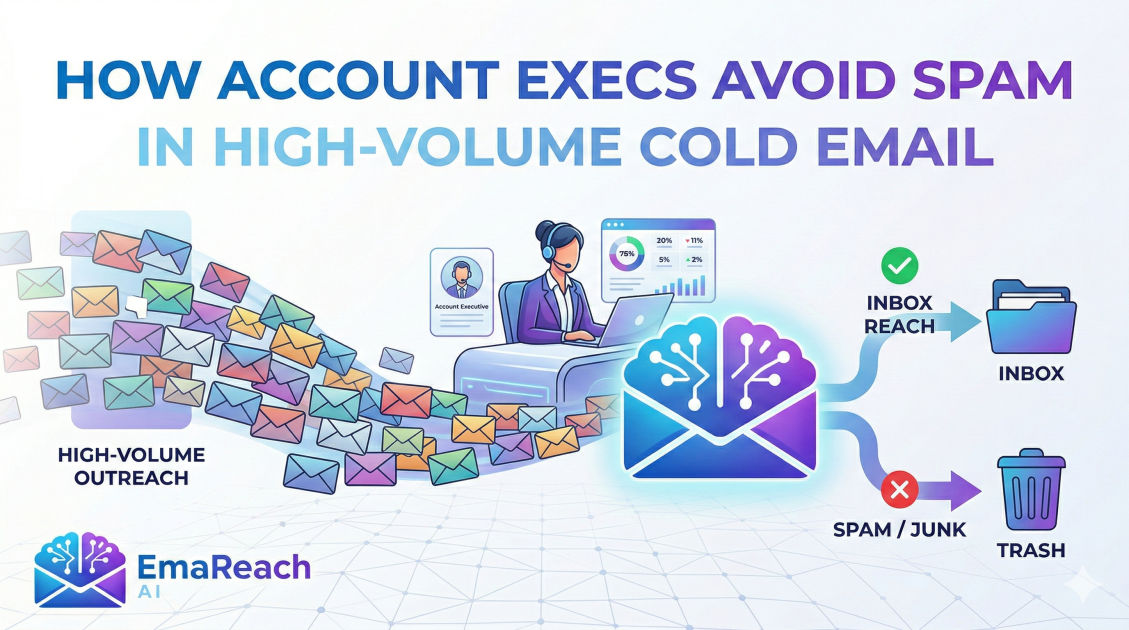
How Account Execs Avoid Spam in High-Volume Cold Email
cold emailemail deliverabilitysales outreachspam filtersaccount executiveemail marketinglead generation
Introduction
For an Account Executive (AE), the challenge of outbound sales is often a numbers game balanced against surgical precision. In a high-volume cold email environment, the objective is to reach as many qualified prospects as possible without sacrificing the integrity of the sender's reputation. However, the modern email landscape is governed by increasingly sophisticated spam filters and sender requirements. One wrong move—sending too many emails from a fresh domain or using 'spammy' trigger words—can result in an entire campaign being ghosted by major providers.
Avoiding the spam folder isn't just about luck; it is a technical and strategic discipline. High-performing AEs understand that deliverability is the foundation of their quota. If the email doesn't land in the primary inbox, the most compelling value proposition in the world won't matter. This guide explores the multifaceted approach required to maintain high-volume outreach while ensuring every message has the best possible chance of being seen.
The Foundation of Technical Deliverability
Before a single email is drafted, the technical infrastructure must be flawless. High-volume sending requires a different setup than occasional 1-to-1 networking. AEs who consistently hit their targets without hitting spam filters start with the basics of domain health.
SPF, DKIM, and DMARC
These three acronyms represent the 'ID cards' of the email world.
- SPF (Sender Policy Framework): This is a DNS record that specifies which mail servers are authorized to send email on behalf of your domain. Without it, receiving servers might view your high-volume sends as unauthorized spoofing.
- DKIM (DomainKeys Identified Mail): This adds a digital signature to your emails, proving that the content wasn't intercepted or changed during transit.
- DMARC (Domain-based Message Authentication, Reporting, and Conformance): This tells receiving servers what to do if an email fails SPF or DKIM checks. Having a 'reject' or 'quarantine' policy in place signals to providers like Google and Outlook that you take security seriously.
The Use of Secondary Domains
Experienced AEs never send high-volume cold outreach from their primary corporate domain. If a primary domain (e.g., company.com) gets blacklisted, the entire company loses the ability to communicate with clients, partners, and internal staff. Instead, they set up 'look-alike' domains (e.g., getcompany.com or companyapp.com). This isolates the risk. If a secondary domain’s reputation suffers, it can be rotated out without paralyzing the organization’s core operations.
The Art of the Inbox Warm-Up
A common mistake in high-volume outreach is 'blasting' from a brand-new domain. To an ISP (Internet Service Provider), seeing a domain go from zero emails to 500 a day looks like a compromised account or a spammer.
Gradual Volume Ramping
Warm-up is the process of gradually increasing email volume to establish a sender reputation. It starts with a few emails a day and scales up over several weeks. During this time, it is vital to get engagement. When recipients open, reply to, and move emails out of the 'Promotions' tab, it signals to algorithms that the sender is legitimate. To streamline this, many AEs use specialized services. For instance, EmaReach helps users stop landing in spam by providing cold emails that reach the inbox through a combination of AI-written outreach, automated inbox warm-up, and multi-account sending.
Engagement Ratios
High-volume sending is only sustainable if the engagement ratio is healthy. If you send 1,000 emails and zero people reply, your reputation will tank. Strategic AEs focus on 'positive signals' like high open rates and consistent reply rates to keep their domains 'warm' indefinitely.
Data Hygiene: The Secret to Low Bounce Rates
Nothing triggers a spam filter faster than a high bounce rate. A 'hard bounce' occurs when an email is sent to a non-existent address. If more than 2% of your emails bounce, ISPs begin to flag your account as a 'directory harvester'—a classic spammer tactic.
Real-Time Verification
High-volume AEs use verification tools to scrub their lead lists before every campaign. This ensures that every email address is active and capable of receiving mail. They also look for 'catch-all' addresses, which are riskier to send to because they don't provide a definitive verification status. By maintaining a clean list, AEs protect their domain reputation and ensure their metrics reflect real human engagement.
Avoiding Spam Traps
Spam traps are 'dead' email addresses used by ISPs to catch irresponsible senders. If you buy a low-quality, unverified list, you are likely hitting these traps. Once you hit a spam trap, your IP or domain is often instantly blacklisted. Rigorous data sourcing and frequent cleaning are the only ways to avoid these hidden landmines.
Crafting Content That Bypasses Filters
Once the technical foundation is set, the content of the email itself becomes the focus. Modern spam filters use Natural Language Processing (NLP) to analyze the intent and 'vibe' of an email.
Eliminating Trigger Words
Words that imply urgency, financial gain, or 'too good to be true' offers are often flagged. Examples include 'Free,' 'Winner,' 'Earn Money,' 'Act Now,' or 'Investment.' While one or two of these might be okay in context, a dense concentration of them will trigger a one-way ticket to the spam folder. AEs must learn to communicate value without sounding like a late-night infomercial.
Personalization at Scale
The 'spray and pray' method is dead. To stay out of spam, emails must look like they were written for a specific individual. High-volume doesn't have to mean generic. By using dynamic tags—not just 'First Name,' but 'Recent Achievement' or 'Specific Industry Pain Point'—AEs can create unique versions of their emails for every recipient. Since every email is slightly different, it prevents the 'pattern matching' filters that look for thousands of identical messages being sent simultaneously.
Formatting and Links
Excessive use of HTML, large images, and too many links can make an email look like a marketing blast rather than a business communication. AEs typically stick to plain-text or light HTML. They avoid using URL shorteners (like bit.ly) because spammers often use them to hide malicious destinations. Instead, they use direct, branded links or, better yet, no links at all in the first touchpoint to maximize deliverability.
Frequency and Timing Strategies
How often you send and when you send matters just as much as what you send.
Avoiding Sudden Spikes
A consistent sending schedule is much better for deliverability than sending 2,000 emails on a Tuesday and zero for the rest of the week. Spread the load. High-volume outreach should be throttled so that emails are sent out over the course of an entire day, mimicking human behavior.
Unsubscribe Management
Making it difficult to unsubscribe is a surefire way to get 'Marked as Spam' by the recipient. A 'Marked as Spam' complaint is significantly more damaging to your reputation than a simple 'Unsubscribe.' Professional AEs make the exit path clear—either through a traditional link or a simple 'Reply STOP to opt-out' message. This keeps the list healthy by removing people who aren't interested before they have a chance to complain to their provider.
Monitoring and Iterating
Deliverability is not a 'set it and forget it' task. It requires constant monitoring.
Tracking Reputation Scores
Tools like Google Postmaster Tools allow AEs to see how Google views their domain. If the 'Domain Reputation' starts dipping from 'High' to 'Medium,' it’s a sign to pause campaigns, investigate the data source, or increase the warm-up intensity.
A/B Testing for Deliverability
Sometimes, a specific subject line might be getting caught in filters more than others. By A/B testing variations, AEs can identify which messaging patterns are making it through and which are getting blocked. If Version A has a 50% open rate and Version B has a 10% open rate, it’s highly likely Version B is landing in spam.
The Multi-Account Approach
To achieve true 'high volume' (thousands of emails per day) without risking any single account, AEs use a distributed sending model. Instead of sending 1,000 emails from one account, they might send 50 emails from 20 different accounts.
This approach, often called 'Inbox Rotation,' ensures that no single mailbox ever hits the daily limits imposed by providers like Microsoft or Google. It also ensures that if one account is flagged, the other 19 continue to generate revenue. This is where modern outreach platforms become indispensable, as they manage the rotation and synchronization of these accounts automatically.
Conclusion
Avoiding the spam folder in high-volume cold email is a balancing act between technical rigor and creative strategy. Account Executives who master this discipline treat their sender reputation as their most valuable asset. By securing their technical DNS records, warming up domains properly, maintaining pristine data hygiene, and personalizing content at scale, they ensure their outreach efforts are actually seen by the people who matter.
In an era where digital noise is at an all-time high, the AEs who succeed are those who respect the rules of the inbox. High-volume outreach doesn't have to be spammy; when done correctly, it is simply a highly efficient way to connect with people who truly need your solution. Protect your domain, verify your data, and always prioritize the recipient's experience—the results will follow in the form of higher open rates, more replies, and a healthier sales pipeline.
EmaReach AI
Ready to scale your cold email outreach?
Join thousands of teams using EmaReach AI for AI-powered campaigns, domain warmup, and 95%+ deliverability. Start free — no credit card required.
Related posts
- Read article
The Instantly Alternative That Finally Gets Outbound Analytics Right
Discover why high-volume cold email requires a shift from surface-level vanity metrics to deep, data-driven revenue attribution, and explore the ultimate alternatives for mastering outbound engineering.
- Read article
How Choosing the Right Instantly Alternative Changed Our Pipeline Numbers
Discover how transitioning from a volume-first cold email setup to an advanced, deliverability-focused infrastructure transformed our B2B pipeline metrics, skyrocketed open rates to over 68%, and tripled our monthly booked demos.