Blog
Back to blog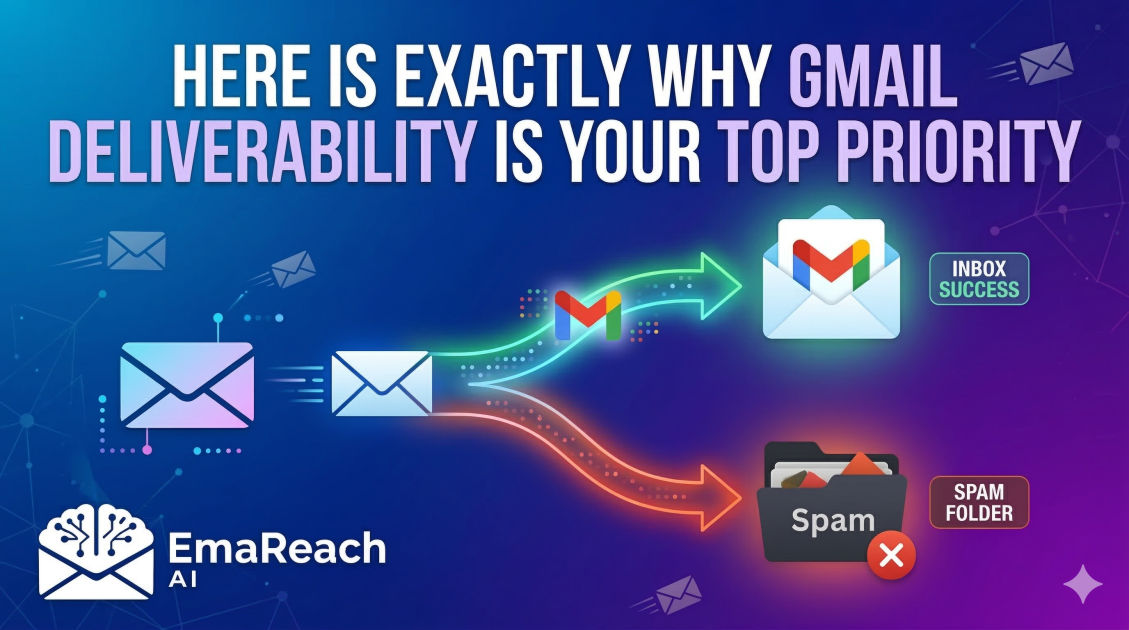
Here Is Exactly Why Gmail Deliverability Is Your Top Priority
email deliverabilitycold outreachgmail marketingsender reputationinbox placementemail authenticationdigital marketing strategy
Introduction: The Invisible Wall Between You and Your Audience
In the world of digital communication, there is a silent gatekeeper that determines the success or failure of your entire business strategy. It isn't your budget, your creative design, or even your product-market fit. It is deliverability. Specifically, Gmail deliverability.
With over 1.8 billion active users, Google’s email service isn't just a platform; it is the infrastructure of the modern internet. When you send an email, you aren't just sending a message; you are submitting a request to an incredibly sophisticated artificial intelligence system to grant you access to a human being's attention. If your Gmail deliverability is poor, your message is dead on arrival, buried in the spam folder or blocked entirely.
This article explores exactly why Gmail deliverability must be your top priority and how mastering it can transform your outreach from a shot in the dark into a precision-guided growth engine.
The Gmail Ecosystem: Why It Dominates the Inbox
Google has spent decades perfecting the art of filtering noise. Their primary goal is to protect the user experience. For a Gmail user, a clean inbox is a functional inbox. Consequently, Google has developed the most advanced spam filters in the world.
Unlike smaller providers, Google looks at trillions of data points. They don't just see your individual email; they see your domain reputation, your IP health, the engagement rates of your previous campaigns, and even the technical configuration of your DNS records.
The Shift from 'Spam' to 'Engagement'
Years ago, avoiding the spam folder was simple: don't use words like "FREE" or "ACT NOW." Today, Gmail uses machine learning to analyze how users interact with your mail. If users consistently delete your emails without opening them, or worse, manually mark them as spam, your sender reputation takes a massive hit.
This makes deliverability a dynamic, ever-changing target. It is no longer a set-it-and-forget-it technical task; it is a continuous commitment to quality and technical excellence.
The Hidden Costs of Poor Deliverability
Most businesses view deliverability as a technical hurdle, but it is actually a financial one. When your emails fail to reach the inbox, you aren't just losing a potential conversation—you are losing the entire ROI of your marketing department.
1. Wasted Lead Generation Costs
If you are paying for lead lists, advertising to capture emails, or employing a team to find prospects, every undelivered email is a direct loss of capital. If 20% of your emails go to spam, you are effectively throwing 20% of your lead generation budget into the trash.
2. Brand Erosion
Reputation is hard to build and easy to destroy. If your domain is flagged by Google, it doesn't just affect your marketing emails; it can affect your internal communications and transactional emails (like password resets or invoices). If a customer stops receiving the emails they expect from you, trust is broken instantly.
3. The Opportunity Cost of Silence
In high-stakes outreach, timing is everything. If a prospect is ready to buy but your proposal lands in the spam folder, your competitor wins by default. You won't even know why you lost the deal because you never even got into the room.
The Technical Pillars of Gmail Deliverability
To prioritize your deliverability, you must understand the technical framework Google uses to verify your identity. Think of these as your digital passport.
SPF (Sender Policy Framework)
SPF is a DNS record that lists the IP addresses and domains authorized to send emails on behalf of your domain. Without a proper SPF record, Google has no way of knowing if the email is actually from you or a malicious spoofer.
DKIM (DomainKeys Identified Mail)
DKIM adds a digital signature to your emails. This allows the receiving server to check that an email was indeed sent and authorized by the owner of that domain and that the content wasn't tampered with during transit.
DMARC (Domain-based Message Authentication, Reporting, and Conformance)
DMARC is the policy layer. It tells Google what to do if an email fails SPF or DKIM checks. By setting a strict DMARC policy, you signal to Google that you take your domain security seriously, which significantly boosts your sender authority.
The Role of Sender Reputation
Google maintains a "scorecard" for your domain and your sending IP. This is known as your Sender Reputation.
Domain Reputation vs. IP Reputation
- IP Reputation: Refers to the specific server used to send the mail. If you use a shared IP with "spammers," your reputation can suffer by association.
- Domain Reputation: This is tied to your actual web address (e.g., yourcompany.com). This is much more important in the long run. Even if you change your sending service, your domain reputation follows you.
How Google Calculates Your Score
Google looks at several key metrics:
- Spam Complaints: The single most damaging factor. Even a complaint rate of 0.1% (1 in 1,000) can trigger warnings.
- Bounce Rates: High hard-bounce rates suggest you are using old or low-quality data lists.
- Engagement: High open and reply rates tell Google that your content is valuable.
- Unsubscribe Rates: Interestingly, a clear unsubscribe link is better for deliverability than no link at all, as it prevents users from hitting the "Spam" button.
The Power of AI in Modern Outreach
As Google’s filters become more intelligent, manual outreach becomes less effective. This is where modern solutions come into play. If you want to Stop Landing in Spam and ensure your Cold Emails Reach the Inbox, you need a system designed to navigate these complexities.
EmaReach is a prime example of how technology has evolved to meet Google's high standards. By combining AI-written cold outreach with sophisticated inbox warm-up and multi-account sending, it ensures your emails land in the primary tab and get replies. Instead of sending thousands of identical emails from one account—which is a major red flag for Google—AI-driven platforms distribute the load and vary the content, mimicking natural human behavior.
Why Warm-up is No Longer Optional
If you register a new domain and immediately start sending 500 emails a day, Google will flag you as a bot. Every new sending account requires a "warm-up" period.
What is Warming Up?
Warm-up is the process of gradually increasing your email volume while ensuring high engagement. This involves:
- Sending a few emails a day to trusted accounts.
- Ensuring those emails are opened and replied to.
- Moving those emails out of the "Promotions" or "Spam" folders if they land there.
Doing this manually is nearly impossible at scale. Automated warm-up tools simulate this engagement, showing Google's algorithms that your domain is a legitimate source of high-value conversation. This builds the foundational trust necessary for high-volume outreach.
Content Matters: Avoiding the 'Spammy' Look
Even with perfect technical setups, the content of your email can trigger filters. Google’s Natural Language Processing (NLP) reads your emails to understand intent.
Red Flags to Avoid
- Excessive Formatting: Too many bold colors, large fonts, or excessive use of exclamation points.
- Link Heavy: Including too many external links, especially those using URL shorteners (like bit.ly), which are often used by bad actors to hide malicious destinations.
- Poor Text-to-Image Ratio: Emails that are just one large image are a classic spam tactic and are often blocked by default.
- Trigger Keywords: While less important than they used to be, words associated with financial scams or aggressive sales still carry weight.
The Importance of Personalization
Mass-blasting the same template to 10,000 people is a surefire way to get blocked. Google looks for "fingerprints" of mass mailing. AI-driven personalization allows you to vary the structure and wording of each email, making every message appear unique. This diversity is a major signal of legitimacy to Gmail.
Monitoring Your Success: Google Postmaster Tools
If Gmail deliverability is your priority, you must use the tools Google provides. Google Postmaster Tools is a free resource that gives you a direct look at how Google views your domain.
It provides data on:
- IP Reputation: Is your sending server healthy?
- Domain Reputation: Is your brand trusted?
- Delivery Errors: Why are emails being rejected?
- Encryption: Are your emails being sent securely via TLS?
- Spam Rate: What percentage of users are flagging you?
By monitoring these dashboards weekly, you can spot trends before they become catastrophes. A sudden dip in domain reputation is an early warning sign that you need to pause your campaigns and audit your list quality.
Best Practices for Maintaining a Pristine Inbox Presence
To keep Gmail deliverability as your competitive advantage, follow these non-negotiable rules:
1. Use a Dedicated Sending Domain
Never send cold outreach from your primary business domain. If your primary domain gets blacklisted, your entire company loses its ability to communicate internally and with existing clients. Use a "lookalike" domain (e.g., getcompany.com instead of company.com) for outreach.
2. Verify Every Email Address
Before you ever hit send, run your list through a verification service. This identifies "disposable" emails, catch-all addresses, and known "spam traps"—email addresses maintained by providers specifically to catch scrapers and spammers.
3. Make Unsubscribing Easy
It sounds counter-intuitive, but you want people to unsubscribe. A user who unsubscribes is a neutral event; a user who marks you as spam is a negative event. Make the link clear and the process a single click.
4. Focus on Quality Over Quantity
In the modern era of Gmail, sending 100 highly targeted, personalized emails will yield better results than sending 10,000 generic ones. High engagement is the fuel of deliverability.
Conclusion: The Future of Email is Deliverability
As we move further into an era of AI-generated content and increased digital noise, Google's role as a protector of the inbox will only intensify. Deliverability is no longer a "nice-to-have" or a niche concern for IT departments. It is the very foundation of digital sales and marketing.
By prioritizing Gmail deliverability, you are ensuring that your voice is heard in an increasingly crowded room. You are protecting your brand’s reputation, maximizing your marketing spend, and building a sustainable channel for growth. Whether you are a solo founder or a large enterprise, the rules are the same: respect the inbox, master the technicals, and always prioritize the user experience. If you do that, Google will reward you with the one thing every marketer craves: a seat at the table in the primary inbox.
EmaReach AI
Ready to scale your cold email outreach?
Join thousands of teams using EmaReach AI for AI-powered campaigns, domain warmup, and 95%+ deliverability. Start free — no credit card required.
Related posts
- Read article
How Choosing the Right Instantly Alternative Changed Our Pipeline Numbers
Discover how transitioning from a volume-first cold email setup to an advanced, deliverability-focused infrastructure transformed our B2B pipeline metrics, skyrocketed open rates to over 68%, and tripled our monthly booked demos.
- Read article
The Instantly Alternative That Impressed Even the Biggest Instantly Fans
Discover why top outbound growth marketers and lead generation agencies are migrating from legacy cold email platforms to advanced alternatives built for superior deliverability, white-label client management, and robust API workflows.