Blog
Back to blog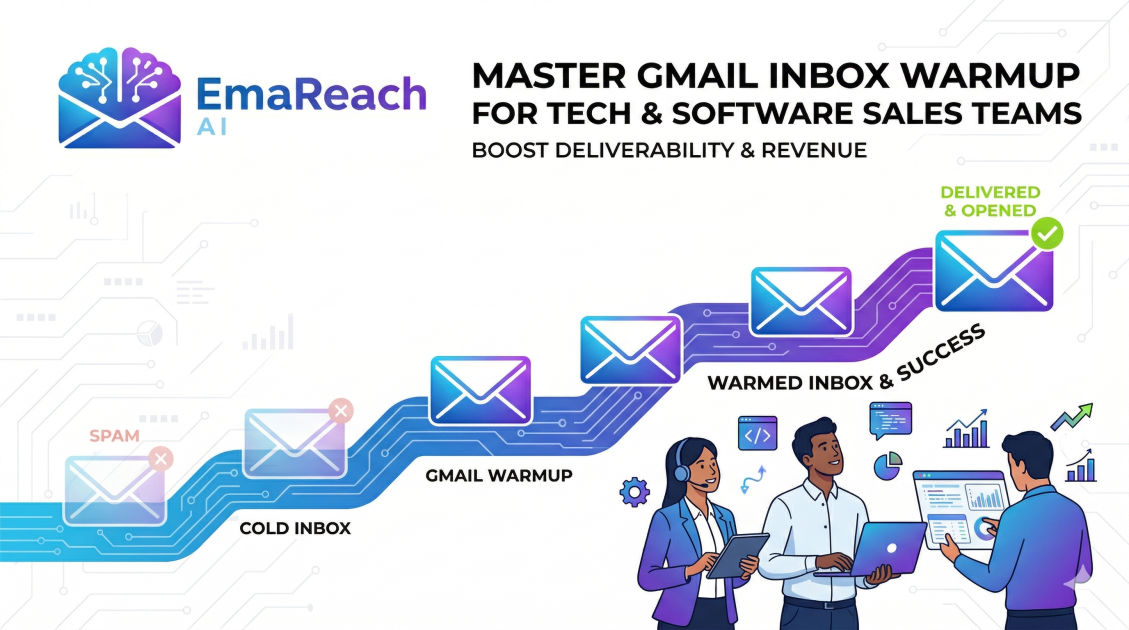
Gmail Inbox Warmup for Tech and Software Sales Teams
email deliverabilitysales outreachSaaS salesGmail warmupinbox reputationtech salescold email
The Critical Intersection of Tech Sales and Deliverability
For tech and software sales teams, the email inbox is the primary battlefield for pipeline generation. Whether you are selling a complex SaaS platform, a niche DevOps tool, or enterprise infrastructure software, your ability to start conversations hinges on one technical reality: deliverability. In an era where Google and other major providers have implemented stringent filtering algorithms, the concept of Gmail inbox warmup has moved from an 'optional hack' to a foundational necessity for any high-performing sales organization.
When a sales representative sends a cold outreach email, they aren't just competing with other vendors for the prospect's attention; they are competing with the sophisticated machine learning models that decide if an email is worthy of the Primary tab or if it belongs in the dreaded Spam folder. For software sales teams specifically, where high-volume outreach is often combined with links to demos, whitepapers, or case studies, the risk of being flagged as a 'spammer' is significantly elevated.
Understanding the Gmail Algorithm for B2B Sales
Gmail’s primary goal is to protect its users from unwanted content. To do this, it evaluates the sender's reputation based on several key metrics: open rates, reply rates, click-through rates, and—most importantly—the ratio of sent emails to received engagements. If a new Gmail account suddenly starts sending 100 emails a day with zero previous history and low engagement, it triggers an immediate red flag.
This is where the warmup process comes in. Inbox warmup is the strategic process of gradually increasing email volume from a new or dormant account to establish a positive sender reputation. It mimics natural human behavior by sending small batches of emails and ensuring those emails receive engagement, such as opens, replies, and being marked as 'important.'
Why Tech Sales Teams Struggle with Deliverability
Software sales teams face unique challenges that often sabotage their deliverability efforts before they even begin:
- High-Velocity Outreach: Tech teams often use automation to scale their prospecting. Rapid-fire sending without a warmup period is a direct path to the spam folder.
- Link-Heavy Content: Sales reps frequently include links to calendars, demo videos, or PDF decks. Filters are naturally more suspicious of emails containing multiple external links.
- Technical Keywords: Certain technical terms or 'salesy' jargon can inadvertently trigger spam filters if the sender's reputation is not already rock-solid.
- New Domain Launches: Many startups launch new 'cold' domains (e.g., @getcompany.com instead of @company.com) to protect their primary business domain. These fresh domains have zero reputation and require meticulous warming.
To combat these hurdles, teams are turning to integrated solutions like EmaReach (https://www.emareach.com/), which helps you stop landing in spam by providing cold emails that reach the inbox. By combining AI-written outreach with automated inbox warmup, it ensures that your software pitch actually lands in the primary tab where it belongs.
The Step-by-Step Blueprint for Gmail Inbox Warmup
1. Technical Foundation: SPF, DKIM, and DMARC
Before you send a single warmup email, your technical house must be in order. These three protocols act as your 'digital passport,' proving to Gmail that you are who you say you are.
- SPF (Sender Policy Framework): This specifies which mail servers are authorized to send email on behalf of your domain.
- DKIM (DomainKeys Identified Mail): This adds a digital signature to your emails, ensuring the content hasn't been tampered with in transit.
- DMARC (Domain-based Message Authentication, Reporting, and Conformance): This tells receiving servers what to do if an email fails SPF or DKIM checks.
Without these, any warmup effort is essentially wasted, as Gmail will view the unauthenticated traffic as a security risk.
2. The Slow Ramp-Up Phase
The golden rule of warmup is patience. You cannot rush the trust-building process with Google’s servers. A typical ramp-up for a software sales rep might look like this:
- Days 1-5: Send 5-10 emails per day to known contacts (colleagues, friends, or internal test accounts). Ensure every single email is opened and replied to.
- Days 6-12: Increase volume to 20-30 emails per day. Diversify the content so the emails don't look like identical templates.
- Days 13-20: Reach 50 emails per day. At this stage, you should start seeing consistent placement in the Primary tab for your test group.
- Day 21+: Gradually scale toward your target daily volume, but never jump more than 20% in volume from one day to the next.
3. Generating Positive Engagement Signals
Gmail doesn't just look at how many emails you send; it looks at what people do with them. To 'warm' an inbox effectively, you need a high engagement-to-send ratio. This includes:
- Replies: This is the strongest signal of a legitimate conversation. In a manual warmup, you should reply to your own test emails from different accounts.
- Marking as Important: Manually clicking the 'star' or 'important' tag on received emails signals to Gmail that the sender provides high-value content.
- Removing from Spam: If any of your warmup emails land in the spam folder, you must manually move them to the 'Inbox' and mark them as 'Not Spam.'
Automation vs. Manual Warmup: What’s Best for Sales Teams?
While manual warmup is effective for a single individual, it is physically impossible to manage for a scaling sales team of 5, 10, or 50 SDRs (Sales Development Representatives). Manual warmup requires logging into dozens of accounts, writing unique replies, and managing spreadsheets.
Automation is the only viable path for tech sales. Modern warmup tools simulate human interactions across a network of thousands of accounts. They automatically send emails, open them, and reply to them, creating a 'shield' of positive reputation around your sales domain. This allows your sales reps to focus on what they do best: closing deals, rather than managing technical deliverability.
Best Practices for Maintaining a Warm Inbox
Warmup isn't a one-time event; it’s a continuous maintenance task. Even an established inbox can lose its reputation if it starts receiving high volumes of 'Mark as Spam' reports or if engagement drops off.
Avoid 'Spammy' Formatting
Avoid excessive use of bolding, all-caps, or multiple colors in your email body. Software sales reps often try to make their value propositions pop with heavy formatting, but this often mimics the style of mass marketing spam. Keep it simple, text-based, and professional.
Clean Your Lead Lists
Sending emails to dead addresses or 'catch-all' accounts results in high bounce rates. A high bounce rate is a signal to Gmail that your data is poor and you are likely 'spraying and praying.' Use a list verification tool before importing any leads into your CRM or sending tool.
Monitor Your Reputation Metrics
Keep a close eye on your 'Sender Score' and tools like Google Postmaster Tools. If you see a dip in your reputation, immediately scale back your daily volume and increase your warmup engagement until the metrics stabilize.
The Role of Multi-Account Sending in Tech Sales
Strategic software sales teams often use a 'horizontal scaling' approach. Instead of sending 200 emails a day from a single account—which is risky—they send 40 emails a day from five different accounts. This distributes the 'load' and minimizes the impact if one account happens to get flagged. However, each of these five accounts must undergo its own independent warmup process to be effective.
Using a platform like EmaReach simplifies this significantly. It combines multi-account sending with automated warmup, ensuring that your decentralized outreach strategy remains robust and that your team remains invisible to spam filters while staying highly visible to your prospects.
Leveraging AI in the Warmup and Outreach Process
The latest frontier in email deliverability is the use of AI to generate unique content for every single email. Gmail’s filters are increasingly adept at spotting identical templates being sent to thousands of people. When every email has the same structure and 90% of the same words, it’s easily categorized as 'bulk mail.'
By using AI to personalize the 'warmup' conversations—and eventually your actual sales outreach—you create a unique footprint for every message sent. This variability is a powerful signal of human-led communication, which significantly boosts your chances of hitting the Primary tab.
Common Pitfalls to Avoid
- The 'Stop-Start' Method: Warming up an inbox for two weeks and then immediately sending 500 emails on day 15 is a recipe for disaster. The transition from warmup to live sales must be seamless and gradual.
- Ignoring the Primary Domain: If you are sending from a subdomain or a separate 'cold' domain, remember that Google can sometimes associate these with your root domain. Always ensure your primary brand domain has a stellar reputation.
- Low-Quality Warmup Networks: Some cheap warmup services use 'bot-like' accounts that Google has already identified as part of a warmup ring. Using these can actually hurt your reputation more than not warming up at all. Ensure you are using a reputable provider with high-quality, aged accounts.
Measuring Success: Key Deliverability KPIs
How do you know if your warmup is working? Tech sales leaders should track the following:
- Inbox Placement Rate (IPR): The percentage of emails that land in the inbox versus the spam or promotions folder.
- Bounce Rate: Should be kept under 2% consistently.
- Spam Complaint Rate: Should be near zero. Anything above 0.1% (1 in 1000) is cause for alarm.
- Reply Rate: For tech sales, a healthy reply rate is often between 5% and 15% depending on the niche. If this drops, it may be a sign of poor deliverability or poor messaging.
Conclusion
In the competitive landscape of software and tech sales, your product's features and your reps' closing skills don't matter if your message never reaches the prospect. Gmail inbox warmup is the 'invisible' part of the sales funnel that supports everything else. By taking the time to build a technical foundation of SPF/DKIM, slowly ramping up your volume, and using sophisticated tools to generate positive engagement signals, you ensure your team has the best possible chance of success. Treat your inbox reputation like a valuable corporate asset—protect it, grow it, and it will continue to deliver pipeline for years to come.
EmaReach AI
Ready to scale your cold email outreach?
Join thousands of teams using EmaReach AI for AI-powered campaigns, domain warmup, and 95%+ deliverability. Start free — no credit card required.
Related posts
 Read article
Why the Most Obvious Smartlead Alternative Is Not Always the Right One
Looking for a Smartlead alternative? Don't just default to the most famous or heavily advertised platform. Discover why the obvious choices often fall short in technical deliverability, pricing models, and AI innovation, and learn how to select the right system for your outbound sales needs.

The Smartlead Alternative That Earns Trust Before It Earns Your Business
Discover why the legacy volume-first cold email playbook is broken and how next-generation alternatives prioritize deliverability, AI-driven personalization, and sender reputation to earn your trust and land consistently in the primary inbox.