Blog
Back to blog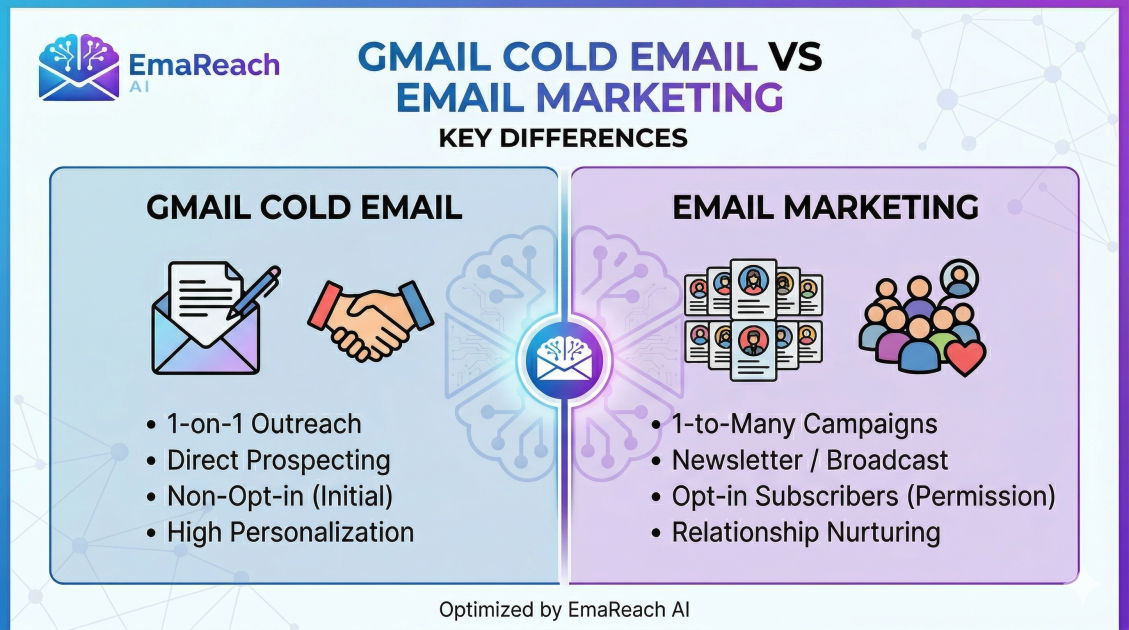
Gmail Cold Email vs Email Marketing: Key Differences
cold emailemail marketingoutreach strategylead generationdeliverabilityb2b salesdigital marketing
Introduction
In the modern digital landscape, email remains the most potent tool for business communication, lead generation, and customer retention. However, there is a common misconception that all business emails are created equal. Professionals often conflate two entirely different strategies: cold email outreach and email marketing. While both rely on the same underlying protocol (SMTP), their objectives, technical requirements, legal frameworks, and execution strategies are worlds apart.
Understanding the nuance between sending a cold email via Gmail and launching an email marketing campaign is critical for any business owner, sales professional, or marketer. Misusing these channels not only leads to poor performance but can result in permanent domain blacklisting or legal repercussions. This guide explores the fundamental differences between these two pillars of digital communication to help you navigate the complexities of modern inbox placement.
Defining the Core Concepts
To understand the differences, we must first define what each practice entails in a professional context.
What is Cold Email?
Cold email is the digital equivalent of a cold call, but significantly less intrusive when done correctly. It involves sending a personalized message to a recipient with whom you have no prior relationship. The goal is typically to start a conversation, book a meeting, or establish a professional connection. Because the recipient has not asked to hear from you, cold emailing requires a high level of research and relevance to avoid being perceived as spam.
What is Email Marketing?
Email marketing involves sending messages to a list of subscribers who have explicitly opted-in to receive communications from you. These recipients are already aware of your brand, having signed up via a website form, a purchase, or a lead magnet. The goal of email marketing is usually to nurture existing leads, promote products, share newsletters, or drive repeat sales through automated sequences and mass broadcasts.
The Technical Infrastructure: One-to-One vs. One-to-Many
The most significant technical difference lies in the volume and the method of delivery.
Gmail and Cold Email Delivery
When using Gmail for cold email, you are operating within a personal or workspace productivity environment. Google’s infrastructure is designed for human-to-human interaction. Cold emails are sent as "one-to-one" messages. Even when using automation tools, each email is sent individually through your actual mail server. This mimics natural human behavior, which is essential for landing in the recipient’s primary inbox.
Email Marketing Service Providers (ESPs)
Email marketing relies on specialized platforms (like Mailchimp or Klaviyo) designed for "one-to-many" communication. These platforms use bulk-sending servers that can blast thousands of emails simultaneously. Because these are recognized as promotional servers, the emails are often automatically filtered into the 'Promotions' or 'Updates' tabs in Gmail and Outlook.
Purpose and Strategic Objectives
Why you are sending the email dictates which method you should choose.
- Cold Email Strategy: The primary objective is outreach and discovery. You are looking for a needle in a haystack—the specific decision-maker who needs your service right now. Success is measured by reply rates and meeting bookings.
- Email Marketing Strategy: The primary objective is retention and conversion. You are speaking to a warm audience. Success is measured by open rates, click-through rates (CTR), and direct revenue generated from the campaign.
Permission and Legal Compliance
Navigating the legalities of email is perhaps the most daunting aspect for newcomers. Both methods must comply with international laws like CAN-SPAM (USA), GDPR (Europe), and CASL (Canada), but they do so in different ways.
The Opt-In Requirement
In email marketing, an explicit opt-in is mandatory. Sending a marketing newsletter to someone who didn't sign up is a direct violation of most anti-spam laws and will get your account banned by your ESP.
In cold emailing, you are generally permitted to contact business individuals without prior consent, provided you have a legitimate interest (under GDPR) and offer a clear way for them to opt-out. The email must be sent to a professional address, relate to their job function, and not be deceptive.
Personalization vs. Segmentation
While both strategies value relevance, they achieve it through different scales of data.
Deep Personalization in Cold Email
A successful cold email often references a specific detail about the recipient—a recent LinkedIn post, a company news event, or a specific pain point unique to their role. This level of detail makes the recipient feel like the email was written exclusively for them, which it should be. Using tools like EmaReach can help bridge this gap; EmaReach AI combines AI-written cold outreach with inbox warm-up and multi-account sending, ensuring your personalized messages actually reach the primary tab and get replies.
Audience Segmentation in Email Marketing
Email marketing uses "tags" or "segments" to group people. For example, you might send one email to "Customers who haven't bought in 30 days" and another to "New subscribers." While you might use a merge tag for their first name, the content of the message is largely the same for everyone in that segment.
The Anatomy of the Message
If you look at a cold email and a marketing email side-by-side, the visual differences are striking.
Cold Email: The Plain Text Powerhouse
Cold emails should look like an email you sent to a friend or a colleague. They are almost always plain text. No heavy images, no flashy buttons, and no complex HTML layouts. Why? Because heavy formatting triggers spam filters and signals to the recipient that they are being marketed to, which immediately raises their defenses.
Email Marketing: The Visual Experience
Marketing emails often use beautiful HTML templates, high-resolution images, brand logos, and clear Call-to-Action (CTA) buttons. They are designed to be visually appealing and on-brand, helping to build brand recognition over time.
Handling Deliverability and the "Spam" Problem
Deliverability is the science of making sure your email actually arrives in the inbox rather than the junk folder.
Warming Up Your Cold Email Domain
Sending 100 cold emails from a brand-new Gmail account will result in an immediate suspension. Cold email requires a "warm-up" period where you gradually increase volume to build a sender reputation. Furthermore, experienced cold emailers often use a secondary domain (e.g., yourcompany.co instead of yourcompany.com) to protect their primary business domain from potential blacklisting.
Managing Sender Reputation in Marketing
In email marketing, your deliverability is often tied to the reputation of the ESP you use. If you send high-quality content that people engage with (open and click), your reputation stays high. If you send to a "dead" list with many bounces, your reputation plummets, and your emails will start landing in spam for everyone.
Cost Structures and Scalability
Scaling Cold Email
Cold email scales horizontally. Since Gmail and Outlook have daily sending limits (usually around 2,000 for Workspace), scaling requires setting up multiple accounts and domains. The cost is usually tied to the number of seats or domains you manage.
Scaling Email Marketing
Email marketing scales vertically. You can send to 100,000 people from a single account. The cost is typically tied to the size of your subscriber list. The larger your list grows, the more you pay the ESP per month.
When to Use Which?
Choosing the right tool for the job is essential for ROI.
Use Cold Email when:
- You are a B2B company looking for new clients.
- You have a high-ticket offer that requires a conversation to sell.
- You want to reach specific high-level executives.
- You are looking for partnerships, press coverage, or guest speaking opportunities.
Use Email Marketing when:
- You have a blog, e-commerce store, or SaaS product.
- You want to nurture leads who downloaded a free resource.
- You want to announce new features or seasonal sales.
- You want to automate your customer journey (e.g., welcome sequences).
Critical Success Factors for Each Channel
To succeed in either, you must master the specific metrics that matter.
Cold Email Success Factors
- List Quality: Your data must be accurate. Sending emails to invalid addresses will destroy your deliverability.
- The Hook: Your subject line and first sentence must be intriguing enough to earn 30 seconds of the recipient's time.
- Low Friction CTA: Don't ask for a 60-minute demo immediately. Ask a simple question or offer a quick 5-minute chat.
Email Marketing Success Factors
- Value Consistency: If you only email when you want to sell something, people will unsubscribe. Provide value, education, or entertainment.
- Automation: Use triggers to send the right message at the right time (e.g., an abandoned cart email).
- Subject Line Testing: Use A/B testing to see which headlines drive the highest engagement from your specific audience.
The Convergence: Can You Do Both?
Most successful businesses use both strategies in tandem. They use cold email to bring people into the ecosystem and email marketing to keep them there. For example, a cold email might lead to a discovery call where the prospect isn't ready to buy yet. With their permission, you then move them to your marketing newsletter to stay top-of-mind until they are ready to pull the trigger.
Conclusion
While Gmail cold email and email marketing both live in the inbox, they serve vastly different purposes. Cold email is your spear—a precision tool for hunting new opportunities through personalized, one-to-one communication. Email marketing is your net—a broad strategy for gathering, nurturing, and maintaining a community of interested prospects and customers.
By respecting the technical boundaries, legal requirements, and etiquette of each channel, you can build a comprehensive email strategy that drives both new growth and long-term loyalty. Whether you are manually crafting a personalized outreach or designing an automated newsletter, the key remains the same: providing genuine value to the person on the other side of the screen.
EmaReach AI
Ready to scale your cold email outreach?
Join thousands of teams using EmaReach AI for AI-powered campaigns, domain warmup, and 95%+ deliverability. Start free — no credit card required.
Related posts
- Read article
The Instantly Alternative That Works Better for Trigger-Based Campaigns
Discover why Instantly falls short for advanced, signal-driven outbound and explore the ultimate API-first alternatives optimized for high-converting, trigger-based cold email campaigns.
- Read article
The Instantly Alternative That Handles High Bounce Rates Without Panic
Discover how transitioning to an advanced Instantly alternative can safeguard your cold email infrastructure. Learn to handle high bounce rates effortlessly using real-time verification, smart mailbox rotation, and automated safety nets to protect your sender reputation and maintain consistent primary inbox placement.