Blog
Back to blog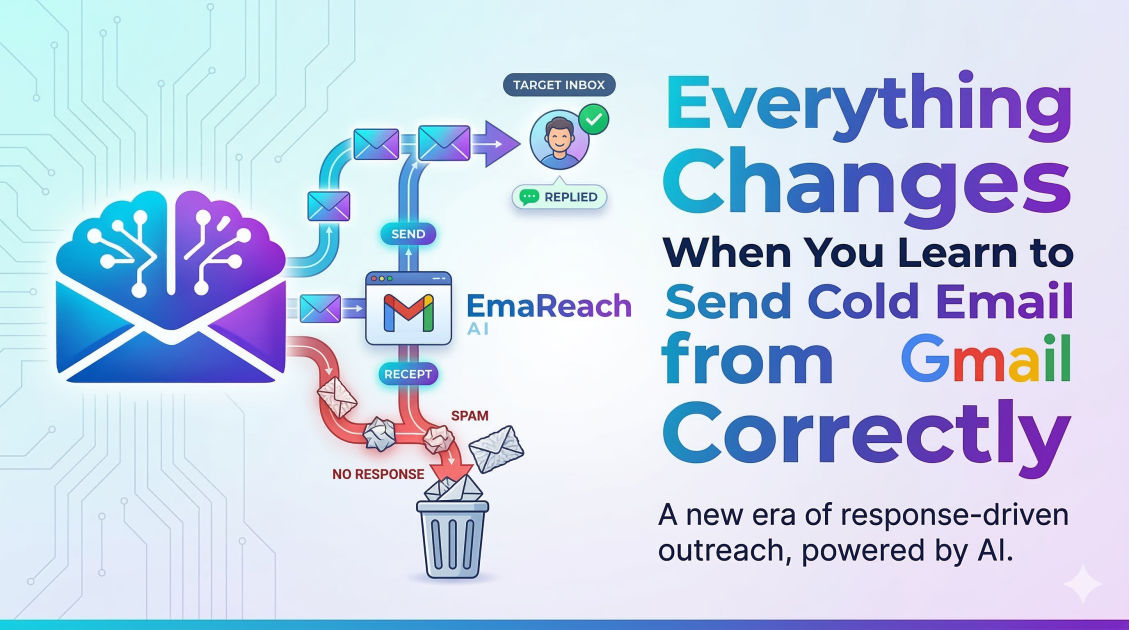
Everything Changes When You Learn to Send Cold Email from Gmail Correctly
cold emailgmail outreachemail deliverabilitysales strategylead generationemail marketingoutreach tips
Introduction
For many entrepreneurs, sales professionals, and agency owners, the term "cold email" evokes a sense of frustration. It is often associated with low open rates, the dreaded spam folder, and a sea of ignored messages. However, there is a fundamental shift that occurs when you stop treating Gmail as a simple personal inbox and start utilizing it as a precision-engineered outreach engine. Everything changes when you learn to send cold email from Gmail correctly.
Mastering Gmail for outreach isn't just about typing a message and hitting send. It is about understanding the delicate balance between technical infrastructure, human psychology, and platform limitations. When done right, Gmail becomes a high-conversion channel that bypasses the noise of social media and the gatekeepers of traditional advertising. This guide explores the deep-level shifts required to turn your Gmail account into a powerhouse for professional growth.
The Psychology of the Inbox
To understand why Gmail is so effective, we must first understand the psychology of the recipient. People live in their inboxes. Unlike social media platforms where content is consumed passively, an email represents a task or a direct communication that requires a decision.
When you send a cold email correctly, you are not interrupting someone's day; you are providing a solution to a problem they might not have voiced yet. The "correct" way to use Gmail involves moving away from the 'blast' mentality. High-volume, generic templates are easily spotted by both Google’s algorithms and human eyes. Transitioning to a personalized, low-volume, high-relevance approach changes the dynamic from a salesperson begging for attention to a professional offering value.
Technical Foundation: Setting Up for Success
Before a single word is written, the technical setup must be flawless. Sending cold emails from a standard @gmail.com address for professional purposes is a common mistake. To do it correctly, you must use a professional Google Workspace account linked to a custom domain. This builds immediate trust and authority.
Authentication Protocols: SPF, DKIM, and DMARC
Google’s primary goal is to protect its users from spam. If your technical records are not configured, your emails will likely land in the spam folder regardless of how good your copy is.
- SPF (Sender Policy Framework): This identifies which mail servers are permitted to send email on behalf of your domain.
- DKIM (DomainKeys Identified Mail): This adds a digital signature to your emails, proving that the email was indeed sent from your domain and hasn't been tampered with.
- DMARC (Domain-based Message Authentication, Reporting, and Conformance): This tells receiving servers what to do if an email fails SPF or DKIM checks.
When these three pillars are in place, your sender reputation scales. You are no longer a 'random' sender; you are a verified entity in the eyes of the global email ecosystem.
The Importance of Warm-Up
One of the biggest mistakes users make is sending 50 emails on day one of a new account. Gmail monitors sending patterns. A sudden spike in activity is a major red flag. Learning to send correctly involves a 'warm-up' period where you gradually increase your volume over several weeks. This mimics natural human behavior and signals to Google that you are a legitimate communicator.
For those looking to automate this complex process and ensure their technical standing remains pristine, using a specialized platform can be a game-changer. EmaReach helps users stop landing in spam by providing cold emails that reach the inbox through a combination of AI-written outreach, automated inbox warm-up, and multi-account sending. This ensures your messages land in the primary tab where they belong.
Crafting the Message: From Noise to Signal
Once the technical pipes are clean, the focus shifts to the content. Sending cold email correctly means abandoning the 'me-centric' approach. Most cold emails fail because they focus on what the sender wants rather than what the recipient needs.
The Subject Line: The Gateway
The subject line has one job: to get the email opened. The most effective subject lines in Gmail are short, informal, and pique curiosity without being 'clickbaity.' For example, "Question about [Company Name]" often performs better than "Our revolutionary services can save you 40%."
The Lead-In: The Personalization Barrier
The first sentence of your email is visible in the Gmail preview pane. If it looks like a marketing blast, it will be deleted before it's even opened. Correct outreach involves a 'compliment or observation' lead-in. Mentioning a recent podcast they appeared on, a specific LinkedIn post, or a company milestone proves that you have done your homework.
The Offer and the Call to Action (CTA)
Your offer should be a 'low-friction' request. Asking for a 30-minute demo in the first email is a high-friction request. Asking a simple question or offering a free piece of value (like an audit or a relevant case study) is low-friction. The goal of the first cold email is not to close a sale; it is to start a conversation.
Managing Deliverability and Reputation
Sending from Gmail correctly is a continuous process of reputation management. Your 'Sender Score' is a fluid metric influenced by several factors:
- Bounce Rates: High bounce rates (sending to dead or invalid emails) destroy your reputation. Always verify your lead list before sending.
- Spam Complaints: If recipients mark your email as spam, your domain health will plummet. This is why relevance is more important than volume.
- Engagement: If people reply to your emails, move them to different folders, or mark them as 'not spam,' your reputation improves. This is why the warm-up process mentioned earlier is so vital.
- Formatting: Avoid excessive use of links, images, or 'salesy' keywords (like 'Free', 'Buy Now', 'Winner') which can trigger automated filters.
The Power of Follow-Ups
Statistics consistently show that the majority of responses come from the third or fourth follow-up, yet most people stop after the first email. Learning to send cold email correctly involves building a sequence.
A successful sequence might look like this:
- Day 1: Initial personalized outreach.
- Day 3: A gentle 'bump' email asking if they saw the previous message.
- Day 7: Providing additional value, such as a relevant industry insight.
- Day 14: The 'break-up' email, acknowledging that now might not be the right time.
Gmail’s interface allows for manual tracking, but as you scale, managing these sequences becomes a logistical challenge. Tools that integrate with Gmail can automate this timing while maintaining the appearance of a 1-to-1 manual email.
Scaling Without Losing the Personal Touch
The ultimate evolution of cold emailing in Gmail is scaling without becoming a spammer. This is achieved through 'Personalization at Scale.' By using variables in your templates (like {First_Name} or {Company_Name}), you can maintain a level of individual focus while reaching a broader audience.
However, true scale comes from using multiple Gmail accounts. Sending 500 emails from one account is risky. Sending 50 emails from 10 different accounts is a much safer and more effective strategy. This distribution of volume protects your primary domain and ensures that even if one account hits a snag, your entire operation doesn't grind to a halt.
Why Gmail Over Other Platforms?
You might wonder why Gmail is the preferred choice for professional cold outreach. The answer lies in the 'IP Reputation.' When you send an email through a generic marketing platform (like those used for newsletters), you are often sending from a shared IP address used by thousands of other companies. If one of those companies sends spam, your deliverability suffers.
When you send through Gmail/Google Workspace, you are using Google’s prestigious mail servers. Recipients' servers (especially other Gmail users) trust Google. This inherent trust is the secret sauce that allows cold emails to bypass the 'Promotions' tab and land directly in the 'Primary' inbox.
Analyzing Metrics for Continuous Improvement
You cannot improve what you do not measure. To send cold email correctly, you must track three key metrics:
- Open Rate: Tells you if your subject line and technical setup are working.
- Reply Rate: Tells you if your offer and copy are resonating with the target audience.
- Positive Reply Rate: The most important metric. It filters out the 'Unsubscribe' or 'No thanks' replies and tells you if you are actually generating business opportunities.
If your open rates are low, look at your technical setup or subject lines. If your reply rates are low, look at your personalization and the value of your offer.
The Compound Effect of Correct Outreach
When you master this process, a compound effect begins to take place. Your sender reputation stays high, meaning more emails land in the inbox. More emails in the inbox lead to more replies. More replies lead to more meetings, and more meetings lead to more revenue.
This shift transforms Gmail from a cost center (something you spend time on) into a profit center (something that generates wealth). It removes the unpredictability of waiting for referrals or spending thousands on unproven ads. You gain control over your growth.
Common Pitfalls to Avoid
Even with the best intentions, certain habits can sabotage your Gmail outreach:
- Sending to Info@ or Support@ addresses: These are generic catch-alls. Aim for specific decision-makers (e.g., [Firstname]@company.com).
- Neglecting Mobile Users: Over 50% of emails are opened on mobile devices. If your email looks like a wall of text on a phone, it won't be read. Keep paragraphs short.
- Lack of a Clear 'Why Now?': Why are you reaching out today? Linking your outreach to a current event, a recent change in their industry, or a specific pain point adds urgency to your message.
- Over-Automation: Using tools to send 1,000 emails an hour will result in an immediate account suspension. Gmail is designed for human-like cadence.
Conclusion
Learning to send cold email from Gmail correctly is one of the most valuable skills a modern professional can acquire. It is the intersection of technical discipline, creative writing, and strategic thinking. By focusing on deliverability, personalization, and consistent follow-up, you move away from the noise and into the primary inbox of your most important prospects.
When the technical foundation is solid, the copy is relevant, and the volume is managed intelligently, the results are inevitable. You no longer have to hope for growth; you can engineer it. The world of cold outreach is not dead—it has simply evolved. And for those who take the time to learn the correct way to navigate this evolution, the opportunities are limitless.
EmaReach AI
Ready to scale your cold email outreach?
Join thousands of teams using EmaReach AI for AI-powered campaigns, domain warmup, and 95%+ deliverability. Start free — no credit card required.
Related posts
- Read article
The Instantly Alternative That Finally Gets Outbound Analytics Right
Discover why high-volume cold email requires a shift from surface-level vanity metrics to deep, data-driven revenue attribution, and explore the ultimate alternatives for mastering outbound engineering.
- Read article
What You Gain and What You Give Up When Switching From Instantly
Thinking about migrating your cold email stack? This detailed guide breaks down the exact operational advantages you gain and the core features you sacrifice when switching away from Instantly's popular outreach platform.