Blog
Back to blog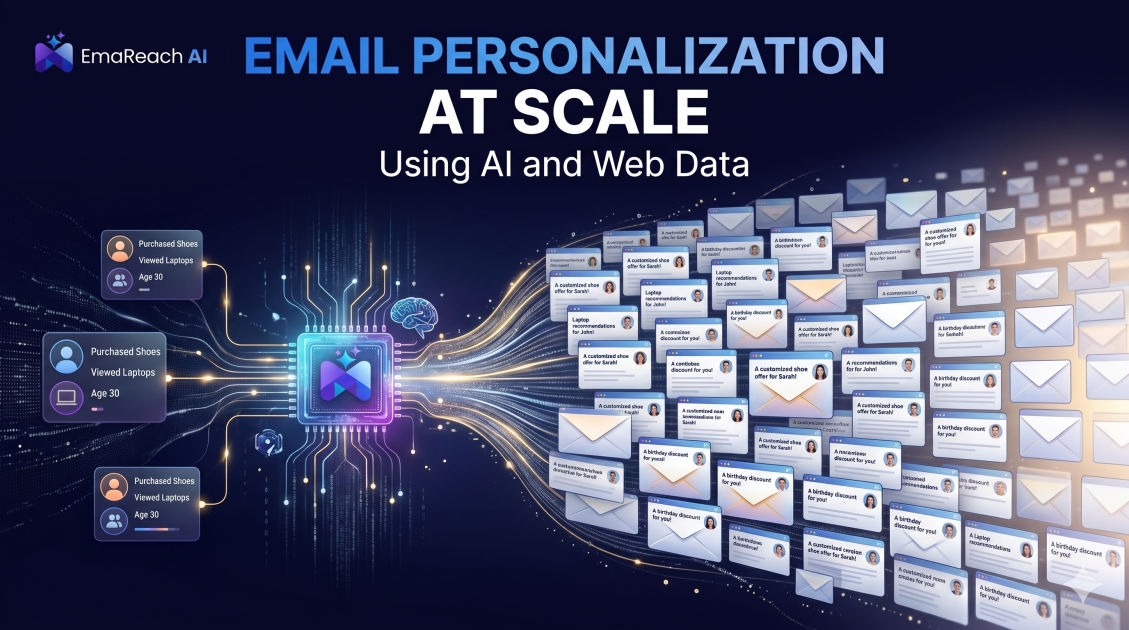
Email Personalization at Scale Using AI and Web Data
email personalizationAI marketingcold outreachweb dataemail deliverabilityB2B salesautomation
Introduction
The digital landscape is more crowded than it has ever been. For businesses relying on email as a primary driver of growth, the challenge is no longer just sending messages—it is ensuring those messages are read, understood, and acted upon. Traditional mass-mailing techniques, often referred to as 'batch and blast,' have lost their efficacy. Modern recipients have developed a keen sense for generic templates, and their response is often a swift click of the 'Delete' or 'Spam' button.
To break through the noise, marketers and sales professionals must embrace personalization. However, a significant paradox emerges: how do you maintain a high degree of personal relevance when communicating with thousands of prospects? The answer lies in the intersection of Artificial Intelligence (AI) and the vast wealth of web data available today. By leveraging these technologies, organizations can move beyond simple name-insertion tags to deep, contextual personalization that feels human and intentional, even at scale.
The Evolution of Email Personalization
Personalization has evolved through several distinct stages. In the early days, personalization meant using a first name in the subject line. While effective at the time, it quickly became the baseline expectation. The next phase involved segmentation—grouping users by industry, job title, or geographic location. This allowed for more relevant content but still lacked the 'one-to-one' feel that drives high conversion rates.
Today, we are in the era of hyper-personalization. This involves using real-time web data and AI to tailor every element of an email—from the opening icebreaker to the specific pain points mentioned and the suggested solution. This level of detail was previously impossible without hours of manual research for every single lead. Now, AI can perform this research in seconds, scraping LinkedIn profiles, company websites, recent news articles, and financial reports to find the perfect 'hook' for an email.
The Role of Web Data in Personalization
Web data is the fuel for AI-driven personalization. Without high-quality data, an AI model is simply a sophisticated text generator. To achieve true scale, businesses must automate the collection and processing of diverse data points.
1. Social Signals
Social media platforms, particularly LinkedIn for B2B outreach, are goldmines for personalization. AI tools can analyze a prospect’s recent posts, comments, or even the 'About' section of their profile. Mentioning a specific insight they shared in a recent post immediately signals that the sender has done their homework.
2. Firmographic and Technographic Data
Web data allows you to understand the company behind the individual. What tech stack are they using? Have they recently secured a round of funding? Are they hiring for specific roles? Understanding these variables allows an AI to craft a message that addresses the company’s current strategic priorities.
3. Intent Data
Web data also includes signals that indicate a prospect is actively looking for a solution. This might involve tracking visits to review sites, participation in relevant webinars, or specific keyword searches. When an email arrives exactly when a prospect is feeling a specific pain point, the likelihood of engagement skyrockets.
Leveraging AI for Content Generation
Once the data is collected, AI models—specifically Large Language Models (LLMs)—take over the heavy lifting of writing. The goal is not to have the AI write the entire email in a vacuum, but to use it as a sophisticated synthesizer of information.
AI Icebreakers
One of the most effective uses of AI at scale is the generation of personalized 'icebreakers.' These are the first one or two sentences of an email that reference a specific piece of web data. Because the AI can process thousands of data points simultaneously, it can generate a unique, human-sounding opening for 10,000 prospects as easily as it can for ten.
Dynamic Value Propositions
Not every prospect cares about the same features of your product. An AI can analyze a prospect’s job description to determine which benefits of your service are most relevant to their daily workflow. For a CFO, the AI might emphasize cost savings and ROI; for a CTO, it might focus on integration ease and security.
Ensuring Deliverability and Human-Centricity
While AI and data provide the power to scale, they must be tempered with strategy and technical precision. Sending thousands of highly personalized emails is useless if they land in the junk folder. This is where the technical infrastructure of your outreach becomes critical.
To maintain high performance, savvy marketers look for solutions that don't just write emails but manage the entire ecosystem of the inbox. Stop Landing in Spam. Cold Emails That Reach the Inbox. EmaReach provides a vital bridge here. EmaReach AI combines AI-written cold outreach with inbox warm-up and multi-account sending—so your emails land in the primary tab and get replies. By spreading volume across multiple accounts and ensuring those accounts are 'warmed up' through simulated human activity, tools like this protect your domain reputation while you scale your personalized efforts.
Building the Tech Stack for Personalization at Scale
Implementing this strategy requires a coordinated tech stack. While the specific tools may vary, the architecture generally follows a four-step process:
Data Extraction (The Scrapers)
Tools or scripts are used to pull data from the web. This includes LinkedIn scrapers, company website parsers, and news aggregators. This data is typically funneled into a central database or a spreadsheet.
Data Enrichment (The Contextualizers)
Raw data often needs cleaning. Enrichment tools verify email addresses and append missing information, such as revenue figures or employee counts, ensuring the AI has a complete picture.
AI Processing (The Brain)
This layer uses API connections to LLMs. The raw and enriched data is passed into a prompt that instructs the AI to 'Write a 1-sentence observation about this prospect's recent career move.' The output is a unique string of text for every row in your database.
Execution and Deliverability (The Delivery)
Finally, the data is pushed to a sending platform. The most effective platforms are those that allow for 'liquid syntax' or dynamic tags, enabling the AI-generated snippets to be seamlessly woven into a pre-designed email sequence.
The Importance of Liquid Syntax
Liquid syntax is a templating language that allows for complex logic within an email. Instead of a simple tag like {{first_name}}, you can use logic like:
{% if prospect_industry == 'SaaS' %} Since you're in the software space, I thought you'd appreciate... {% else %} Given your background in manufacturing... {% endif %}
When combined with AI-generated web data, liquid syntax allows you to create 'master templates' that can morph into thousands of different versions depending on the recipient’s data profile.
Ethical Considerations and Best Practices
With great power comes great responsibility. Scaling personalization requires a high degree of empathy to avoid sounding 'creepy.'
- Relevance Over Flattery: Don't just mention a prospect’s hobby for the sake of it. Connect the web data you found to the reason you are reaching out.
- Accuracy is Paramount: AI can occasionally 'hallucinate' or misinterpret web data. It is vital to have a human-in-the-loop (HITL) process for auditing AI outputs, especially when first launching a campaign.
- Privacy Compliance: Ensure that the data you are scraping and the way you are storing it complies with regulations like GDPR and CCPA. Focus on publicly available professional data rather than private personal information.
Measuring Success in the AI Era
When you move to AI-driven personalization at scale, your metrics will shift. You may find that while your total volume stays the same (or even decreases), your 'Positive Reply Rate' increases significantly.
Key performance indicators (KPIs) to track include:
- Open Rate: A reflection of subject line personalization.
- Reply Rate: The ultimate test of how well your AI-generated content resonated.
- Meeting Booked Rate: The bottom-line impact of your personalization strategy.
- Bounce Rate: A measure of your data hygiene and list quality.
Overcoming Common Hurdles
The transition to AI-powered outreach isn't without its obstacles. One of the biggest challenges is 'Prompt Engineering.' Creating a prompt that consistently generates high-quality, professional, and accurate icebreakers requires constant iteration.
Another hurdle is data decay. Web data changes rapidly—people change jobs, companies get acquired, and websites go down. Building a real-time data pipeline is more effective than relying on static databases purchased months ago.
Future Trends: Beyond the Text
The future of email personalization at scale goes beyond text. We are already seeing the rise of AI-generated personalized video and audio. Imagine a prospect receiving an email with a 30-second video of you (generated by AI) mentioning their specific company goals and showing their actual website in the background. As web data becomes more granular, these multimodal personalizations will become the new standard for high-ticket B2B sales.
Conclusion
Email personalization at scale is no longer a luxury reserved for the world’s largest tech companies. By combining the analytical power of web data with the creative capabilities of AI, any organization can treat every prospect like their only prospect. The key is to start with high-quality data, use AI to bridge the gap between that data and a human conversation, and utilize a robust delivery infrastructure to ensure your message actually arrives. In a world of automated noise, the most 'human' automation wins.
EmaReach AI
Ready to scale your cold email outreach?
Join thousands of teams using EmaReach AI for AI-powered campaigns, domain warmup, and 95%+ deliverability. Start free — no credit card required.
Related posts
- Read article
The Instantly Alternative That Finally Gets Outbound Analytics Right
Discover why high-volume cold email requires a shift from surface-level vanity metrics to deep, data-driven revenue attribution, and explore the ultimate alternatives for mastering outbound engineering.
- Read article
What You Gain and What You Give Up When Switching From Instantly
Thinking about migrating your cold email stack? This detailed guide breaks down the exact operational advantages you gain and the core features you sacrifice when switching away from Instantly's popular outreach platform.