Blog
Back to blog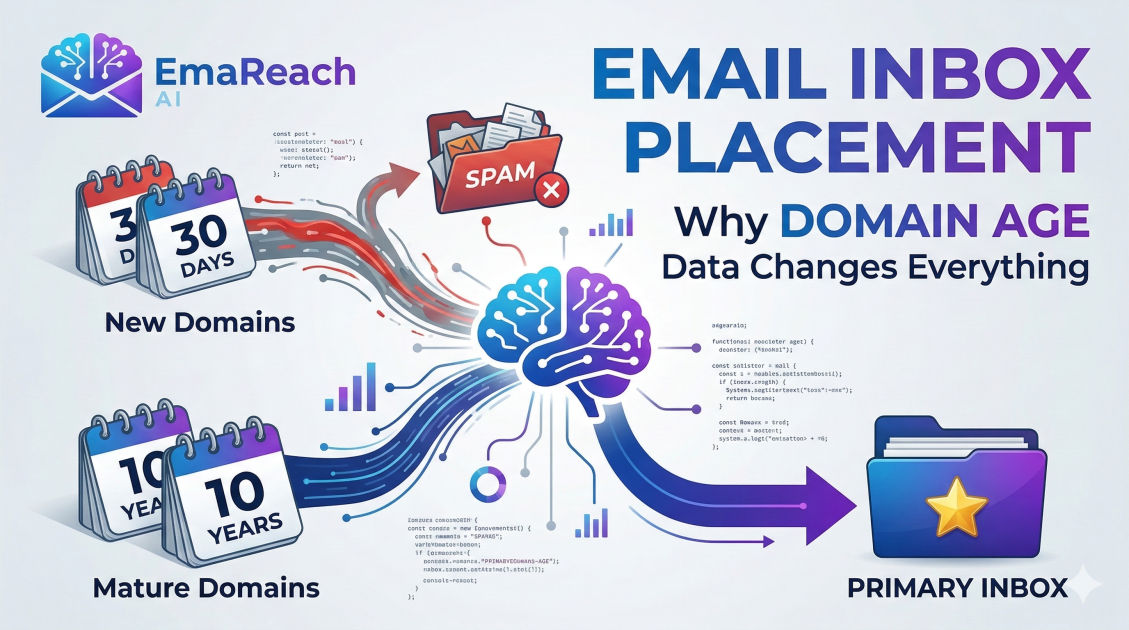
Email Inbox Placement: Why Domain Age Data Changes Everything
email deliverabilitydomain reputationinbox placementcold emailemail marketingSPF/DKIMoutreach strategy
Introduction
In the high-stakes world of digital communication, the distance between a successful conversion and a missed opportunity is often measured by a single metric: inbox placement. For years, marketers and sales professionals have obsessed over subject lines, list hygiene, and SPF/DKIM records. While these remain critical, a silent powerhouse has emerged as a primary gatekeeper for Mail Transfer Agents (MTAs) and Spam Filters: Domain Age Data.
Understanding how the age of a domain influences its reputation is no longer a niche technical detail—it is the foundation of modern deliverability strategy. As internet service providers (ISPs) like Google and Microsoft become more sophisticated, they rely heavily on historical data to distinguish legitimate businesses from ephemeral bad actors. This guide explores why domain age is the 'missing link' in your email strategy and how you can leverage this data to ensure your messages land exactly where they belong.
The Evolution of Email Filtering: From Content to Context
To understand why domain age matters, we must first look at how filtering has evolved. In the early days of the internet, filters were primarily reactive and content-based. They looked for keywords like 'free,' 'guaranteed,' or excessive use of currency symbols. Spammers quickly adapted, leading to the rise of reputation-based filtering.
Today, filtering is predictive. ISPs don't just look at what you are saying; they look at who you are and how long you have existed. A brand-new domain sending thousands of emails is a massive red flag. Why? Because the 'burn and churn' method is the hallmark of malicious actors. By prioritizing domain age, ISPs create a barrier to entry that rewards stability and punishes volatility.
The 'New Domain' Penalty
When a domain is registered, it enters a 'probationary period.' During this time, every email sent is scrutinized with a higher level of skepticism. This isn't just a lack of positive reputation; it is a default 'neutral-to-negative' stance. Without historical data to prove you are a responsible sender, the mailbox provider assumes the worst to protect its users.
Why Domain Age is a Proxy for Trust
Domain age serves as a proxy for business legitimacy. A domain that has been active for five years, with consistent traffic and a clean record, suggests a stable entity. Conversely, a domain registered yesterday lacks the 'digital footprint' necessary to bypass modern security protocols.
1. Historical Stability
Longevity implies a commitment to a brand. Spammers rarely keep a domain for more than a few months because their IP addresses and domains get blacklisted quickly. By maintaining a domain over a long period, you signal to MTAs that you are a long-term player in the ecosystem.
2. Resistance to 'Snowshoeing'
'Snowshoeing' is a technique where spammers spread their volume across many different domains and IP addresses to dilute their spam footprint. Because many of these domains are new, ISPs have tightened the net around young domains. If you are using a fresh domain for cold outreach without understanding the implications of its age, you are likely being caught in filters designed to stop snowshoeing attacks.
The Impact of Domain Age on Deliverability Metrics
Domain age doesn't just affect whether an email is accepted; it influences every part of the delivery funnel.
The Connection to IP Warm-up
Even if you have a dedicated, warmed-up IP address, a 'cold' or new domain can still sabotage your efforts. Modern reputation is tied to the Domain-based Message Authentication, Reporting, and Conformance (DMARC) and the organizational domain itself. If the domain is new, the IP's reputation cannot fully compensate for the domain's lack of history.
Rate Limiting and Throttling
ISPs often apply strict rate limits to new domains. If you attempt to send 5,000 emails on day one from a domain registered a week ago, the majority will be deferred or blocked. Older domains enjoy higher 'burst' allowances because the ISP has a baseline of what 'normal' behavior looks like for that entity.
Strategies for Managing Domain Age and Reputation
Knowing that domain age is critical, how can organizations manage it effectively, especially when launching new products or entering new markets?
1. The Pre-Aging Strategy
Strategic marketers often purchase domains months, or even a year, before they intend to use them for high-volume outreach. This 'seasoning' period allows the domain to exist in the global DNS registry, losing the 'newly registered' tag that many firewalls automatically block.
2. Gradual Volume Scaling
For a domain to be trusted, its activity must look human. This means starting with a handful of emails per day and slowly increasing. This is where manual effort often fails, and technology takes over. For those looking to streamline this, EmaReach provides a vital service. By combining AI-written outreach with automated inbox warm-up, it ensures that your domain age data works for you rather than against you, helping your emails land in the primary tab rather than the spam folder.
3. Monitoring Domain 'Blacklist' Status
Age is a double-edged sword. An old domain with a history of spam reports is worse than a new domain. Regular audits of your domain's health are essential. Use tools to check if your domain appears on blocklists like Spamhaus or Barracuda.
Technical Foundations: SPF, DKIM, and DMARC in the Context of Age
While domain age provides the 'trust,' authentication protocols provide the 'proof.' They work in tandem. An old domain without proper SPF (Sender Policy Framework) or DKIM (DomainKeys Identified Mail) is still a security risk. However, an old domain with a perfect DMARC record is the 'Gold Standard' for inbox placement.
SPF and DKIM: The Basics
- SPF: Specifies which mail servers are authorized to send email on behalf of your domain.
- DKIM: Adds a digital signature to emails, allowing the receiver to verify that the email was indeed authorized by the owner of that domain.
When an ISP sees an email from a 5-year-old domain with valid DKIM signatures, the probability of that email being spam drops significantly. The age validates the signature's reliability.
The Risks of Buying 'Expired' Domains
One common 'hack' in the industry is purchasing expired domains to bypass the age penalty. While this can work, it is fraught with danger. If the previous owner used the domain for predatory lending, adult content, or mass spamming, you are inheriting a 'toxic' legacy. The age will be high, but the reputation will be in the gutter. Always perform a deep background check on any domain history before using it for core business communications.
The Future of Domain Data: Beyond Just the 'Registration Date'
ISPs are beginning to look at more than just the registration date. They are looking at 'Domain Activity Age.' This includes:
- How long the domain has had an active MX record.
- Consistent volume patterns over months.
- Engagement rates (opens, clicks, and replies) relative to the domain's age.
This shift means that simply letting a domain sit idle isn't as effective as it used to be. Active, positive engagement is the new gold standard.
The Role of AI in Domain Reputation
As spam filters use machine learning to analyze patterns, senders must use AI to ensure their patterns remain 'healthy.' This involves generating high-quality, relevant content that generates real replies. Systems like EmaReach allow you to scale this human-like interaction, ensuring that your domain age is backed by a history of genuine engagement.
Common Mistakes That Reset Your Progress
Even with an aged domain, certain actions can 'reset' the trust you've built with ISPs, effectively making your domain feel 'new' and suspicious again.
- Changing Hosting Providers Abruptly: A sudden shift in the IP range or data center location can trigger security alerts.
- Massive Spikes in Volume: Going from 100 emails a day to 10,000 overnight is the fastest way to get throttled, regardless of domain age.
- Changing the 'From' Name Frequently: While less technical, inconsistent sender identities can lead to higher user complaint rates, which directly damages domain reputation.
Summary of Domain Age Benefits
| Feature | New Domain (< 3 Months) | Aged Domain (> 1 Year) |
|---|---|---|
| Default Trust Level | Low / Suspicious | Moderate / High |
| Daily Send Limits | Very Restrictive | Flexible |
| Spam Filter Sensitivity | High | Standard |
| Warm-up Required? | Yes, Extensive | Yes, but faster |
| Primary Tab Placement | Difficult | Highly Likely |
Practical Steps to Protect Your Domain Age Investment
- Register Your 'Safety' Domains Early: If you plan to expand your sales team, buy the domains now.
- Enable Auto-Renewal: Never let your domain expire. A gap in registration can reset the 'age' clock in the eyes of many security algorithms.
- Use Subdomains Wisely: Sometimes it is better to use a subdomain (e.g., sales.example.com) on an aged primary domain rather than buying a completely new domain (e.g., example-sales.com).
- Prioritize Quality Over Quantity: One spam report on a new domain is catastrophic. One spam report on a 10-year-old domain is a statistical outlier.
Conclusion
In the ecosystem of email deliverability, time is your greatest ally. Domain age data has changed the game by giving ISPs a historical context to judge sender intent. You can no longer 'force' your way into the inbox through sheer volume; you must earn your place through longevity and consistent, positive behavior.
By treating your domain as a long-term asset—protecting its reputation, authenticating it properly, and scaling your outreach with intelligent tools—you ensure that your voice is heard. Domain age isn't just a number; it is a testament to your brand's reliability. In an era of instant gratification, the patient sender who respects the power of domain history will always be the one who reaches the primary inbox.
EmaReach AI
Ready to scale your cold email outreach?
Join thousands of teams using EmaReach AI for AI-powered campaigns, domain warmup, and 95%+ deliverability. Start free — no credit card required.
Related posts
- Read article
The Instantly Alternative That Finally Gets Outbound Analytics Right
Discover why high-volume cold email requires a shift from surface-level vanity metrics to deep, data-driven revenue attribution, and explore the ultimate alternatives for mastering outbound engineering.
- Read article
What You Gain and What You Give Up When Switching From Instantly
Thinking about migrating your cold email stack? This detailed guide breaks down the exact operational advantages you gain and the core features you sacrifice when switching away from Instantly's popular outreach platform.