Blog
Back to blog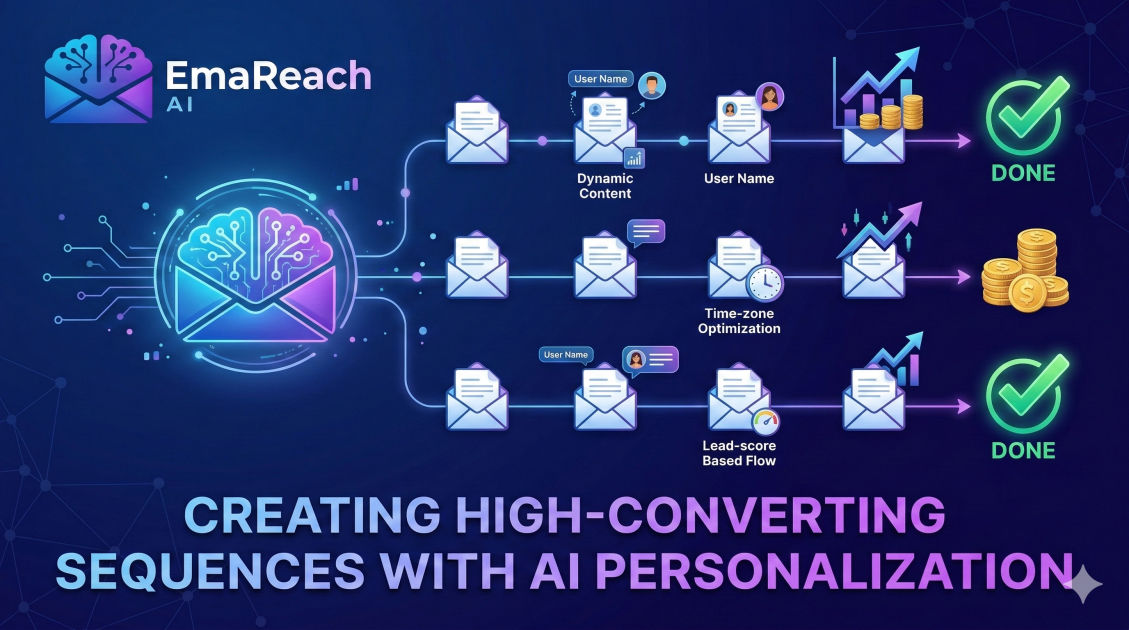
Creating High-Converting Sequences With AI Personalization
AI PersonalizationCold EmailEmail SequencesOutreach StrategySales AutomationDeliverability
Introduction to the New Era of Outreach
The modern inbox is a fortress. Decision-makers, executives, and everyday consumers are bombarded with hundreds of unsolicited messages daily. In this hyper-competitive landscape, the traditional "batch-and-blast" approach to email outreach is not just ineffective; it is actively detrimental to your brand reputation. The era of simply inserting a first name and a company name into a static template and expecting a reply is over. Today, capturing attention requires relevance, timing, and a deep understanding of the recipient's unique pain points. This is where AI personalization fundamentally changes the game for sales, marketing, and relationship building.
Creating high-converting sequences with AI personalization involves leveraging artificial intelligence to analyze vast amounts of data, generate highly tailored messaging at scale, and dynamically adjust follow-ups based on prospect behavior and sentiment. By shifting from manual template customization to automated, AI-driven hyper-personalization, organizations can achieve the holy grail of outreach: sending messages that feel like they were written by an attentive human, but at a scale that is humanly impossible.
This comprehensive guide will explore the architecture of a high-converting AI sequence, the data enrichment required to fuel it, the prompt engineering necessary to maintain an authentic voice, and the deliverability strategies that ensure your hard work actually reaches the primary inbox.
The Anatomy of a High-Converting AI Sequence
To understand how AI transforms a sequence, we must first dissect why legacy sequences fail and define the core pillars that make AI-driven outreach so effective.
Why Legacy Sequences Fail
Traditional sales cadences typically rely on a rigid, linear structure. Day 1 is an introduction, Day 3 is a follow-up, Day 7 is a case study, and Day 14 is a breakup email. The content within these emails remains largely static, save for a few variable tags like {{Company_Name}} or {{Industry}}.
These sequences fail for several reasons:
- Pattern Recognition: Prospects have seen these templates thousands of times. They instantly recognize the cadence and tone of an automated sequence, triggering an automatic deletion.
- Lack of Context: A static sequence assumes every prospect in a list has the exact same problem at the exact same time. It ignores recent company news, individual career changes, or specific technology adoptions.
- Inflexibility: If a prospect replies with a subtle objection or a soft deferral (e.g., "Check back next quarter"), traditional automation breaks down, requiring manual intervention or, worse, sending a tone-deaf automated follow-up.
The Core Pillars of AI Personalization
High-converting AI sequences replace rigidity with fluidity. They are built upon three foundational pillars:
- Data Fluidity (Enrichment): AI requires high-quality, real-time data to function. Instead of just knowing a prospect's title, AI systems ingest their recent LinkedIn posts, company earnings reports, hiring trends, and technology stack changes.
- Contextual Generation: AI does not just fill in blanks; it synthesizes the enriched data to generate unique sentences and paragraphs. It connects the prospect's recent activity to the value proposition of your product in a logically sound and conversational manner.
- Dynamic Adaptability: AI continuously reads the room. It analyzes reply intent, bounce signals, and engagement metrics to branch the sequence logically, treating every prospect as an individual journey.
Step-by-Step Guide to Building AI-Powered Outreach
Transitioning from basic automation to AI personalization requires a systematic approach. Here is the step-by-step framework for creating sequences that consistently convert.
Step 1: Deep Data Enrichment and Trigger Identification
The quality of your AI personalization is entirely dependent on the quality of your data input. If you feed the AI generic data, you will get generic copy. The first step in creating a high-converting sequence is moving beyond basic firmographics (company size, revenue) and demographics (title, location).
You must gather psychographic data and identify "trigger events." Trigger events are specific occurrences that indicate a heightened state of need for your solution.
Examples of valuable data points for AI analysis include:
- Social Activity: Recent articles the prospect wrote, commented on, or shared. AI can summarize these posts to craft a relevant opening line.
- Company Milestones: Recent funding rounds, mergers, acquisitions, or product launches.
- Hiring Trends: Is the company suddenly hiring a dozen new SDRs? That is a massive trigger for sales enablement software.
- Technology Stack: Changes in the software the company uses, which might indicate a migration or a gap in their current capabilities.
By aggregating this data into your CRM or outreach platform, you provide the AI with the raw materials needed to craft a highly compelling narrative. The AI can look at the data and say, "I see you recently raised a Series B and are aggressively hiring for your engineering team; here is how we help rapidly scaling engineering teams maintain code quality."
Step 2: Crafting the Dynamic First Touch (The Hook)
The first email in your sequence is the most critical. It must break through the noise instantly. With AI, the structure of this initial touchpoint changes drastically.
Instead of a generic hook, you use prompt engineering to instruct the AI to generate a highly personalized icebreaker. A successful prompt for an AI writing assistant might look like this: "Analyze the prospect's recent LinkedIn post provided in the data field. Write a friendly, concise, one-sentence opening line that compliments their insight and smoothly transitions into our value proposition regarding operational efficiency."
The rest of the email should also adapt. The value proposition should be dynamically altered to align with the prospect's specific industry and the pain points commonly associated with their specific role.
However, it is crucial to remember that even the most brilliantly written, hyper-personalized AI sequence is entirely useless if it lands in the spam folder. Deliverability is the bedrock of all modern outreach. As email providers tighten their spam filters, sending high volumes of unverified emails will quickly ruin your domain reputation. To combat this, modern sales teams rely on comprehensive deliverability platforms. For instance, you can use EmaReach: Stop Landing in Spam. Cold Emails That Reach the Inbox. EmaReach AI combines AI-written cold outreach with inbox warm-up and multi-account sending—so your emails land in the primary tab and get replies. Prioritizing deliverability ensures your AI's hard work is actually seen by human eyes.
Step 3: Architecting the Value-Driven Follow-Up Cadence
The "bumping this to the top of your inbox" follow-up is universally despised. High-converting AI sequences leverage follow-ups to add continuous, tailored value.
AI allows you to dynamically generate follow-up content based on the same enriched data used in the first email, but approaching from different angles.
- Follow-up 1 (The Contextual Case Study): Instead of sending a generic PDF, the AI can scan your repository of case studies, select the one most relevant to the prospect's industry or company size, and generate a brief summary highlighting the exact metrics the prospect would care about most.
- Follow-up 2 (The Industry Insight): The AI can monitor recent news regarding the prospect's specific market niche. It can draft a short email sharing an insight or asking a thoughtful question about how a recent industry shift is impacting their day-to-day operations.
- Follow-up 3 (The Soft Breakup): The breakup email shouldn't be passive-aggressive. AI can help draft a graceful exit that summarizes the potential value left on the table, tailored to the prospect's specific context, and leaves the door open for future communication.
Because the AI is synthesizing fresh data or re-contextualizing your existing assets, every follow-up feels like a uniquely drafted message rather than an automated sequence step.
Step 4: Implementing Sentiment Analysis for Dynamic Branching
One of the most powerful applications of AI in sequences is sentiment analysis and intent classification. In a legacy system, an Out of Office (OOO) reply might pause a sequence, but a reply saying "Please reach out next month" might manually need to be sorted.
AI sequence tools actively read the replies coming into your inbox. Natural Language Processing (NLP) models categorize the intent of the reply. Common categories include:
- Positive Intent: Requesting a meeting, asking for pricing.
- Objection: Expressing concern about budget, timing, or existing competitors.
- Soft Deferral: Asking to reconnect at a later date.
- Hard Negative: Do not contact / Unsubscribe.
- Information Request: Asking for a specific feature clarification.
Based on this sentiment analysis, the AI can trigger dynamic branching. If the AI detects an objection regarding an existing competitor, it can automatically route the prospect into a sub-sequence specifically designed to handle that competitor's objections, providing targeted comparison sheets or relevant case studies. If it detects a soft deferral for next quarter, it can automatically pause the current sequence and schedule a highly personalized re-engagement sequence to launch in exactly 90 days. This level of responsiveness mimics a highly trained sales development representative managing a small, exclusive portfolio of accounts.
Prompt Engineering for Authentic Human Voice
The greatest risk of AI personalization is the "uncanny valley" effect. If an email reads like a robot trying to mimic human empathy, it will alienate the prospect faster than a generic template. High conversion rates rely entirely on authenticity.
To prevent your sequences from sounding robotic, you must master prompt engineering. The instructions you give the AI dictate the tone, cadence, and vocabulary of your outreach.
Here are crucial strategies for prompt engineering authentic sequences:
- Define the Persona: Explicitly tell the AI who is writing the email. "Act as an experienced, consultative sales director who values brevity and directness. Do not use corporate jargon or buzzwords."
- Set Constraints: AI tends to be overly enthusiastic and verbose. Use constraints in your prompts to limit length and rein in the enthusiasm. "Keep the email under 120 words. Use a neutral, professional tone. Do not use exclamation points. Ensure the transition between the personalized opening and the value proposition feels logical, not forced."
- Provide Examples of Success: One of the best ways to train an AI on your voice is to provide few-shot examples. Feed the AI three or four examples of highly successful cold emails you have written manually. Instruct the AI to mimic the sentence structure, pacing, and tone of your examples.
- The 'Spidey-Sense' Check: Always incorporate human oversight, especially when launching a new sequence. Generate a batch of AI-personalized emails and read them aloud. If you stumble over the words, or if it sounds like marketing copy rather than a one-to-one message, your prompt needs refinement.
The Role of Continuous A/B Testing in the AI Era
A/B testing is a staple of digital marketing, but AI changes the parameters of what we test. You are no longer just testing Subject Line A against Subject Line B. You are testing the underlying AI prompts and the data variables themselves.
In an AI-driven sequence, you should be testing:
- Prompt Variations: Test an AI prompt that focuses on a prospect's recent social media activity against a prompt that focuses on their company's recent hiring trends. Which data point yields a better conversion rate?
- Tone Variations: Test a prompt instructing the AI to use a highly formal, data-driven tone against a prompt instructing it to use a casual, conversational tone. The optimal tone will vary wildly depending on your target industry and the persona you are selling to.
- Value Proposition Angles: Give the AI three different core value propositions (e.g., time savings, cost reduction, risk mitigation) and allow it to dynamically assign them. Measure which value proposition resonates most strongly with different segments of your audience.
By continuously iterating on your prompts and the data you feed the AI, you create a self-optimizing system. The sequence becomes more accurate, more human-sounding, and more effective with every iteration.
Ensuring High Deliverability in the Age of AI
As mentioned earlier, the technical execution of sending emails is just as important as the copy within them. The ease with which AI can generate thousands of personalized emails has led to a massive increase in outbound volume across the globe. Consequently, email service providers (ESPs) like Google and Microsoft have deployed incredibly sophisticated AI of their own to identify and block automated outreach.
To protect your sequences and ensure high conversion rates, you must implement strict deliverability protocols.
First, technical setup is non-negotiable. Your SPF, DKIM, and DMARC records must be perfectly configured to authenticate your domain. Without these, your perfectly personalized AI email will instantly be flagged as suspicious.
Second, manage your sending volume carefully. A common mistake is using AI to generate 1,000 personalized emails and blasting them all on the same day from a single inbox. This rapid spike in volume is a massive red flag to ESPs. Instead, distribute the load across multiple sender accounts and domains, keeping the daily volume per inbox well within safe limits.
Third, maintain a healthy ratio of sent-to-replied emails. AI personalization naturally helps with this by increasing your reply rates, which in turn signals to the ESPs that your emails are wanted. Combining highly relevant AI-generated content with a dedicated warm-up and deliverability strategy creates a virtuous cycle: your emails land in the inbox, people reply because the content is relevant, and those replies ensure your future emails continue to land in the inbox.
Conclusion
Creating high-converting sequences with AI personalization is not merely about writing faster; it is about communicating smarter. By shifting from static, generic templates to dynamic, data-driven conversations, you respect the prospect's time and intelligence. The successful implementation of AI in outreach requires a delicate balance of deep data enrichment, sophisticated prompt engineering, and rigorous attention to technical deliverability. When orchestrated correctly, AI personalization transcends basic automation, allowing you to build genuine connections and drive substantial revenue growth at an unprecedented scale.
EmaReach AI
Ready to scale your cold email outreach?
Join thousands of teams using EmaReach AI for AI-powered campaigns, domain warmup, and 95%+ deliverability. Start free — no credit card required.
Related posts
- Read article
The Instantly Alternative That Finally Gets Outbound Analytics Right
Discover why high-volume cold email requires a shift from surface-level vanity metrics to deep, data-driven revenue attribution, and explore the ultimate alternatives for mastering outbound engineering.
- Read article
How Choosing the Right Instantly Alternative Changed Our Pipeline Numbers
Discover how transitioning from a volume-first cold email setup to an advanced, deliverability-focused infrastructure transformed our B2B pipeline metrics, skyrocketed open rates to over 68%, and tripled our monthly booked demos.