Blog
Back to blog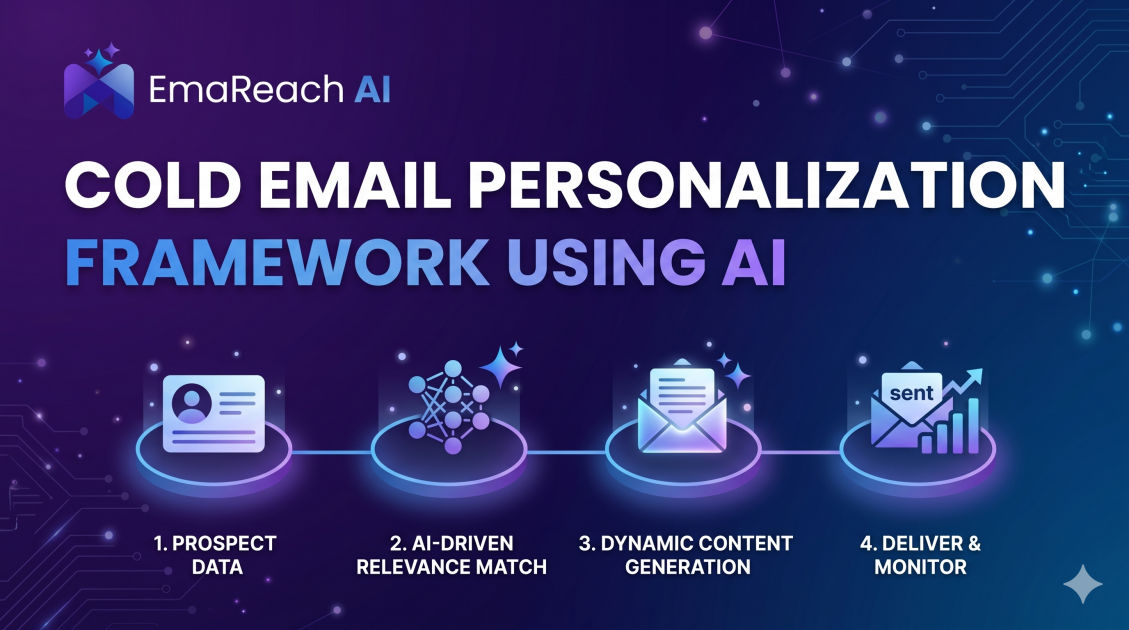
Cold Email Personalization Framework Using AI
cold emailAI outreachemail personalizationsales automationB2B saleslead generationemail deliverability
Introduction
The landscape of outbound sales has undergone a seismic shift. Gone are the days when a generic, beautifully written pitch could yield a steady stream of qualified leads. Today, prospects' inboxes are heavily guarded fortresses, flooded daily with automated pitches, generic value propositions, and relentless follow-ups. In this hyper-competitive environment, personalization is no longer just a nice-to-have tactic—it is the absolute minimum requirement for entry.
However, true personalization presents a mathematical dilemma for sales teams and marketers. Crafting a genuinely individualized email that references a prospect's recent achievements, understands their specific pain points, and aligns seamlessly with their company's current trajectory takes time. If a sales development representative spends twenty minutes researching a prospect and writing a bespoke email, their daily output drops to a crawl. The age-old tradeoff has always been quality versus quantity. You could either send a thousand generic emails or fifty highly targeted ones.
Artificial Intelligence has shattered this paradigm. By leveraging advanced language models and automated workflows, revenue teams can now achieve hyper-personalization at an unprecedented scale. This article outlines a comprehensive, step-by-step Cold Email Personalization Framework using AI. It will guide you through the process of combining structured data, strategic prompt engineering, and intelligent automation to create outreach campaigns that resonate deeply, build genuine connections, and ultimately drive revenue—all without sacrificing volume.
The Evolution of Cold Outreach: Moving Beyond the Superficial
Before diving into the framework, it is crucial to understand what AI personalization is not. Early attempts at automating personalization relied on merge tags—simple variables like {{First_Name}} or {{Company_Name}}. While this was a start, the modern buyer instantly recognizes a templated email.
The next evolution was what many call "superficial personalization." This involves scraping a single data point, such as the prospect's alma mater or the weather in their city, and awkwardly forcing it into the opening line: "Hey John, saw you went to the University of Michigan—Go Wolverines! Anyway, I'm reaching out because..."
This approach fails because it lacks relevance. A prospect's college has absolutely nothing to do with their current business challenges or the software you are trying to sell them.
Deep personalization—the kind that AI enables—connects the dots between the prospect's world and your solution. It involves analyzing complex, unstructured data sets (such as recent funding rounds, executive hiring trends, podcast interviews, or technical stacks) and synthesizing that information into a cohesive, highly relevant narrative. AI does not just insert a name; it understands the context of the prospect's situation and tailors the core value proposition accordingly.
The Data Foundation: Fueling the AI Engine
No AI model can generate personalized insights without high-quality data. The intelligence of your AI cold email framework is directly proportional to the quality of the data you feed it. We call this the "Data Foundation." To build a scalable system, you must systematically capture three distinct tiers of data.
Tier 1: Firmographic and Demographic Data
This is the baseline information required for any B2B outreach campaign. It includes:
- Company size and employee count
- Industry and sub-verticals
- Geographic location
- Prospect's exact job title and seniority
- Technologies actively used by the company (Tech Stack)
Tier 2: Intent Signals and Trigger Events
Timing is often more important than the message itself. Intent signals tell your AI why it makes sense to reach out right now. Key trigger events include:
- Recent rounds of funding or acquisitions
- Leadership changes (e.g., a new VP of Marketing joining the team)
- Hiring sprees in specific departments
- Company expansions into new markets
- Website visitor identification (if the prospect's company has been browsing your site)
Tier 3: Individual Psychographic and Content Data
This is where AI truly shines. By feeding language models unstructured text written by or about the prospect, the AI can mimic tone and reference highly specific ideas. This includes:
- Recent posts or articles published by the prospect on professional networks
- Quotes from the prospect in industry publications
- Company mission statements and recent press releases
- The prospect's career history and notable transitions
The Advanced AI Cold Email Personalization Framework
With a solid data foundation in place, you can operationalize the AI personalization process. This framework operates as a continuous loop, transforming raw data into highly targeted, personalized emails ready for deployment.
Step 1: Defining Micro-Segments
Instead of creating one massive list of thousands of prospects, use your firmographic data to slice your audience into hyper-specific micro-segments. For example, instead of targeting "B2B SaaS Founders," target "Bootstrapped B2B SaaS Founders in the FinTech space who have recently hired a Head of Sales."
By narrowing the focus, you constrain the AI's generation parameters, ensuring that the foundational value proposition it relies on is inherently relevant to the entire micro-segment, requiring the AI only to personalize the "last mile" of the email.
Step 2: Automated Data Extraction and Structuring
Utilize data scraping tools and APIs to gather the Tier 2 and Tier 3 data for each prospect in your micro-segment. Once collected, this unstructured data (like a 500-word LinkedIn post) needs to be processed.
You can use an initial AI prompt to summarize the scraped data. For instance, pass a prospect's recent article into a language model with the prompt: "Extract the single most important business challenge mentioned in this text and summarize it in one concise sentence." This structured output becomes a clean variable to inject into your email generation prompt.
Step 3: Architecture of the Master Prompt
The Master Prompt is the set of instructions you give the AI to write the email. A robust master prompt should include:
- Role Setup: "Act as a top-tier enterprise sales executive who is polite, concise, and expert in the [Industry] space."
- The Objective: "Write a cold email to [Prospect Name] aimed at booking a 10-minute discovery call."
- The Inputs: Provide the structured data gathered in Step 2. (e.g., "Prospect's recent post summary: [Variable]").
- The Value Proposition: Clearly state what your company does and how it solves specific pain points related to the inputs.
- Constraints and Rules: This is the most critical part. Give the AI strict boundaries. "Do not exceed 100 words. Do not use words like 'delve', 'synergy', or 'unlock'. Keep the tone conversational and avoid overly formal greetings. Do not sound salesy."
Step 4: The Dynamic Template Structure
Rather than asking the AI to write the entire email from scratch—which can lead to wildly inconsistent results and hallucinations—use a hybrid approach. Create a "Dynamic Template" where the AI is only responsible for generating specific, highly personalized sentences.
A typical hybrid structure looks like this:
- AI-Generated Icebreaker: A personalized opening line based on the prospect's recent activity or trigger event. (e.g., "Loved your recent breakdown on the shift toward PLG models in enterprise software.")
- The Transition: A human-written bridge that connects their activity to your solution.
- The Value Prop / Case Study: A heavily segmented, human-written sentence proving ROI.
- AI-Generated Call to Action (CTA): A soft, customized question based on the prospect's context.
Step 5: Human-in-the-Loop Quality Assurance
Never connect an AI directly to your outbound email server without a review mechanism, especially when starting out. Implement a "Human-in-the-Loop" (HITL) process. Generate the emails in batches and have a sales representative quickly scan them.
The rep should look for formatting errors, awkward phrasing, or "AI hallucinations" (instances where the AI invents facts). Over time, as you refine your prompts and data inputs, the rejection rate will plummet, allowing you to automate larger portions of the workflow.
Deliverability: The Crucial Missing Link in AI Outreach
You can build the most sophisticated AI personalization engine in the world, train it on perfect data, and craft prose that rivals top copywriters. However, none of that matters if your emails never actually reach the prospect's eyes.
As spam filters become increasingly aggressive and email service providers tighten their authentication protocols, landing in the primary inbox is harder than ever. If you are sending AI-personalized emails at volume from a single, un-warmed domain, your meticulously crafted messages will almost certainly end up in the spam folder or the dreaded promotions tab.
This is where specialized deliverability infrastructure becomes mandatory. You need a system designed to protect your sender reputation while scaling your volume. Stop Landing in Spam. Cold Emails That Reach the Inbox. EmaReach AI combines AI-written cold outreach with inbox warm-up and multi-account sending—so your emails land in the primary tab and get replies.
By integrating a platform like EmaReach into your AI personalization framework, you ensure that the deep, contextual messaging you generated actually has the opportunity to convert. The warm-up processes signal to algorithms that you are a legitimate sender, while multi-account sending distributes the volume naturally, mimicking human behavior and maximizing primary inbox placement.
Analytics, A/B Testing, and Continuous Iteration
An AI cold email framework is not a "set it and forget it" system. It requires constant tuning and optimization based on market feedback. To truly master this process, you must obsess over the right metrics and continuously experiment with your AI prompts.
Prioritize the Right Metrics
Historically, email marketers focused heavily on Open Rates. However, with the advent of privacy protection features that pre-fetch tracking pixels, open rates have become an unreliable vanity metric. Instead, focus entirely on:
- Positive Reply Rate: Out of the emails delivered, how many prospects responded with interest?
- Meeting Booked Rate: The ultimate indicator of success for outbound campaigns.
- Spam Complaint Rate: A critical health metric for your domain.
A/B Testing AI Variables
When testing an AI-driven campaign, you are no longer just testing subject lines; you are testing the AI's core logic. Consider running experiments on:
- Data Inputs: Does personalizing based on a recent LinkedIn post perform better than personalizing based on a company's recent funding round? Test the data variables against each other.
- Prompt Constraints: Run a campaign where the AI is instructed to be "highly analytical and data-driven" versus a campaign where the AI is instructed to be "casual, brief, and conversational."
- Length: Instruct the LLM to generate emails under 50 words, and test them against emails capped at 120 words.
The Feedback Loop
Whenever an AI-generated email results in a positive reply and a booked meeting, feed that success back into your system. Use successful emails as "Few-Shot Examples" in your master prompts. By showing the language model examples of what "good" looks like (e.g., "Here are three examples of highly successful cold emails we have sent in the past. Emulate this exact style."), the output quality will compound over time.
Conclusion
The integration of Artificial Intelligence into cold email outreach represents the most significant leap forward in B2B sales technology in a generation. By systematically gathering rich contextual data, crafting precise prompts, employing hybrid dynamic templates, and safeguarding your deliverability, you can build an outbound engine that operates with both the scale of a machine and the empathy of a seasoned sales professional. While the tools and algorithms will continue to evolve, the core philosophy remains the same: use AI to deeply understand your prospect's reality, communicate value concisely, and build authentic business relationships at an unprecedented scale.
EmaReach AI
Ready to scale your cold email outreach?
Join thousands of teams using EmaReach AI for AI-powered campaigns, domain warmup, and 95%+ deliverability. Start free — no credit card required.
Related posts
- Read article
The Instantly Alternative That Finally Gets Outbound Analytics Right
Discover why high-volume cold email requires a shift from surface-level vanity metrics to deep, data-driven revenue attribution, and explore the ultimate alternatives for mastering outbound engineering.
- Read article
What You Gain and What You Give Up When Switching From Instantly
Thinking about migrating your cold email stack? This detailed guide breaks down the exact operational advantages you gain and the core features you sacrifice when switching away from Instantly's popular outreach platform.