Blog
Back to blog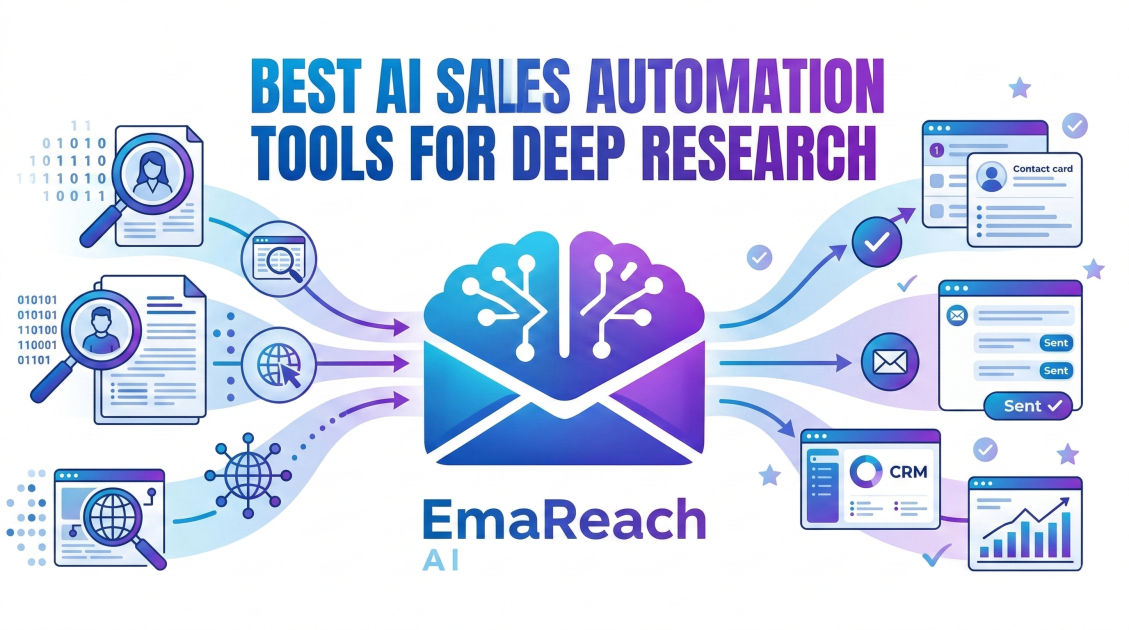
Best AI Sales Automation Tools for Deep Research
sales automationAI researchlead generationsales intelligenceoutreach strategyB2B sales
Introduction to AI-Powered Sales Intelligence
In the modern sales landscape, the difference between a closed deal and a cold ignored email often lies in the depth of research. Gone are the days when a generic template and a broad list of leads could yield high conversion rates. Today, buyers expect personalization that reflects a deep understanding of their specific business challenges, recent accomplishments, and industry positioning. This is where AI sales automation tools for deep research come into play.
Deep research in sales involves more than just finding a LinkedIn profile. It encompasses analyzing company financial reports, monitoring executive interviews, tracking technological shifts within a prospect's organization, and identifying 'trigger events' that signal a high intent to purchase. Manually performing this level of due diligence for hundreds of leads is impossible. Fortunately, a new generation of AI-driven platforms has emerged to automate the heavy lifting of data gathering and synthesis.
The Evolution of Sales Research
Historically, sales research was a manual, time-consuming process. Reps would spend hours scouring Google News, company blogs, and SEC filings. While effective, this 'detective work' significantly reduced the time available for actual selling.
With the integration of Large Language Models (LLMs) and specialized web-scraping technologies, sales automation has shifted from simple 'mail merges' to 'intelligent insight generation.' These tools don't just find data; they interpret it. They can summarize a 50-page annual report into three bullet points that explain why your product is a perfect fit for the company's current strategic goals.
Key Criteria for Deep Research Tools
When evaluating AI tools for deep research, it is essential to look beyond basic contact discovery. The best tools in this category should offer:
- Real-time Data Access: The ability to browse the live web to find news that happened this morning.
- Contextual Synthesis: The power to connect disparate pieces of information (e.g., a recent round of funding combined with a new job posting for a specific role).
- Integration Capabilities: Seamlessly pushing insights into your CRM or cold outreach platform.
- Accuracy and Verification: Mechanisms to ensure the AI isn't 'hallucinating' facts about a prospect.
Top AI Tools for Deep Sales Research
1. Perplexity AI
While often categorized as an AI search engine, Perplexity has become a secret weapon for elite sales development representatives (SDRs). Unlike standard chatbots, Perplexity cites its sources and searches the live web.
For deep research, sales professionals use it to ask complex questions like, "What are the top three strategic priorities mentioned by the CEO of [Company] in their latest earnings call, and how do they relate to cybersecurity?" The tool provides a detailed report with links to the original sources, allowing for ultra-personalized outreach that feels human and informed.
2. Clay
Clay is perhaps the most powerful orchestration layer for sales research currently available. It allows users to pull data from over 50+ different providers (like LinkedIn, Clearbit, and Github) and then run that data through an AI agent.
With Clay, you can automate a research workflow that looks like this:
- Find a new lead at a target company.
- Scrape their latest three LinkedIn posts.
- Visit their company website to find their mission statement.
- Use AI to write a customized opening sentence for an email based on a commonality between their posts and the mission statement.
This level of automation ensures that every email sent is backed by deep research without the SDR having to open a single browser tab.
3. Apollo.ai (with Content Intelligence)
Apollo has long been a leader in lead databases, but its recent pivots into AI-driven insights have moved it into the deep research category. Their AI-driven 'Signals' feature tracks when companies are expanding, hiring, or changing their tech stack. By automating the monitoring of these signals, sales teams can reach out at the exact moment a prospect is most likely to need a solution.
4. 6sense and Demandbase
These platforms represent the 'Account-Based Marketing' (ABM) side of deep research. They use 'Intent Data' to tell you which companies are researching your category before they ever talk to you. They analyze 'dark social' and anonymous web traffic to provide a research summary of what specific topics a target account is interested in. This allows sales teams to tailor their research specifically to the problems the prospect is already trying to solve.
Bridging Research and Outreach
Deep research is only valuable if it leads to successful engagement. Once you have identified the core pain points and triggers of a prospect through AI, the next step is ensuring your message actually gets seen.
This is a common friction point in sales automation. You might have the best research in the world, but if your email lands in the spam folder, the effort is wasted. For those focusing on high-volume, high-quality outreach, utilizing a platform like EmaReach can be a game-changer. EmaReach combines AI-written cold outreach with specialized inbox warm-up and multi-account sending. This ensures that the deep research you've gathered is translated into a compelling message that actually reaches the primary inbox rather than the promotions tab.
How to Conduct Deep Research Using AI: A Step-by-Step Workflow
To get the most out of these tools, sales teams should follow a structured research workflow.
Step 1: Define Your Ideal Customer Profile (ICP) Triggers
Before researching, you must know what you are looking for. Is it a new CEO? A recent merger? A specific technology being dropped? Use AI to analyze your past successful deals to identify what these triggers were.
Step 2: Automated Data Aggregation
Use a tool like Clay or Apollo to aggregate all public-facing data about your target accounts. This should include social media activity, news mentions, and job board listings.
Step 3: AI Summarization and Insight Extraction
Feed the raw data into an LLM (via Perplexity or an integrated AI agent) to extract the "Why Now?" Every piece of outreach should answer the question: "Why am I reaching out to you today specifically?"
Step 4: Personalization at Scale
Take the insights generated and map them to your value proposition. If the research shows the company is expanding into Europe, and you sell a compliance tool, your research-driven message should focus specifically on European data regulations.
The Role of Intent Data in Deep Research
Intent data is the 'holy grail' of sales research. It tells you not just who a person is, but what they are doing. AI tools can now parse through massive datasets to identify patterns that suggest a company is in a 'buying window.'
For example, if several employees at a target account start visiting review sites for CRM software, an AI research tool can flag this to the sales team. The resulting outreach can be incredibly specific: "I noticed your team might be evaluating ways to improve sales data hygiene; here is how we helped a similar firm during their transition."
Overcoming the 'Creepy' Factor
One risk of deep research is appearing too intrusive. There is a fine line between being 'well-informed' and 'stalker-like.' The key to using AI research tools effectively is to focus on professional insights rather than personal ones.
- Do: Mention a company's recent quarterly growth or a public interview given by an executive.
- Don't: Mention a prospect's personal social media post about their vacation unless it's publicly shared on a professional platform like LinkedIn for the purpose of engagement.
AI tools help maintain this balance by filtering for professional relevance, ensuring that the research enhances the business relationship.
Future Trends in Sales Automation Research
The future of this space lies in 'Autonomous Sales Agents.' We are moving toward a world where the AI doesn't just provide a report but actually monitors the web 24/7 for you. When a specific event happens—like a competitor's service going down—the AI will immediately conduct deep research on the competitor's top clients and draft personalized 'break-up' emails for your sales team to review.
Furthermore, predictive research will become more common. AI will not only look at what has happened but will use historical data to predict which companies are likely to have a budget surplus or a strategic pivot in the coming months.
Maximizing ROI with AI Research Tools
To ensure these tools provide a return on investment, companies should avoid 'tool fatigue.' It is better to have two tools that are deeply integrated into your workflow than five tools that are used sporadically.
Training is also vital. Sales teams need to be taught how to prompt AI tools to get the best research. A prompt like "Tell me about this company" will yield generic results. A prompt like "Identify the top three challenges this company faces regarding remote team productivity based on their Glassdoor reviews and recent LinkedIn articles" will yield high-value research.
Integrating Research into the Full Sales Stack
Deep research should not exist in a vacuum. It must be the fuel that powers your entire sales engine.
- Lead Gen: Use research to filter out accounts that aren't a fit.
- Outreach: Use research to write the first two lines of every email.
- Discovery Calls: Use research to ask 'Level 2' and 'Level 3' questions that prove your expertise.
- Closing: Use research to align your final proposal with the prospect's long-term KPIs.
By focusing on tools that facilitate this flow, sales organizations can transition from being perceived as 'vendors' to becoming 'trusted advisors.'
Conclusion
The rise of AI sales automation tools for deep research has leveled the playing field. Even a small sales team can now perform the same level of account intelligence as a Fortune 500 company. By leveraging platforms like Clay for data orchestration, Perplexity for insight gathering, and specialized delivery tools like EmaReach to ensure those insights reach the prospect, sales professionals can focus on what they do best: building relationships and solving problems. The key is to stay curious, keep your data clean, and always use AI to enhance the human connection, not replace it.
EmaReach AI
Ready to scale your cold email outreach?
Join thousands of teams using EmaReach AI for AI-powered campaigns, domain warmup, and 95%+ deliverability. Start free — no credit card required.
Related posts
- Read article
Beyond Instantly: The Cold Email Platforms Worth Taking Seriously
Discover the top advanced cold email platforms that go beyond basic multi-inbox rotation. Learn how to optimize your technical infrastructure, leverage advanced personalization, and scale your B2B sales pipeline safely without landing in the spam folder.
- Read article
What the Cold Email Community Actually Says About Instantly Alternatives
Discover what growth marketers, agency owners, and outbound practitioners across major cold email communities are saying about the top alternatives to Instantly. This comprehensive, research-driven guide breaks down the real-world pros, cons, and technical features of tools like Smartlead, EmaReach, Saleshandy, and Lemlist based on community consensus.