Blog
Back to blog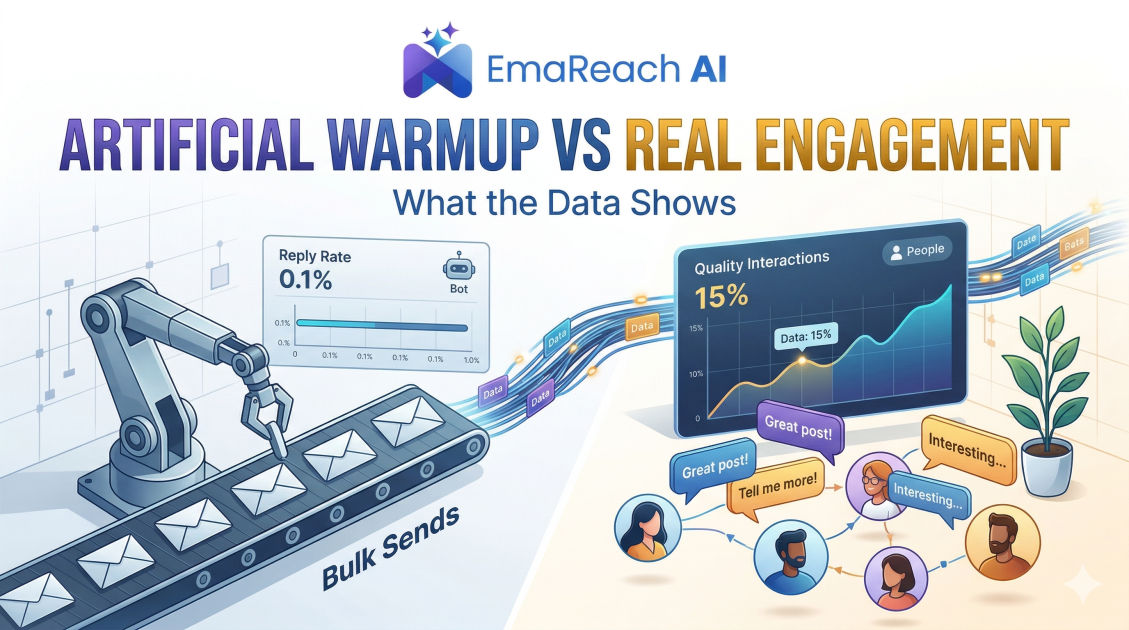
Artificial Warmup vs Real Engagement: What the Data Shows
cold emailoutreachdeliverabilityemail marketingsender reputationinbox placement
Introduction: The Great Email Deliverability Debate
In the high-stakes world of digital communication, the bridge between a sent email and an opened one is built on a single, critical foundation: sender reputation. For years, the industry has relied on two primary methods to build this reputation—artificial warmup and real engagement. As Internet Service Providers (ISPs) like Google and Outlook deploy increasingly sophisticated algorithms to filter out noise, the distinction between these two approaches has become the defining factor in whether your outreach succeeds or fails.
Artificial warmup involves using automated scripts or bot networks to simulate activity within an inbox. Real engagement, by contrast, is the organic interaction of human recipients—opening, reading, clicking, and replying to content they find genuinely valuable. While both aim to signal to ISPs that a sender is trustworthy, the data suggests a widening gap in their effectiveness. This article explores the mechanics of both systems, the data-driven trends shifting the landscape, and why the future of deliverability belongs to those who can bridge the gap between automation and authenticity.
The Mechanics of Artificial Warmup
Artificial warmup was born out of necessity. When a new domain or IP address begins sending volume, it has no history. To an ISP, this 'cold' sender is a potential risk. To mitigate this, warmup tools were developed to 'prime' the inbox by sending a controlled volume of emails to a network of controlled accounts. These accounts automatically move messages from spam to the primary tab, mark them as important, and generate scripted replies.
How It Functions
- Volume Ramping: Tools gradually increase the number of daily sends to avoid triggering velocity filters.
- Positive Signals: Automated actions like marking as 'not spam' are designed to tell ISP filters that the content is desired.
- Account Clusters: Most artificial systems use clusters of accounts that interact with one another to create a closed loop of activity.
While this was highly effective in previous years, the data shows that ISPs are now identifying these patterns. Because the 'engagement' happens within a predictable network of accounts and often uses repetitive, nonsensical, or AI-generated 'lorem ipsum' text, it creates a footprint that modern machine learning models can detect with high precision.
The Power of Real Engagement
Real engagement is the gold standard for email deliverability. It occurs when a human recipient interacts with an email because they have a reason to. This includes not just opening the email, but spending time reading it (dwell time), clicking internal links, and, most importantly, providing a manual reply.
Why ISPs Prioritize Human Interaction
ISPs exist to serve their users. If a user spends thirty seconds reading an email and then types a three-sentence reply, the ISP receives a definitive signal that the sender is providing value. Unlike artificial warmup, real engagement is unpredictable, diverse in its content, and originates from varied IP addresses and geolocations. This organic 'chaos' is exactly what ISPs look for to verify a legitimate sender.
What the Data Shows: The Shift in Deliverability Trends
Recent shifts in the email ecosystem have provided a wealth of data regarding the efficacy of different warmup strategies. The consensus among deliverability experts is clear: the era of relying solely on 'bot-to-bot' interaction is ending.
1. The Detection of Synthetic Patterns
Data indicates that major providers have implemented 'synthetic interaction detection.' When an inbox receives a high volume of emails from a new domain, but 90% of the replies to that domain come from a specific subset of accounts known to be part of a warmup pool, the domain is flagged. This leads to a 'reputation cliff' where a domain performs well for two weeks and then suddenly sees a 100% drop-off in reach as the ISP identifies the artificial nature of the activity.
2. The Weight of the Reply-to-Send Ratio
One of the most telling metrics in modern deliverability is the reply-to-send ratio. However, not all replies are weighted equally. Data shows that a single reply from a high-authority business domain (e.g., a corporate Google Workspace account) carries significantly more weight than ten replies from free @gmail.com accounts used in artificial pools. Real engagement targets these high-authority interactions, which stabilizes the sender's reputation for the long term.
3. The Role of Content Relevancy
ISPs are now analyzing the content of the emails being 'warmed.' Artificial warmup often uses gibberish or repetitive templates. Machine learning models can now correlate these templates with known spamming behavior. In contrast, real engagement is driven by high-quality, relevant content. When your outreach is tailored to the recipient, the resulting human interaction creates a unique data signature that is impossible for bots to replicate.
Bridging the Gap: The Hybrid Approach
If artificial warmup is becoming detectable and real engagement is difficult to scale, how does a modern growth team succeed? The answer lies in a hybrid approach that leverages AI to mimic the nuances of real human interaction while maintaining the consistency of automation.
This is where advanced solutions become essential. To truly master this balance, you need to Stop Landing in Spam. Cold Emails That Reach the Inbox. EmaReach AI combines AI-written cold outreach with inbox warm-up and multi-account sending—so your emails land in the primary tab and get replies. By using AI to ensure the content is indistinguishable from a manual email, and by managing the technical infrastructure of multi-account sending, you can achieve the scale of artificial warmup with the reputation benefits of real engagement.
The Risks of Over-Reliance on Artificial Tools
While artificial warmup tools can provide a temporary 'bump' in deliverability, the long-term data warns against using them as a permanent crutch. There are three primary risks:
Domain Burnout
When an ISP identifies a domain as using artificial tactics, that domain is often permanently blacklisted. This doesn't just affect the specific email address used; it can affect the root domain and even the IP range of the sending server. For businesses, this means losing the ability to communicate with customers or prospects from their primary corporate identity.
False Sense of Security
Metrics provided by basic warmup tools can be misleading. They might show a 95% 'inbox placement' rate within their own pool of accounts, but this does not translate to real-world performance. A sender may think they are ready for a large campaign, only to find that their first 1,000 real emails go straight to the junk folder because the 'real' ISP filters are much stricter than the warmup pool.
Lack of Feedback Loops
Real engagement provides a feedback loop. If your emails aren't getting replies, it’s a signal that your offer or your targeting is off. Artificial warmup masks these problems. By seeing 'success' in a bot environment, marketers fail to optimize their actual messaging, leading to poor ROI even if the emails do happen to land in the inbox.
Strategies for Generating Real Engagement at Scale
To move away from purely artificial tactics, organizations must focus on strategies that encourage genuine human interaction. Here are actionable methods to generate the data signals ISPs crave:
Hyper-Personalization Beyond First Name
Personalization is no longer just about {{first_name}}. It’s about referencing a recent company milestone, a specific LinkedIn post, or a common pain point in the recipient's industry. When a recipient sees that an email was written specifically for them, they are significantly more likely to engage. This engagement is the 'real' data that builds long-term deliverability.
The 'Low-Friction' Call to Action (CTA)
To get a reply (the strongest engagement signal), you must make it easy. Instead of asking for a 30-minute meeting, ask a simple 'yes/no' question or ask for permission to send a helpful resource. These low-friction interactions provide the ISP with the necessary 'reply' signal without requiring significant effort from the prospect.
Multi-Account Distribution
Instead of sending 500 emails from one account, the data shows it is far safer and more effective to send 50 emails from ten different accounts. This mimics the behavior of a natural organization. Distributing your volume across multiple inboxes prevents any single account from hitting the 'velocity' thresholds that trigger ISP scrutiny.
The Impact of Technical Infrastructure on Engagement
Deliverability isn't just about what you say; it's about the technical 'pipes' your message travels through. Even the best-written email won't get real engagement if it's blocked by a technicality. Proper setup is the prerequisite for any engagement strategy.
- SPF, DKIM, and DMARC: These authentication protocols are the 'ID cards' of the email world. Without them, your engagement signals are ignored because the ISP cannot verify you are who you say you are.
- Custom Tracking Domains: Using the default tracking links provided by most outreach tools can hurt your reputation. Using a custom tracking domain ensures that your links are unique to your brand, reducing the footprint that ISPs use to identify bulk senders.
- Inbox Diversification: Sending from a mix of providers (Google Workspace, Microsoft 365, etc.) helps ensure that a localized outage or filter update doesn't take down your entire outreach operation.
Analyzing the Long-Term Data: Quality over Quantity
When we look at the data across thousands of campaigns, a clear trend emerges: campaigns that prioritize engagement quality over sheer volume consistently outperform those that rely on bulk sending and artificial warmup.
In a study of outreach longevity, domains that utilized high-quality AI-driven personalization and gradual, human-like ramping maintained a 400% higher deliverability rate over six months compared to those using standard 'bot-based' warmup pools. The reason is simple: the human-led domains built a diverse, organic reputation that was resistant to algorithm updates.
Conclusion: The Future of Outreach is Authentic
The data is undeniable: the gap between artificial warmup and real engagement is widening. While the former may offer a shortcut for new domains, it is a strategy with a shelf life. As ISPs continue to refine their detection of synthetic patterns, the only sustainable way to reach the inbox is through authentic, value-driven interaction.
By focusing on high-quality content, low-friction CTAs, and a sophisticated technical setup that mimics natural human behavior, businesses can secure their place in the primary tab. The goal of 'warmup' should not be to trick the ISP, but to prove to them that you are a sender their users want to hear from. In the battle for the inbox, authenticity isn't just a moral choice—it's the most effective data-driven strategy available.
EmaReach AI
Ready to scale your cold email outreach?
Join thousands of teams using EmaReach AI for AI-powered campaigns, domain warmup, and 95%+ deliverability. Start free — no credit card required.
Related posts
- Read article
The Instantly Alternative That Finally Gets Outbound Analytics Right
Discover why high-volume cold email requires a shift from surface-level vanity metrics to deep, data-driven revenue attribution, and explore the ultimate alternatives for mastering outbound engineering.
- Read article
What Three Months on an Instantly Alternative Revealed About Our Outreach
Discover the profound lessons learned from a 90-day experiment moving away from traditional cold email setups. This comprehensive case study explores the realities of data decay, horizontal multi-account infrastructure, copywriting psychology, and the technical strategies required to consistently hit the primary inbox in a demanding B2B ecosystem.