Blog
Back to blog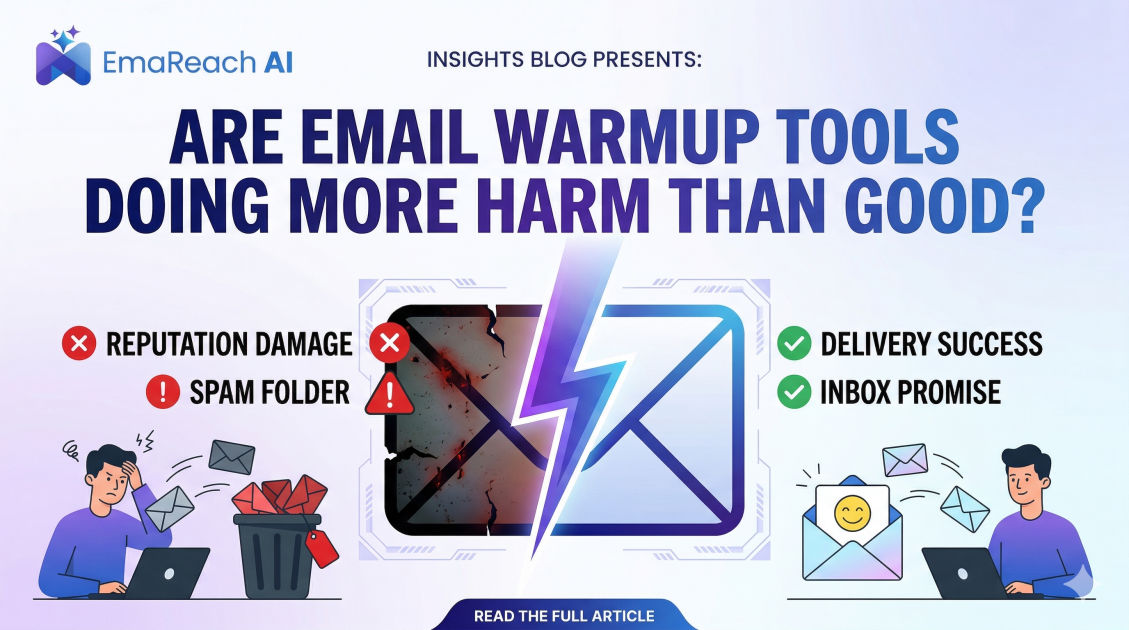
Are Email Warmup Tools Doing More Harm Than Good
email deliverabilitycold outreachemail warmupspam filterssender reputationmarketing automation
Introduction
For years, the gold standard for launching a new cold outreach campaign was to plug your fresh inbox into an automated warmup tool. The logic was simple: simulate human activity by having a network of bots or peer accounts open, reply to, and move your emails from the spam folder to the primary tab. This would "train" email service providers (ESPs) like Google and Microsoft to trust your domain, ensuring high deliverability when the real campaign launched.
However, the landscape of email deliverability is shifting. As major providers roll out more sophisticated detection algorithms, the very tools designed to save your reputation might be the ones putting a target on your back. In this deep dive, we explore whether email warmup tools are still a necessity or if they have become a liability in the modern outreach ecosystem.
The Evolution of Email Warmup
In the early days of cold outreach, the primary challenge was domain age and volume spikes. A new domain sending 100 emails on day one was an immediate red flag for spam filters. Warmup tools solved this by gradually increasing volume over several weeks.
These tools work by connecting a network of thousands of inboxes. Your account sends emails to these inboxes, which are programmed to interact with your content. By generating these "positive engagement signals," you theoretically build a sender reputation that allows you to bypass strict filters. But as the volume of automated warmup traffic has exploded, ESPs have taken notice.
Why Modern ESPs Are Cracking Down
Google and Microsoft are in a constant arms race with spammers. Their goal is to protect the user experience by ensuring that only relevant, high-quality content reaches the inbox. They have realized that much of the "engagement" on their platforms is no longer human.
Pattern Recognition and Fingerprinting
Machine learning models are now incredibly adept at spotting non-human behavior. When an inbox receives 50 emails a day, all of which are 2-3 sentences long, use similar syntax, and receive immediate replies from accounts that only interact with other "warmup" accounts, a pattern emerges.
ESPs can now "fingerprint" warmup networks. If Google identifies that a specific cluster of IP addresses or accounts is part of a commercial warmup service, any domain associated with that service may be flagged. Instead of building reputation, you are inadvertently telling the provider that you are using artificial means to manipulate their filters.
The Shift Toward Authentic Engagement
Engagement is still the number one factor in deliverability, but the quality of that engagement matters more than ever. A hundred bot-replies do not carry the same weight as five genuine replies from high-authority business domains. This is where many traditional warmup tools fail; they provide volume without the substance of real-world business interactions.
The Risks of Using Low-Quality Warmup Tools
While the concept of warming up an email is still valid, the method matters. Using low-tier or outdated tools can lead to several negative outcomes:
- Shadowbanning: Your emails may technically be "delivered," but they are routed directly to the promotions or spam folders without you ever knowing.
- Domain Reputation Burn: Once a domain is associated with a bot network, it is very difficult to recover. You may find that even after stopping the tool, your deliverability remains low.
- Security Risks: Many tools require OAuth access or app passwords. Granting a third-party tool full access to your inbox can expose sensitive data if that tool’s network is compromised.
How to Bridge the Gap: The EmaReach Approach
If traditional, bot-heavy warmup tools are becoming risky, what is the alternative? The industry is moving toward integrated solutions that prioritize authenticity.
Stop Landing in Spam. Cold Emails That Reach the Inbox. EmaReach (https://www.emareach.com/) represents this shift in strategy. Rather than relying on isolated, artificial engagement, EmaReach AI combines AI-written cold outreach with inbox warm-up and multi-account sending. This ensures that your emails land in the primary tab and get replies by mimicking the natural flow of human conversation more accurately than ever before. By integrating the warmup process directly with the outreach engine, it creates a seamless reputation-building cycle that looks legitimate to ESPs.
The Technical Reality of Deliverability
To understand why tools might be doing harm, we have to look at the technical markers ESPs use to evaluate your domain.
SPF, DKIM, and DMARC
Before you even think about warmup, your technical foundation must be flawless. Many users blame their warmup tool for poor results when, in reality, their authentication records are missing.
- SPF (Sender Policy Framework): Specifies which mail servers are authorized to send email on behalf of your domain.
- DKIM (DomainKeys Identified Mail): Adds a digital signature to emails, allowing the receiver to verify that the email was indeed authorized by the owner of that domain.
- DMARC (Domain-based Message Authentication, Reporting, and Conformance): Uses SPF and DKIM to give the receiver instructions on how to handle emails that fail authentication.
The Role of IP Reputation vs. Domain Reputation
In the past, your IP address was the most important factor. Today, domain reputation is king. This is why "shared IP" warmup tools are increasingly ineffective. If you are warming up your domain alongside a thousand other users on the same server, their bad habits can bleed into your reputation.
Are Warmup Tools Still Useful?
Despite the risks, it is not time to abandon the concept entirely. For a brand-new domain, some level of controlled sending is essential. The key is moderation and mimicry.
When They Work
Warmup tools are still effective when they are used to build a "baseline" of activity. If you have a fresh Google Workspace account, sending 5-10 emails a day through a reputable network can help establish the account's existence. The trouble starts when users try to "over-warm" or use the tool as a shield for poor-quality outreach.
When They Cause Harm
If you are sending 100 warmup emails a day but your actual sales emails have a 0.5% reply rate and high spam reports, the discrepancy is obvious. ESPs look at the delta between your "simulated" traffic and your "real" traffic. If the gap is too large, it triggers an audit of your account's behavior.
Best Practices for Modern Email Deliverability
To ensure your outreach remains effective without falling into the traps of outdated automation, follow these guidelines:
1. Slow and Steady Volume Increases
Forget the "aggressive" settings. If you are starting a new domain, your volume increase should look like a natural growth curve.
| Week | Daily Volume | Goal |
|---|---|---|
| Week 1 | 5-10 emails | Establish existence |
| Week 2 | 15-20 emails | Build baseline engagement |
| Week 3 | 30-45 emails | Transition to real prospects |
| Week 4 | 50+ emails | Maintain steady outreach |
2. Focus on Content Quality
No amount of warmup can fix a bad email. If your copy contains "spammy" keywords (e.g., "Free," "Winner," "Act Now"), or if your unsubscribe rate is high, your reputation will tank. Use AI-driven tools to personalize content at scale, ensuring each recipient feels the message was meant for them.
3. Multi-Account Infrastructure
One of the biggest mistakes in modern outreach is sending too much volume from a single address. Instead of sending 200 emails from one inbox, send 30 emails from seven different inboxes across different domains. This distributes the risk and makes your sending patterns appear much more human.
4. Monitor Google Postmaster Tools
If you use Gmail/Google Workspace, Google Postmaster Tools is your best friend. It provides direct data on your domain reputation, spam rate, and delivery errors. If you see your reputation dropping while using a warmup tool, it is a clear sign to disconnect immediately.
The Human Element: Why It Can’t Be Replaced
The ultimate "warmup" is real business. Engaging in genuine conversations, replying to newsletters you actually subscribe to, and having colleagues send you emails are the strongest signals of a healthy inbox.
Automation should support human activity, not replace it. The most successful outreach experts use a hybrid approach: they use advanced platforms like EmaReach to handle the heavy lifting of scaling and initial warming, but they ensure the actual outreach is targeted, valuable, and designed to elicit a real human response.
Conclusion
Are email warmup tools doing more harm than good? The answer is: it depends on the tool and how you use it.
Blindly trusting a low-quality, high-volume bot network is a recipe for deliverability disaster. ESPs are too smart to be fooled by basic simulation anymore. However, when used as part of a comprehensive strategy that includes perfect technical setup, AI-personalized content, and a multi-account infrastructure, the right tools can provide the necessary foundation for a successful campaign.
The future of email outreach belongs to those who prioritize authenticity. By moving away from "tricking" the system and toward providing genuine value, you ensure that your messages don't just reach the inbox—they get read.
EmaReach AI
Ready to scale your cold email outreach?
Join thousands of teams using EmaReach AI for AI-powered campaigns, domain warmup, and 95%+ deliverability. Start free — no credit card required.
Related posts
- Read article
The Instantly Alternative That Works Better for Trigger-Based Campaigns
Discover why Instantly falls short for advanced, signal-driven outbound and explore the ultimate API-first alternatives optimized for high-converting, trigger-based cold email campaigns.
- Read article
The Instantly Alternative That Handles High Bounce Rates Without Panic
Discover how transitioning to an advanced Instantly alternative can safeguard your cold email infrastructure. Learn to handle high bounce rates effortlessly using real-time verification, smart mailbox rotation, and automated safety nets to protect your sender reputation and maintain consistent primary inbox placement.