Blog
Back to blog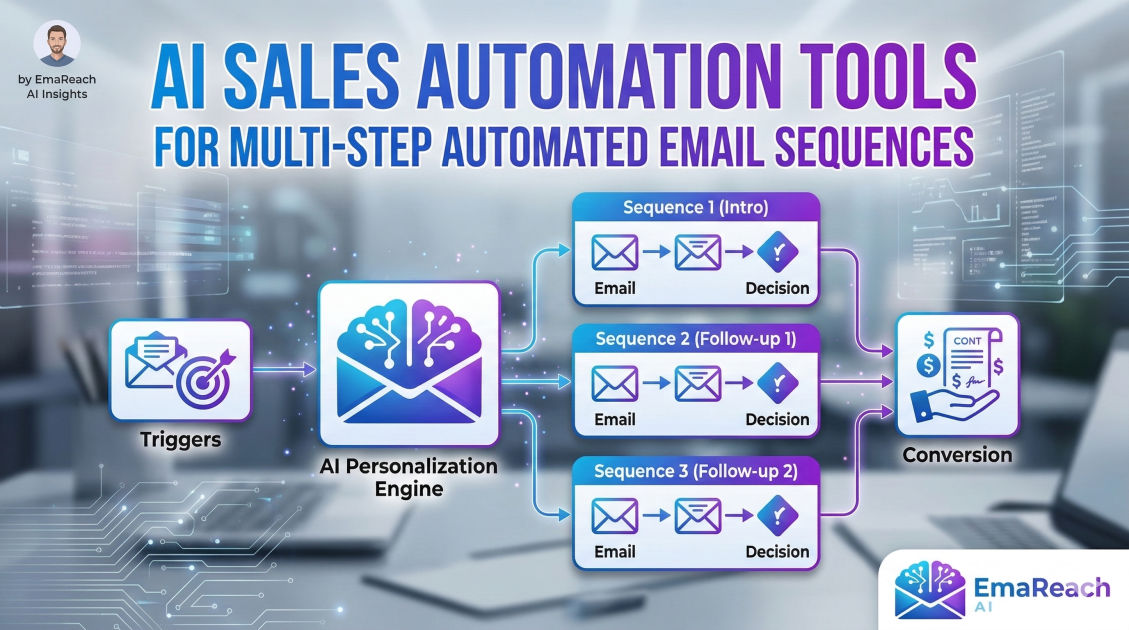
AI Sales Automation Tools for Multi-Step Automated Email Sequences
sales automationemail sequencesAI in salescold outreachlead generationemail deliverabilityB2B marketing
The Revolution of AI in Modern Sales Outreach
The landscape of B2B sales has undergone a fundamental shift. Gone are the days when a single, generic email blast could yield a pipeline full of qualified leads. Today, prospects are inundated with digital noise, making it increasingly difficult for sales teams to break through the clutter. This is where AI sales automation tools for multi-step automated email sequences have become the cornerstone of modern revenue generation.
Artificial Intelligence has moved beyond being a mere buzzword into a practical engine that powers every stage of the sales cycle. By leveraging machine learning, natural language processing (NLP), and sophisticated data analysis, these tools allow sales professionals to execute high-volume outreach that maintains the high-touch feel of a manual, personalized message. The goal is no longer just automation; it is intelligent orchestration.
Understanding Multi-Step Automated Email Sequences
A multi-step automated email sequence is a series of pre-scheduled emails sent to a prospect over a defined period. The primary objective is to nurture the lead through the sales funnel by providing value, addressing pain points, and eventually securing a meeting or conversion.
Traditional automation followed a rigid 'if-this-then-that' logic. If the prospect didn't reply after three days, send email two. While effective to a point, these legacy systems lacked the nuance required for complex B2B sales. AI-driven sequences, however, utilize behavioral triggers and sentiment analysis to adjust the flow in real-time. For instance, if an AI tool detects that a prospect has clicked a specific link regarding pricing but hasn't replied, it can automatically pivot the next email to focus on ROI and case studies rather than a generic introductory follow-up.
The Importance of the 'Multi-Step' Approach
Statistical data in the sales industry consistently highlights that it takes an average of eight to twelve touchpoints to engage a high-level decision-maker. Most sales representatives give up after two or three attempts. Multi-step sequences solve this persistence gap by ensuring that no lead falls through the cracks. When powered by AI, these sequences ensure that each of those eight to twelve touchpoints is relevant, timely, and data-backed.
Key Components of AI Sales Automation Tools
To understand why AI is such a game-changer for email sequences, we must look at the specific features that these tools bring to the table.
1. Hyper-Personalization at Scale
Personalization used to mean inserting a {first_name} or {company_name} tag into a template. Modern AI tools go much deeper. They can scrape a prospect’s LinkedIn profile, recent company news, or published articles to generate a custom 'icebreaker' sentence for every individual in a list of thousands. This level of detail signals to the prospect that the sender has done their homework, significantly increasing open and response rates.
2. Intelligent Send-Time Optimization
Sending an email at 9:00 AM on a Monday might work for some, but others might be more responsive on a Thursday afternoon. AI tools analyze historical engagement data to determine when a specific recipient is most likely to be in their inbox. Instead of sending the entire sequence batch at once, the AI staggers delivery to hit the 'golden window' for each individual recipient.
3. Dynamic Content Adaptation
AI can analyze the sentiment of a prospect’s 'Out of Office' reply or a 'Not interested right now' response. Instead of just stopping the sequence or requiring manual intervention, the AI can categorize the response and reschedule the sequence for a later date or change the tone of the follow-up. This keeps the sales engine running without human bottlenecking.
4. Advanced Deliverability Management
No matter how good your copy is, it’s useless if it lands in the spam folder. This is a critical area where specialized platforms excel. For example, EmaReach helps users stop landing in spam by ensuring cold emails reach the inbox. It combines AI-written cold outreach with inbox warm-up and multi-account sending, ensuring your emails land in the primary tab where they actually get read and replied to.
Building a High-Converting Multi-Step Sequence
Creating an effective AI-powered sequence requires a blend of strategic planning and technical execution. Here is a blueprint for a high-performing multi-step sequence.
Step 1: The Hook (Initial Outreach)
The first email should focus entirely on the prospect's world. AI can help identify a specific 'trigger event'—such as a new funding round or a recent hire—to mention. The goal here is not to sell the product, but to sell the 'conversation.'
Step 2: The Value-Add (Day 3)
If there is no response, the second email should provide immediate value. This could be a link to a relevant whitepaper, a tip on how to solve a common industry problem, or a brief insight derived from AI analysis of their competitors.
Step 3: The Case Study (Day 7)
Social proof is a powerful motivator. Use AI to select a case study from your library that most closely matches the prospect’s industry or size. Highlighting how a similar company achieved specific results builds credibility.
Step 4: The Soft Break-up (Day 14)
If the prospect still hasn't engaged, a 'break-up' email can often trigger a response. This email should be polite, noting that you'll stop reaching out for now but are available if their priorities change. Surprisingly, this often yields the highest response rate in a sequence as it removes the pressure of the 'sale.'
The Role of Data in AI Sales Tools
AI is only as good as the data it consumes. Top-tier sales automation tools integrate directly with CRM systems like Salesforce or HubSpot to pull accurate contact information. They also use 'cleaning' algorithms to verify email addresses in real-time, reducing bounce rates which can negatively impact sender reputation.
Furthermore, AI tools use 'A/B testing' on steroids. Instead of testing two subject lines against each other over a month, AI can test dozens of variations simultaneously across different segments, quickly identifying the winning combinations and automatically shifting the rest of the campaign to the most successful version.
Overcoming the 'Robotic' Stigma
A common fear among sales leaders is that automation makes the brand feel cold or robotic. However, the irony of modern AI is that it actually allows for more humanity. By automating the data entry, the scheduling, and the initial 'hello,' sales reps are freed up to spend their time on what humans do best: building deep relationships, conducting nuanced discovery calls, and closing complex deals.
To ensure your AI sequences feel human:
- Avoid Over-Automation: Don't send ten emails in ten days. Respect the prospect's space.
- Use Natural Language: AI writing tools should be trained on your brand’s specific voice and tone.
- Keep it Short: Long, rambling emails are a hallmark of bad automation. AI can help summarize your value proposition into three or four punchy sentences.
Selecting the Right AI Tool for Your Business
When evaluating AI sales automation tools for multi-step sequences, consider the following criteria:
Integration Capabilities
Does the tool play well with your existing tech stack? You need a seamless flow of data between your lead source, your email sender, and your CRM.
Deliverability Features
As mentioned previously, deliverability is the foundation of outreach. Look for tools that offer automated 'warm-up' periods for new email accounts and features that rotate sending between multiple accounts to avoid triggering spam filters.
Intelligence and Learning
Does the tool actually get smarter? The best AI tools learn from every open, click, and reply, providing you with insights on which personas are most engaged and which messaging pillars are falling flat.
User Experience for Sales Reps
If the tool is too complex, your team won't use it. The interface should make it easy to visualize the sequence flow and jump in manually when a prospect shows high intent.
The Future of AI in Sales Sequences
We are moving toward a future where sales sequences are entirely 'self-healing.' Imagine an AI that notices a drop in engagement for a certain demographic and automatically rewrites the sequence copy based on successful patterns it sees elsewhere in the market.
Predictive analytics will also play a larger role. AI will be able to tell a salesperson which prospects are most likely to buy before the first email is even sent, allowing teams to prioritize their highest-value targets with surgical precision.
Conclusion
AI sales automation tools for multi-step automated email sequences are no longer a luxury for elite tech companies; they are a necessity for any business looking to scale their outbound efforts. By combining the efficiency of automation with the intelligence of AI, sales teams can reach more people, with more relevance, than ever before. The key is to find the right balance between technology and human touch—using AI to handle the heavy lifting of data and delivery while ensuring the core message remains centered on solving the prospect's problems. As deliverability becomes more challenging, leveraging platforms that prioritize the inbox, such as EmaReach, ensures that your sophisticated AI strategies actually result in tangible business growth.
EmaReach AI
Ready to scale your cold email outreach?
Join thousands of teams using EmaReach AI for AI-powered campaigns, domain warmup, and 95%+ deliverability. Start free — no credit card required.
Related posts
- Read article
What Makes the Right Instantly Alternative Worth the Migration Effort
Discover why upgrading your cold email infrastructure to the right Instantly alternative can dramatically improve your deliverability, scale your personalization, and future-proof your sales pipeline against strict spam filters.
- Read article
The Instantly Alternative That Wins for Teams With Strict IT Policies
Discover why traditional cold email tools fail strict IT security audits and explore the ultimate enterprise-grade alternative built for secure, compliant, and high-performance outbound sales teams.