Blog
Back to blog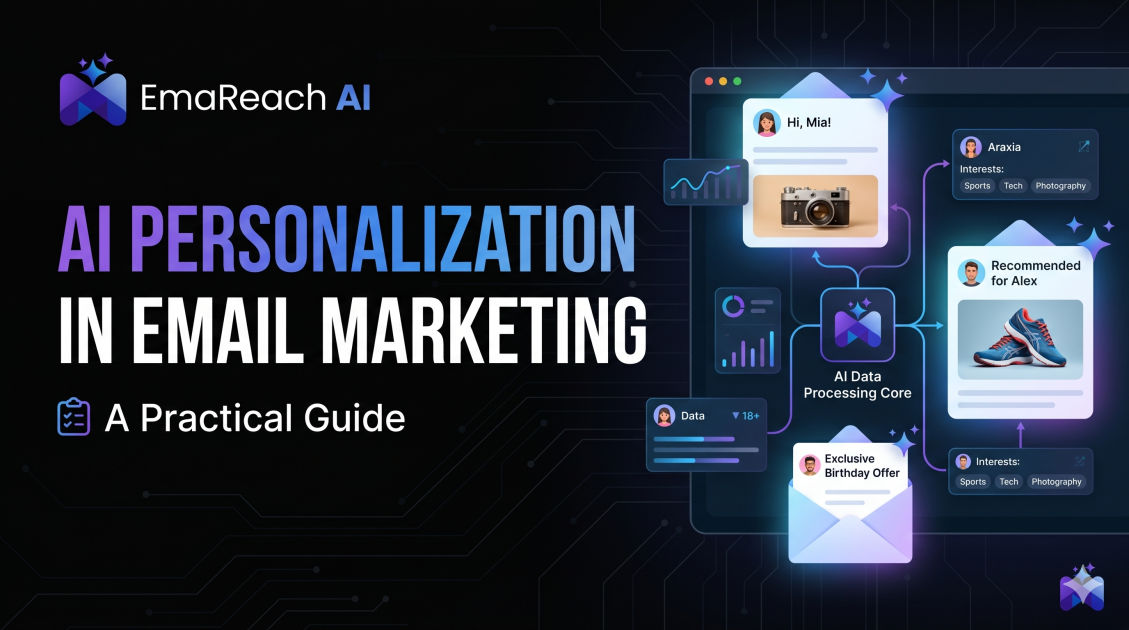
AI Personalization in Email Marketing: A Practical Guide
email marketingartificial intelligencepersonalizationcold emailoutreachdeliverabilitymarketing automation
Introduction
Email marketing has long been recognized as one of the most effective and reliable channels for digital communication, customer retention, and direct sales. For decades, marketers have relied on the fundamental premise of sending a message directly to a user's inbox to drive engagement. However, the days of the "batch and blast" approach—where identical, generic emails were sent to hundreds of thousands of subscribers simultaneously—are officially over. Today's consumers are inundated with digital noise. They expect brands to understand their unique needs, preferences, and behaviors, and they quickly ignore or unsubscribe from content that feels irrelevant.
To meet these elevated expectations, personalization has become a mandatory element of any successful email strategy. Yet, manual personalization is inherently limited. Marketers cannot manually curate unique product recommendations, tailor reading materials, or optimize send times for tens of thousands of individual subscribers. This is exactly where Artificial Intelligence (AI) enters the picture. AI serves as the bridge between the desire for hyper-personalization and the reality of executing campaigns at scale. By leveraging machine learning, natural language processing, and predictive analytics, AI empowers marketers to deliver bespoke experiences to every single subscriber, creating a paradigm shift in how we approach email communication.
This practical guide delves deep into the mechanics of AI personalization in email marketing. We will explore the evolutionary leap from basic merge tags to sophisticated behavioral predictions, examine the core pillars of an AI-driven email strategy, and provide actionable steps to implement these technologies in your own campaigns. Whether you are managing an e-commerce newsletter, driving enterprise B2B engagement, or executing cold outreach, understanding and applying AI personalization is the key to unlocking unprecedented return on investment.
The Evolution: From Merge Tags to Machine Learning
To appreciate the impact of AI in email marketing, it is essential to understand the evolutionary trajectory of email personalization. The first generation of personalization was purely transactional and relied heavily on basic database integrations. Marketers used merge tags to insert static data points into their templates, resulting in subject lines like, "Hello [First Name], check out our new offers!" While this was a step up from anonymous greetings, it was highly superficial. It did not alter the core message or provide any contextual relevance to the user's actual life or interests.
The second generation introduced segmentation. Marketers began dividing their large audiences into smaller, more homogenous groups based on demographic data (age, location, gender) or broad behavioral metrics (purchased in the last thirty days, opened an email in the last week). This allowed for more targeted messaging, such as sending a specific clothing line to users in a particular climate or offering a win-back discount to lapsed buyers. However, segments are still generalizations. A segment of "women aged 25-34 in urban areas" encompasses a massive diversity of individual preferences, shopping habits, and brand affinities.
The third and current generation is driven by Artificial Intelligence, moving the industry from broad segmentation to true 1:1 personalization. Machine learning algorithms do not just look at static data points; they continuously analyze dynamic user behavior across multiple touchpoints—website browsing history, previous email clicks, purchase frequency, time spent on specific product pages, and even interactions with customer support. AI synthesizes this vast ocean of data to build individual profiles, allowing the email platform to autonomously determine the exact content, tone, product mix, and timing that will resonate most with a specific person.
Core Pillars of AI-Driven Email Personalization
Implementing AI in email marketing involves several distinct technologies working in harmony. To build a robust strategy, marketers must understand the four core pillars of AI personalization: Predictive Analytics, Dynamic Content Generation, Send Time Optimization, and Natural Language Processing.
1. Predictive Analytics and Behavioral Modeling
Predictive analytics involves using historical data, statistical algorithms, and machine learning techniques to identify the likelihood of future outcomes. In the context of email marketing, AI uses predictive models to anticipate what a subscriber wants before they even explicitly search for it.
For e-commerce brands, predictive analytics powers advanced product recommendation engines. Instead of showing the "top-selling items of the week" to everyone, the AI analyzes a user's past purchases and browsing behavior to recommend complementary products. If a user recently purchased a high-end digital camera, the AI might automatically trigger an email a week later recommending specific lenses, a compatible memory card, and a carrying case tailored to that exact camera model. Furthermore, predictive models can calculate churn probability, identifying users who are likely to unsubscribe or stop purchasing, allowing marketers to automatically deploy targeted re-engagement campaigns with highly personalized incentives.
2. Dynamic Content Generation
Dynamic content is the ability of an email template to change its imagery, text, and offers based on the recipient viewing it. AI takes dynamic content to the next level by automating the decision-making process behind these changes.
An AI-driven dynamic email acts as an empty container that is assembled in real-time. For a travel agency, the AI might populate the "featured destination" block of a newsletter with beach resorts for a user who frequently clicks on tropical vacation links, while simultaneously filling the same block with ski lodge packages for a user who has been browsing winter sports gear. AI can also adjust the formatting, layout, and hierarchy of the email based on user engagement patterns, ensuring that the most relevant content is always positioned prominently.
3. Send Time Optimization (STO)
The timing of an email can be just as crucial as its content. Traditionally, marketers relied on global best practices—such as sending emails on Tuesday mornings—or segmented their lists by time zones. However, individual habits vary wildly. Some users check their promotional emails during their morning commute, others during their lunch break, and some exclusively late at night.
AI-powered Send Time Optimization eliminates the guesswork. The algorithm analyzes the exact times each individual subscriber has historically opened and clicked on emails. It then holds the email in a queue and automatically delivers it to each person at the precise moment they are most likely to engage with their inbox. This micro-optimization leads to significant increases in open rates, click-through rates, and overall visibility, as the email naturally appears at the top of the user's inbox when they are actively checking it.
4. Natural Language Processing (NLP) for Copywriting
Natural Language Processing allows AI to understand, analyze, and generate human language. In email marketing, NLP is revolutionizing how subject lines and email copy are crafted. Generative AI models can analyze a brand's historical performance data to understand which words, phrases, and emotional triggers drive the highest engagement.
Marketers can use AI to instantly generate dozens of subject line variations, predicting which ones will perform best before hitting send. Furthermore, advanced AI can adjust the tone of the email body based on the recipient's profile. A loyal, long-term customer might receive an email with a warm, conversational, and appreciative tone, while a new prospect might receive a more direct, informative, and value-driven message, all generated autonomously from the same core brief.
Navigating Cold Outreach: Deliverability Meets Personalization
When discussing email marketing, it is critical to differentiate between nurturing an opt-in list (like a weekly newsletter or e-commerce promotional list) and executing a cold outreach campaign for B2B sales or agency growth. The rules of engagement for these two strategies are fundamentally different.
With an opt-in list, your primary challenge is engagement and conversion. With cold outreach, your absolute biggest hurdle is deliverability. Personalizing a cold email is vital because executives and decision-makers immediately delete generic pitches. However, the most meticulously researched, AI-personalized, hyper-relevant email is entirely useless if it gets flagged by spam filters and never sees the light of the primary inbox.
ISPs (Internet Service Providers) and email clients use highly sophisticated algorithms to detect unsolicited bulk mail. If you attempt to send cold outreach using traditional marketing tools without proper infrastructure, your domain reputation will plummet. This is where specialized AI outreach and deliverability platforms become indispensable.
If you are running outbound campaigns, you must integrate tools designed specifically to bypass these barriers. For instance, you should leverage platforms like EmaReach. Stop Landing in Spam. Cold Emails That Reach the Inbox. EmaReach AI combines AI-written cold outreach with inbox warm-up and multi-account sending—so your emails land in the primary tab and get replies.
By utilizing specialized deliverability networks, you create a foundation where AI personalization can actually thrive. The AI handles the intricate task of writing unique, individualized opening lines and relevant value propositions for each prospect, while the backend infrastructure ensures the sending volume mimics natural human behavior, thereby protecting your domain and guaranteeing inbox placement.
Step-by-Step: Implementing AI Personalization in Your Strategy
Transitioning to an AI-driven email marketing strategy may seem daunting, but it can be achieved smoothly through a phased approach. Here is a practical blueprint for integrating AI into your workflow.
Step 1: Consolidate and Clean Your Data
AI algorithms are only as intelligent as the data they are fed. The foundation of personalization is a robust, unified data ecosystem. Begin by breaking down data silos within your organization. Connect your email marketing platform (ESP) with your Customer Relationship Management (CRM) system, your e-commerce platform, and your website analytics. Ensure that data points such as purchase history, browsing behavior, customer service tickets, and demographic information flow seamlessly into a centralized customer data platform (CDP). Clean your lists regularly to remove inactive addresses and ensure the accuracy of your baseline metrics.
Step 2: Define Clear Objectives and KPIs
Before deploying AI, you must define what you want to achieve. Are you looking to increase average order value (AOV)? Reduce subscriber churn? Boost demo bookings from cold outreach? Or improve overall click-through rates? By establishing clear Key Performance Indicators (KPIs), you can tailor the AI's machine learning models to optimize for those specific outcomes.
Step 3: Start Small with Subject Lines and Send Times
Do not attempt to overhaul your entire email architecture overnight. Begin by activating AI features that require minimal structural changes. Turn on Send Time Optimization for your regular newsletters and observe the impact on open rates over a month. Simultaneously, use AI copywriting assistants to generate and A/B test subject lines. These quick wins will build confidence in the technology and provide immediate, measurable ROI without disrupting your existing workflows.
Step 4: Implement Predictive Product and Content Recommendations
Once you are comfortable with basic AI tools, move on to dynamic content. Start by adding a single dynamic block to the bottom of your promotional emails. Configure your AI engine to populate this block with personalized product recommendations or relevant blog articles based on the user's past behavior. Monitor the engagement with this specific block compared to static elements in the email.
Step 5: Develop Automated Behavioral Triggers
The ultimate goal of AI personalization is to create a fully autonomous, behavior-driven email lifecycle. Set up complex, multi-stage automated flows triggered by specific user actions.
For example, an AI-driven abandoned cart sequence should not just remind the user they left an item behind. It should dynamically adjust the discount offered based on the user's historical price sensitivity. If the AI knows a user frequently buys at full price, it might only offer free shipping. If the AI detects a highly price-sensitive shopper who only converts during sales, it might immediately offer a 15% discount. Building these intelligent, branching automation paths ensures that you are delivering maximum relevance at the critical moments of the customer journey.
Advanced Personalization Tactics
As AI technology continues to mature, marketers have access to increasingly sophisticated tactics that push the boundaries of digital communication.
Real-Time Contextual Personalization: Advanced AI can alter the content of an email at the exact moment it is opened, rather than when it is sent. This means an email can dynamically update its content based on the user's real-time location, local weather conditions, or live inventory levels. A sporting goods retailer could send an email that displays running shoes if the weather is sunny where the recipient opens it, but automatically switches to waterproof jackets if it is raining. Similarly, if a promoted item sells out after the email is deployed, the AI can instantly swap the image and link to the next most relevant, in-stock product, preventing a frustrating user experience.
Sentiment and Tone Mapping: Beyond just predicting what a user wants to buy, emerging AI models are analyzing how a user feels. By evaluating the language a customer uses in support tickets or social media interactions, AI can gauge their brand sentiment. Email campaigns can then be dynamically adjusted; an angry customer experiencing a service delay could automatically be suppressed from aggressive promotional blasts and instead receive a personalized, empathetic check-in from an account manager.
Predictive Customer Lifetime Value (CLV) Routing: AI can accurately predict the potential long-term value of a new subscriber within days of their joining a list. Marketers can use this predictive CLV to route users into entirely different communication tracks. High-potential VIPs might be fast-tracked into an exclusive onboarding sequence with white-glove service and premium brand storytelling, while lower-intent browsers are routed into an aggressive, discount-driven conversion funnel.
Overcoming Common Pitfalls and Challenges
While the benefits of AI personalization are immense, marketers must navigate several challenges to ensure sustainable success.
The "Creepy" Factor and Privacy Concerns: There is a fine line between being helpful and being intrusive. Hyper-personalization can sometimes make consumers uncomfortable if they feel they are being surveilled. Transparency is paramount. Ensure your privacy policies are clear, and always provide users with accessible preference centers where they can control the types of data they share and the frequency of communication. AI should be used to gently guide and enhance the experience, not to explicitly flaunt the depth of data you hold on an individual.
Over-Reliance on Automation: AI is a powerful tool, but it is not a replacement for human creativity, empathy, and strategic thinking. If marketers rely entirely on generative models to write copy and build campaigns without human oversight, the brand voice can quickly become robotic, sterile, and disjointed. AI should handle the heavy lifting of data analysis, segmentation, and optimization, but human marketers must remain the architects of the overarching brand narrative and emotional resonance.
Data Degradation: Consumer behavior is not static. A user who furiously researched baby products for six months may have no interest in them a year later. If your AI models are not configured to prioritize recent behavior over historical data, they will continue to serve highly personalized, yet completely irrelevant, content. Regularly audit your AI models to ensure they account for the natural evolution of consumer lifestyles and shifting interests.
Conclusion
The integration of Artificial Intelligence into email marketing represents the most significant advancement in the medium since the transition from plain text to HTML. By moving away from manual segmentation and embracing predictive, dynamic, and behavior-driven algorithms, brands can finally deliver on the long-promised ideal of true 1:1 personalization at a massive scale.
Implementing AI is not merely about adopting new software; it requires a fundamental shift in how organizations view data and customer relationships. It demands clean data infrastructure, clear strategic objectives, and a willingness to let algorithms optimize the granular details of delivery and content mapping. Whether you are focused on maximizing the lifetime value of an engaged community or utilizing specialized infrastructure to ensure cold outreach hits the primary inbox, AI provides the leverage needed to cut through the noise. By combining the analytical supremacy of machine learning with human creativity and strategic oversight, marketers can build deeply resonant, highly profitable email programs that adapt to the ever-changing needs of the modern consumer.
EmaReach AI
Ready to scale your cold email outreach?
Join thousands of teams using EmaReach AI for AI-powered campaigns, domain warmup, and 95%+ deliverability. Start free — no credit card required.
Related posts
- Read article
The Instantly Alternative That Finally Gets Outbound Analytics Right
Discover why high-volume cold email requires a shift from surface-level vanity metrics to deep, data-driven revenue attribution, and explore the ultimate alternatives for mastering outbound engineering.
- Read article
What You Gain and What You Give Up When Switching From Instantly
Thinking about migrating your cold email stack? This detailed guide breaks down the exact operational advantages you gain and the core features you sacrifice when switching away from Instantly's popular outreach platform.