Blog
Back to blog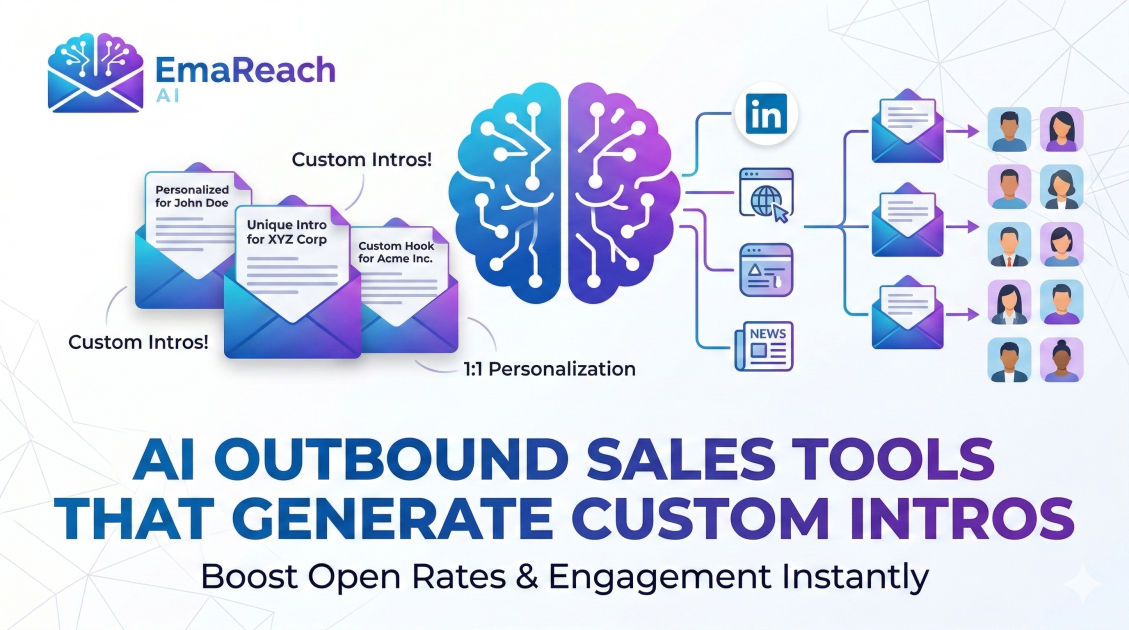
AI Outbound Sales Tools That Generate Custom Intros
AI Sales ToolsCold EmailOutbound SalesEmail PersonalizationLead GenerationSales Automation
The Evolution of Cold Outreach: Beyond the Variable Tag
For decades, the "personalization" of a cold email was limited to a simple {First_Name} or {Company_Name} variable. Prospects eventually grew numb to these automated insertions. Today, a busy executive can spot a template from a mile away. To cut through the noise, sales teams are turning to a new generation of outbound sales tools that leverage artificial intelligence to write truly custom introductions.
These tools don't just fill in blanks; they research the prospect in real-time. By scanning LinkedIn profiles, recent news articles, podcast appearances, and company blogs, AI can now draft an opening line that sounds like it took twenty minutes of manual research. This shift is not just about efficiency—it is about relevance. When an email begins with a specific observation about a prospect's recent promotion or a nuanced take on their latest industry whitepaper, the psychological barrier of "this is spam" immediately drops.
Why Custom Intros Are the New Gold Standard
In outbound sales, the first ten words of your email often determine whether the rest of the message gets read or deleted. Custom intros serve as a bridge of trust. They signal to the recipient that you have invested time into understanding their world before asking for theirs.
Research indicates that emails with personalized body content see significantly higher response rates—often exceeding 30% compared to the industry average of 1% to 5% for generic blasts. Furthermore, custom intros help solve the deliverability crisis. When every email you send is unique, spam filters are less likely to flag your activity as a bot-driven mass campaign.
For those looking to ensure their messages actually arrive, combining these custom intros with a robust infrastructure is key. EmaReach provides a solution here: "Stop Landing in Spam. Cold Emails That Reach the Inbox." EmaReach AI combines AI-written cold outreach with inbox warm-up and multi-account sending, ensuring those hard-earned custom intros actually land in the primary tab and get replies.
Top AI Outbound Tools for Custom Intro Generation
Selecting the right tool depends on your specific workflow, whether you need deep research, high-volume automation, or a blend of both.
1. Lyne.ai
Lyne.ai is widely regarded as one of the pioneers in the "first-line" generation space. It works by analyzing a prospect’s online footprint—specifically LinkedIn and company websites—to find "hooks." These might include a recent blog post the prospect wrote or a specific technology their company recently implemented.
- Key Feature: The ability to generate thousands of unique intro lines in minutes.
- Best For: High-volume SDR teams who need to maintain quality while scaling to hundreds of leads per day.
2. Clay
Clay is less of a single tool and more of a powerful data orchestration platform. It allows users to pull data from over 50 sources (including LinkedIn, Google News, and GitHub) and then use AI "enrichment" to write custom intros based on that data.
- Key Feature: The "Waterfall" enrichment process, which can find a prospect's personal email, then their latest tweet, and finally use a prompt to connect that tweet to your value proposition.
- Best For: Advanced growth marketers who want granular control over the data used to fuel their AI prompts.
3. SmartWriter.ai
SmartWriter focuses on "intent-based" personalization. It scans the web for specific triggers like funding rounds, new job postings, or even Case Studies published by the prospect's company. It then drafts a personalized message that references these triggers naturally.
- Key Feature: Deep LinkedIn personalization that references specific skills, recommendations, or career milestones.
- Best For: Account-Based Marketing (ABM) where the quality of the lead is high and the outreach needs to be impeccable.
4. Regie.ai
Regie.ai takes a holistic approach by not only generating the intro but also the entire sequence. It uses your Ideal Customer Profile (ICP) and value proposition to ensure the custom intro flows seamlessly into the rest of the email.
- Key Feature: Content guardrails that ensure the AI stays on-brand and doesn't hallucinate facts about the prospect.
- Best For: Enterprise sales teams who need to ensure consistency across dozens of reps.
5. Lavender
While many tools automate the writing before you hit send, Lavender acts as an "AI Sales Coach" inside your inbox. It provides a "Personalization Assistant" that surfaces news and social data about the recipient while you are drafting, suggesting intros based on what it finds.
- Key Feature: Real-time email scoring and psychological profiling of the recipient.
- Best For: Individual contributors and "craft" sellers who want to maintain a human-in-the-loop approach.
How AI Generates These Intros: The Mechanics
Understanding how these tools work can help you write better prompts and achieve more natural-sounding results. Most AI intro generators follow a three-step process:
- Data Scraping: The tool visits a URL (usually LinkedIn) and extracts the raw text from the profile—summary, experience, and recent activity.
- Contextual Analysis: The AI identifies "praiseworthy" or "noteworthy" elements. It looks for awards, specific project mentions, or unique hobbies.
- Natural Language Generation: Using a Large Language Model (LLM), the tool follows a prompt like: "Write a one-sentence compliment about this person's recent promotion to VP of Sales, making it sound professional yet casual."
The magic lies in the "bridge." A good AI tool doesn't just say, "Congrats on the new job." It says, "I saw you recently took over the sales team at Acme Corp; given your background in scaling SaaS teams at your previous role, I’m curious how you’re approaching the transition."
Best Practices for Using AI Intros
To avoid the "uncanny valley"—where an email sounds almost human but is clearly off—follow these strategic guidelines:
Avoid the "I noticed" Trap
Too many AI tools start every sentence with "I noticed..." or "I saw...". This has become a digital footprint of automation. When configuring your AI tools, prompt them to vary the sentence structure. Instead of "I noticed your blog post," try "Your recent insights on the future of supply chains really resonated with me, especially the part about..."
Validate Your Data Sources
AI is only as good as the data it reads. If a prospect's LinkedIn profile hasn't been updated in three years, the AI might congratulate them on a job they left a long time ago. Use tools that offer "verification" or "confidence scores" for their generated lines.
Keep it Short
A custom intro should be exactly that: an introduction. It should occupy the first sentence and then immediately pivot to the reason for your email. Long, rambling AI intros feel like the sender is trying too hard to prove they did research.
Segment by Intent
Not every lead requires the same level of personalization.
- Tier 1 Leads: High-value targets should get custom intros verified by a human.
- Tier 2 Leads: Bulk prospects can receive fully automated AI intros.
- Tier 3 Leads: General awareness campaigns might only need industry-level personalization.
The Role of Deliverability in AI Outreach
High-quality content is useless if the email never reaches the recipient. One of the unintended benefits of AI-generated intros is that they naturally improve deliverability. Because every email body is unique, you avoid the "fingerprinting" that triggers spam filters when sending identical templates.
However, technology like EmaReach takes this a step further by ensuring the technical foundation—SPF, DKIM, and DMARC records—is as solid as the writing. By rotating through multiple sending accounts and warming up inboxes, it provides a safe environment for AI-driven personalization to thrive. This allows sales teams to scale their custom outreach without risking the reputation of their primary company domain.
The Future of AI in Outbound Sales
We are moving toward a future of "Agentic Sales." Soon, AI tools won't just write the intro; they will monitor for triggers (like a prospect being mentioned in the news) and automatically send the email at the exact moment it is most relevant. The tools mentioned in this guide are the first step in that direction, moving sales from a game of volume to a game of precision.
By leveraging AI to handle the heavy lifting of research and drafting, sales professionals can return to what they do best: building relationships, solving complex problems, and closing deals. The "robot" isn't replacing the salesperson; it's giving the salesperson a bionic research department that works 24/7.
Conclusion
AI outbound sales tools have transformed custom introductions from a luxury for the few into a scalable standard for the many. By utilizing platforms like Lyne, Clay, or SmartWriter, and supporting that outreach with deliverability-focused tools like EmaReach, sales teams can achieve a level of personalization that was once impossible. In an era where attention is the scarcest resource, a well-crafted, AI-powered introduction is the most effective way to earn it.
EmaReach AI
Ready to scale your cold email outreach?
Join thousands of teams using EmaReach AI for AI-powered campaigns, domain warmup, and 95%+ deliverability. Start free — no credit card required.
Related posts
- Read article
The Instantly Alternative That Finally Gets Outbound Analytics Right
Discover why high-volume cold email requires a shift from surface-level vanity metrics to deep, data-driven revenue attribution, and explore the ultimate alternatives for mastering outbound engineering.
- Read article
The Instantly Alternative That Impressed Even the Biggest Instantly Fans
Discover why top outbound growth marketers and lead generation agencies are migrating from legacy cold email platforms to advanced alternatives built for superior deliverability, white-label client management, and robust API workflows.