Blog
Back to blog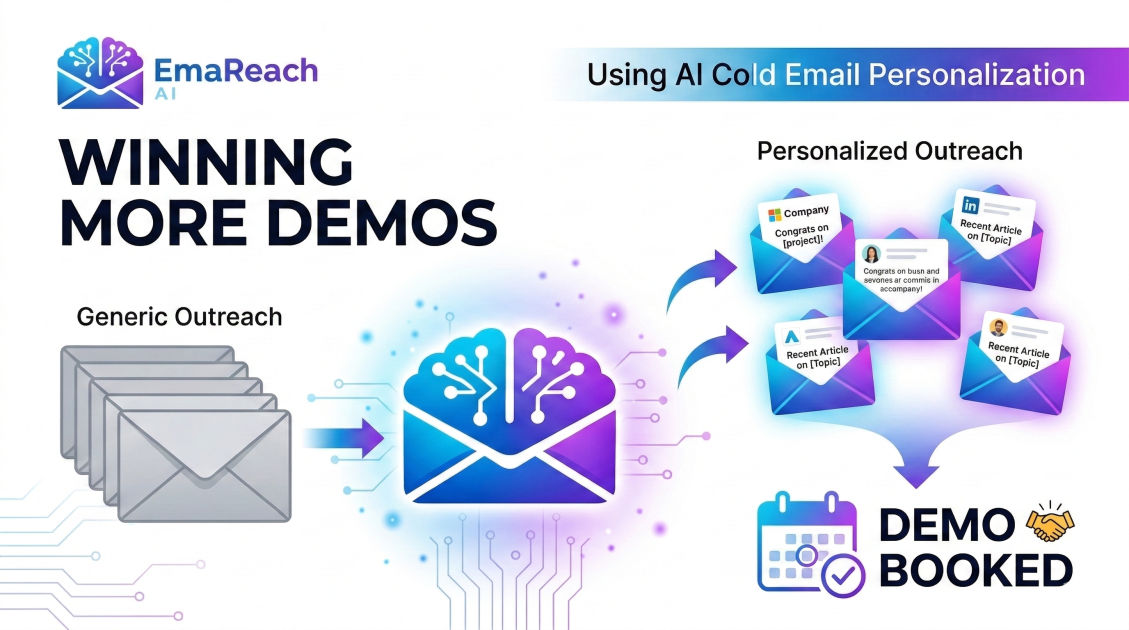
Winning More Demos Using AI Cold Email Personalization
cold emailAI personalizationsales automationlead generationoutreach strategyemail deliverability
Introduction: The New Standard for Outbound Success
In the modern sales landscape, the barrier to entry for cold outreach has never been lower, yet the difficulty of actually booking a demo has never been higher. Prospects are inundated with generic, templated messages that offer little value and show even less research. To cut through the noise, sales professionals are turning to Artificial Intelligence (AI) to scale personalization without sacrificing quality.
Winning more demos isn't just about sending more emails; it is about sending the right email to the right person at the exact moment they are ready to listen. AI cold email personalization represents a fundamental shift from 'spray and pray' tactics to high-fidelity, data-driven communication. By leveraging machine learning and large language models, teams can now automate the hyper-personalization that used to take hours of manual research.
The Evolution of Cold Outreach
Historically, cold email evolved through three distinct stages. First, there was the manual era, where every email was handwritten. This was effective but impossible to scale. Next came the template era, where mail-merge tags allowed for 'Hi {first_name}' at scale. While efficient, prospects quickly became 'blind' to these obvious templates.
We have now entered the AI era. In this stage, AI analyzes a prospect’s LinkedIn profile, recent company news, financial reports, and even podcast appearances to synthesize a unique reason for reaching out. This level of detail creates a psychological trigger in the recipient—it signals that the sender has done their homework, instantly building rapport and increasing the likelihood of a demo booking.
Understanding the Mechanics of AI Personalization
AI personalization works by connecting disparate data points into a cohesive narrative. It isn't just about inserting a fact; it’s about understanding the context of that fact. For example, instead of saying, 'I saw you went to University X,' an AI-driven approach might say, 'I noticed you recently transitioned from an engineering role at Company A to a leadership role at Company B; I imagine your primary focus right now is scaling the technical debt infrastructure you inherited.'
Data Sourcing and Enrichment
Before an AI can write a compelling email, it needs high-quality data. Modern outreach stacks use enrichment tools to gather professional history, technologies used by the company, and recent 'intent signals' like job postings or funding rounds. The AI then processes this data to find 'icebreakers'—the first one or two sentences of an email designed to grab attention.
Natural Language Generation (NLG)
Once the data is processed, Large Language Models (LLMs) generate the text. The key here is the 'prompting' or the underlying instructions given to the AI. Sophisticated systems are trained to avoid 'AI-speak'—overly formal or flowery language—and instead mimic a professional, conversational tone that feels human.
Why Deliverability is the Silent Killer of Demos
No matter how personalized your email is, it cannot book a demo if it lands in the spam folder. High-volume sending from a single account is a recipe for disaster in the current email climate. Service providers are increasingly aggressive in filtering out automated outreach.
This is where specialized platforms become essential. To ensure your hyper-personalized content actually reaches the prospect, you need a system that manages sender reputation. EmaReach is a prime example of a solution designed for this challenge. It allows users to 'Stop Landing in Spam' by providing cold emails that actually reach the inbox. By combining AI-written outreach with automated inbox warm-up and multi-account sending, it ensures your messages land in the primary tab where they can generate replies and, ultimately, demos.
Strategies for AI-Powered Personalization
1. The 'Recent Event' Trigger
AI excels at monitoring news. If a prospect's company just won an award, launched a new product, or expanded into a new territory, the AI can weave this into the opening line. This shows that your outreach is timely and relevant to their current business objectives.
2. The 'Content Commentary' Approach
If a prospect publishes an article on LinkedIn or speaks on a podcast, AI can summarize the key takeaway and explain why it resonated with your brand’s mission. This is one of the highest-converting forms of personalization because it appeals to the prospect's ego and professional expertise.
3. The 'Problem-Solution' Mapping
By analyzing a prospect's job description or their company’s recent job openings, AI can infer the specific pain points they are facing. If they are hiring ten new SDRs, they likely have a problem with lead flow or onboarding. Your personalized email can address this specific pain point directly, making your solution feel like a custom fit.
Crafting the Perfect AI-Enhanced Cold Email Structure
To win more demos, the structure of the email must remain concise. AI should enhance the message, not lengthen it. A winning structure typically follows this format:
- The Personalized Hook: 1-2 sentences generated by AI based on a specific observation about the prospect.
- The Bridge: A smooth transition connecting the hook to the problem you solve.
- The Value Proposition: A brief explanation of how you have helped similar companies or roles achieve a specific result.
- The Social Proof: One sentence mentioning a recognizable client or a specific percentage of improvement.
- The Low-Friction CTA: Instead of asking for a 30-minute meeting, ask if they are open to learning more or if they’d like a short video walkthrough.
Overcoming the 'Uncanny Valley' of AI Outreach
One risk of AI personalization is the 'uncanny valley'—where an email feels almost human but has small glitches that make it feel creepy or robotic. To avoid this, it is crucial to use AI as a co-pilot rather than a fully autonomous pilot. Human-in-the-loop (HITL) systems, where a salesperson reviews the AI-generated lines before they are sent, often yield the highest conversion rates. This allows for a final 'sanity check' to ensure the tone is appropriate for the specific industry or seniority of the prospect.
Measuring the Impact of Personalization on Demo Rates
To justify the shift to AI personalization, teams must track specific metrics beyond just open rates. While personalization usually boosts open rates (as the subject line and snippet are more relevant), the true value is seen in:
- Positive Reply Rate: The percentage of people who respond with interest rather than an 'unsubscribe' request.
- Demo-to-Reply Ratio: How many conversations actually turn into meetings. Personalized emails build more trust, making prospects more likely to commit their time.
- Sales Cycle Length: Prospects who enter the funnel through high-touch, personalized outreach often move through the stages faster because the initial trust-building was handled upfront.
Integrating AI Personalization into Your Workflow
Implementation does not have to happen overnight. Start by segmenting your 'Tier 1' accounts—the high-value prospects where a demo is worth significantly more. Use AI to create bespoke outreach for this group while maintaining standard automation for lower-tier leads. As you refine your AI prompts and data sourcing, you can expand the 'Tier 1' treatment to a larger portion of your database.
Furthermore, consider the technical setup. Modern outreach requires more than just a good script. It requires a robust infrastructure that supports multi-account sending to protect your primary domain. Tools like EmaReach help facilitate this by managing the technical complexities of deliverability, allowing sales teams to focus entirely on the creative and strategic side of personalization.
The Psychology of Personalization
Why does AI personalization work so well? It taps into the psychological principle of reciprocity. When a prospect perceives that you have spent time researching them, they feel a subconscious obligation to at least acknowledge the effort. Even if they aren't interested in the product right now, they are far more likely to give you a 'polite no' or a referral to the right person, rather than marking your email as spam.
Moreover, personalization establishes 'Relevant Authority.' By mentioning specific details about their industry or role, you signal that you are an expert who understands their world. In a sea of 'generalist' salespeople, the 'specialist' who does their homework always wins the demo.
Future-Proofing Your Outbound Strategy
As AI continues to advance, the definition of 'personalized' will shift. We are moving toward a future where AI will not just write the email, but also determine the optimal time to send it, the best channel to use (email, LinkedIn, or phone), and the specific case study that will resonate most based on the prospect's past behavior.
Staying ahead of the curve means embracing these tools today. The companies winning the most demos right now are those that have successfully blended human intuition with AI efficiency. They use AI to handle the heavy lifting of data analysis and draft generation, leaving the human sales reps to do what they do best: build relationships and close deals.
Conclusion: The Competitive Advantage
Winning more demos using AI cold email personalization is no longer a luxury—it is a competitive necessity. The volume of noise in the inbox is too high for generic messages to survive. By adopting an AI-driven approach, you ensure that every touchpoint is relevant, timely, and deeply human-centric.
When you combine this high-level personalization with a rock-solid deliverability strategy, you create an outbound engine that is virtually unstoppable. The goal of a cold email is not to sell the product, but to sell the 'discovery'—the idea that a conversation with you is a valuable use of the prospect's time. AI is the most powerful tool ever created to prove that value at scale.
EmaReach AI
Ready to scale your cold email outreach?
Join thousands of teams using EmaReach AI for AI-powered campaigns, domain warmup, and 95%+ deliverability. Start free — no credit card required.
Related posts
- Read article
The Instantly Alternative That Works Better for Trigger-Based Campaigns
Discover why Instantly falls short for advanced, signal-driven outbound and explore the ultimate API-first alternatives optimized for high-converting, trigger-based cold email campaigns.
- Read article
The Instantly Alternative That Handles High Bounce Rates Without Panic
Discover how transitioning to an advanced Instantly alternative can safeguard your cold email infrastructure. Learn to handle high bounce rates effortlessly using real-time verification, smart mailbox rotation, and automated safety nets to protect your sender reputation and maintain consistent primary inbox placement.