Blog
Back to blog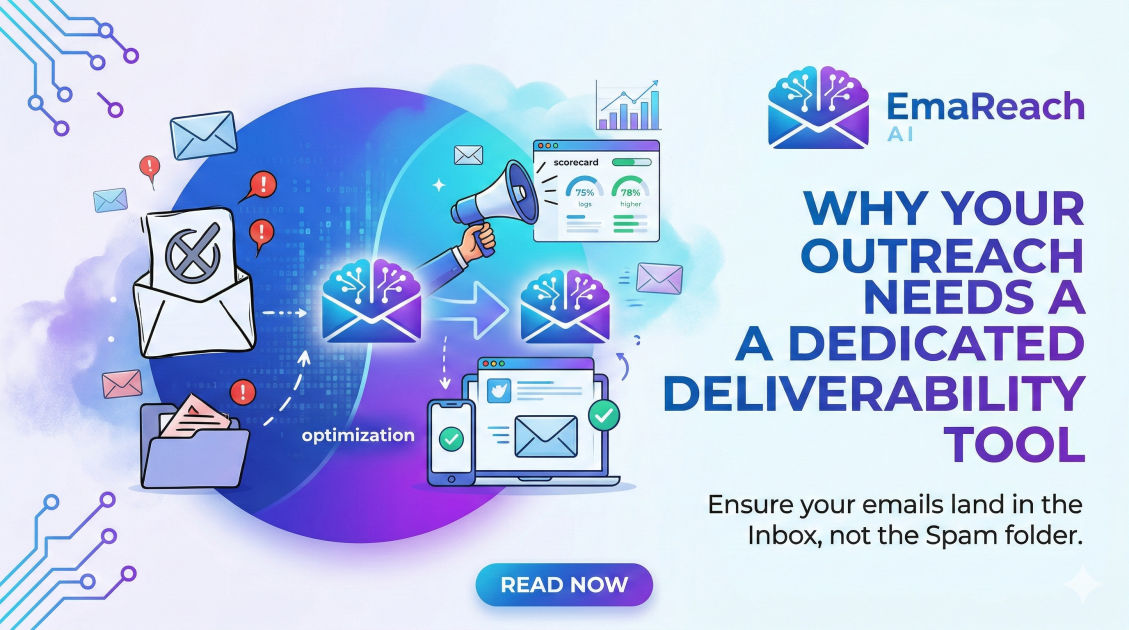
Why Your Outreach Needs a Dedicated Deliverability Tool
cold emailoutreachdeliverabilityemail marketingsales automationb2b sales
The Silent Killer of Outreach Campaigns
You have spent weeks identifying the perfect prospects. You have meticulously crafted a value proposition that addresses their deepest pain points. Your sequences are timed to perfection. But as you hit 'send,' a silent mechanism shifts in the background. Instead of arriving in the primary inbox of your future client, your message is diverted. It bypasses the eyes of your prospect and lands in the digital equivalent of a black hole: the spam folder.
In the modern landscape of digital communication, sending an email is no longer a guarantee of it being seen. Mail Service Providers (MSPs) like Google and Outlook have become increasingly sophisticated, deploying complex algorithms designed to protect users from unwanted noise. While these filters are essential for consumer safety, they often catch legitimate B2B outreach in their nets. This is why a dedicated deliverability tool is no longer a 'nice-to-have'—it is the foundation of a successful outreach strategy.
Understanding the Deliverability Gap
Many marketers confuse 'delivery' with 'deliverability.' They are not the same. Delivery refers to whether the receiving server accepted your email. Deliverability, or 'inbox placement,' refers to where that email ends up—the primary inbox, the promotions tab, or the dreaded spam folder.
If your delivery rate is 99% but your open rate is 2%, you don't have a messaging problem; you have a deliverability problem. A dedicated tool bridges this gap by providing visibility into the technical health of your sending infrastructure, which is often invisible to standard email marketing platforms.
The Anatomy of Email Reputation
Your ability to reach the inbox depends on three core pillars: Technical Setup, Sender Reputation, and Content Quality. Without a dedicated tool, managing these pillars is like trying to navigate a ship in a storm without a compass.
- IP Reputation: The 'trust score' of the server sending your mail.
- Domain Reputation: The history of your specific web address in the eyes of filters.
- Authentication Protocols: The digital passports (SPF, DKIM, DMARC) that prove you are who you say you are.
Why Standard Outreach Platforms Aren't Enough
Most sales engagement platforms are designed for execution, not diagnostics. They excel at scheduling follow-ups and tracking clicks, but they rarely tell you why your emails are being blocked. They provide the 'what' (a low open rate) but leave you guessing on the 'how' to fix it.
Dedicated deliverability tools focus on proactive maintenance. For instance, EmaReach (https://www.emareach.com/) takes a comprehensive approach. It doesn't just send emails; it ensures they reach the inbox by combining AI-written outreach with automated inbox warm-up and multi-account sending. This ensures your emails land in the primary tab where they actually get replies, rather than languishing in the promotions graveyard.
The Power of Automated Warm-up
One of the primary reasons outreach campaigns fail is 'cold sending.' If you suddenly go from sending zero emails to 500 a day on a new domain, filters flag you as a potential spammer.
How Warm-up Works
A dedicated tool automates the process of building your reputation. It sends a low volume of emails to a network of 'friendly' inboxes that are programmed to open the messages, mark them as 'not spam,' and reply. This peer-to-peer interaction signals to Google and Outlook that your content is valuable and desired. Over time, this raises your sender score, allowing you to scale your volume without triggering alarms.
Technical Monitoring: SPF, DKIM, and DMARC
Authentication is the first hurdle your email faces. If your DNS records are misconfigured, your emails may be rejected before they are even scanned for content.
- SPF (Sender Policy Framework): Specifies which IP addresses are authorized to send mail for your domain.
- DKIM (DomainKeys Identified Mail): Adds a digital signature to your emails, ensuring they haven't been tampered with in transit.
- DMARC (Domain-based Message Authentication, Reporting, and Conformance): Tells the receiving server what to do if the first two checks fail.
A deliverability tool monitors these records 24/7. If a change in your hosting provider or a manual error breaks one of these links, the tool alerts you immediately. Without this, you might spend weeks sending emails that are destined for rejection.
Real-Time Blacklist Monitoring
There are hundreds of public blacklists that track 'bad' senders. If your domain or IP ends up on one of these lists, your deliverability will plummet instantly.
Blacklisting can happen for many reasons: a sudden spike in volume, high bounce rates, or 'spam traps' (old email addresses used by providers to catch scrapers). A dedicated tool scans these blacklists in real-time. If you are flagged, the tool provides the exact steps needed to request a delisting, saving you from a prolonged outreach blackout.
Content Analysis and Spam Trigger Detection
It isn't just about technical settings; what you say matters. Modern filters use Natural Language Processing (NLP) to scan for 'spammy' patterns. Words like 'Free,' 'Guarantee,' or excessive use of exclamation points can trigger a filter.
Dedicated tools offer content 'sandboxing.' Before you send your campaign to 1,000 prospects, the tool runs it through multiple spam filters and gives you a score. It identifies exactly which phrases are causing friction and suggests alternatives. This allows you to optimize your copy for the algorithm as much as for the human reader.
The Shift to Multi-Account Sending
The era of 'one domain, one account' for massive outreach is over. Pushing too much volume through a single inbox is a high-risk strategy. If that one account gets flagged, your entire operation stops.
A dedicated deliverability tool facilitates Multi-Account Sending. By distributing your daily volume across ten or twenty different accounts (e.g., name@company.com, name@getcompany.com), you stay under the radar of volume-based filters. This decentralized approach is a core feature of platforms like EmaReach, which manages this complexity for you, ensuring that even if one account hits a snag, the rest of your campaign continues seamlessly.
Bounce Management and List Hygiene
Sending emails to non-existent addresses is a major red flag for MSPs. It suggests that your list was poorly sourced or purchased. High bounce rates (typically over 3%) destroy your reputation quickly.
A deliverability tool integrates with verification services to 'clean' your list before the first email is sent. It identifies catch-all addresses, temporary inboxes, and syntax errors. By ensuring your list is 100% valid, you protect your sender score and ensure your data reflects actual engagement.
The ROI of Deliverability Tools
Consider the math. If you spend $5,000 a month on sales reps and lead data, but only 50% of your emails reach the inbox, you are effectively throwing $2,500 into the trash every month.
A dedicated tool might cost a fraction of that, but it can increase your inbox placement to 90% or higher. The increase in open rates leads directly to more meetings, more demos, and more closed deals. In this light, a deliverability tool isn't an expense; it's a high-yield investment in your revenue pipeline.
Future-Proofing Your Outreach
The rules of the game are constantly changing. Major providers are always updating their requirements for senders. Recently, we have seen stricter mandates for one-click unsubscribes and lower thresholds for reported spam rates.
A dedicated tool evolves with these changes. While you focus on closing deals, the tool developers are busy updating their systems to comply with the latest industry standards. This peace of mind allows your team to remain agile and focused on high-level strategy rather than technical firefighting.
Practical Steps to Implementing a Deliverability Strategy
- Audit Your Current Setup: Use a tool to check your current SPF/DKIM/DMARC status.
- Activate Warm-up: Even if you aren't currently sending, keep your domains 'warm' to maintain reputation.
- Diversify Your Domains: Set up secondary domains specifically for outreach to protect your main corporate domain.
- Monitor Your Scores: Check your sender reputation scores weekly to catch dips before they become crises.
- Use AI Wisely: Leverage platforms that combine deliverability with high-quality content generation to ensure your messages are both seen and valued.
Conclusion
Outreach is becoming more competitive and technically demanding every day. The companies that succeed are those that treat deliverability as a strategic priority rather than a technical footnote. By utilizing a dedicated deliverability tool, you remove the guesswork from your campaigns. You gain the confidence that your hard work is actually being seen by your prospects. Don't let your best ideas die in a spam folder; give your outreach the foundation it deserves.
EmaReach AI
Ready to scale your cold email outreach?
Join thousands of teams using EmaReach AI for AI-powered campaigns, domain warmup, and 95%+ deliverability. Start free — no credit card required.
Related posts
- Read article
The Instantly Alternative That Finally Gets Outbound Analytics Right
Discover why high-volume cold email requires a shift from surface-level vanity metrics to deep, data-driven revenue attribution, and explore the ultimate alternatives for mastering outbound engineering.
- Read article
What You Gain and What You Give Up When Switching From Instantly
Thinking about migrating your cold email stack? This detailed guide breaks down the exact operational advantages you gain and the core features you sacrifice when switching away from Instantly's popular outreach platform.