Blog
Back to blog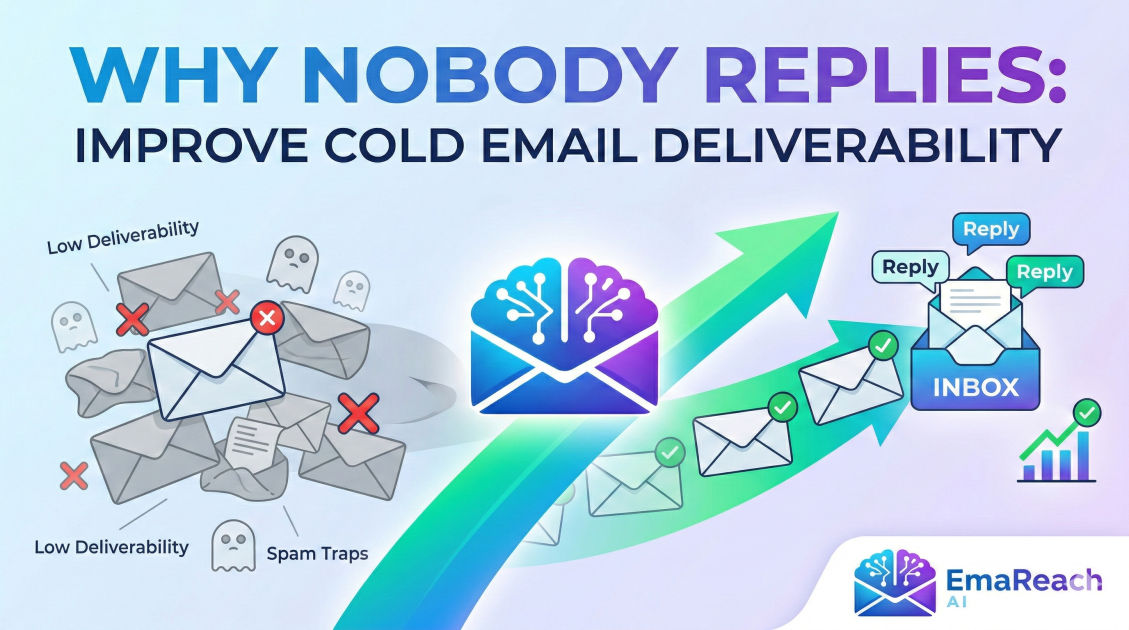
Why Nobody Replies: Improve Cold Email Deliverability
cold emailemail deliverabilityoutreach strategyemail marketingsales tipsinbox placement
Introduction
There is a specific kind of silence that haunts every salesperson, founder, and marketer: the silence of a cold email campaign that yields zero replies. You’ve spent hours researching your prospects, crafting the perfect value proposition, and hitting 'send' on a list of high-value leads. Yet, the metrics show a flatline. No clicks, no opens, and certainly no replies.
While most people immediately blame their copywriting or their offer, the reality is often much more clinical. If your email never makes it to the recipient's primary inbox, it doesn't matter how compelling your subject line is. In the modern landscape of digital communication, the gatekeepers—Internet Service Providers (ISPs) and email service providers—have become incredibly sophisticated.
Improving your cold email deliverability is no longer a 'nice-to-have'—it is the foundation of your entire outbound strategy. Without it, you are shouting into a void. This guide explores the technical, behavioral, and strategic shifts required to ensure your emails actually reach the people who need to read them.
The Technical Foundation: Authentication is Non-Negotiable
Before you send a single word of copy, your technical setup must be flawless. Think of email authentication as your digital passport; without it, you won't even be allowed past the border of the spam filter.
SPF (Sender Policy Framework)
SPF is a DNS record that lists the IP addresses and domains authorized to send emails on behalf of your domain. When an email server receives your message, it checks the SPF record to see if the sender is 'on the list.' If it’s not, your email is flagged as suspicious.
DKIM (DomainKeys Identified Mail)
DKIM adds a digital signature to your emails. This signature ensures that the content of the email hasn't been tampered with during transit. It proves that the email originated from your domain and remained intact from the moment you hit send until it reached the recipient.
DMARC (Domain-based Message Authentication, Reporting, and Conformance)
DMARC sits on top of SPF and DKIM. It tells the receiving server what to do if an email fails the first two checks. You can set it to 'none' (just monitor), 'quarantine' (send to spam), or 'reject' (block entirely). Having a DMARC policy in place is a massive signal to ISPs that you take your domain security seriously.
The Danger of the 'Burned' Domain
One of the most common mistakes in cold outreach is sending high volumes of mail from your primary company domain. If your primary domain (e.g., company.com) gets flagged for spam, your entire team loses the ability to send internal emails or communicate with existing clients.
To prevent this, sophisticated outbound teams use 'lookalike' domains (e.g., getcompany.com or companyapp.io). This isolates your cold outreach activity. However, a new domain has zero reputation. If you start sending 500 emails a day from a brand-new domain, you will be blacklisted instantly. This leads us to the critical process of 'warming up.'
For those looking to streamline this process, EmaReach offers a powerful solution. EmaReach AI combines AI-written cold outreach with inbox warm-up and multi-account sending, ensuring that your emails land in the primary tab rather than the promotions or spam folders.
The Science of Inbox Warm-Up
An inbox warm-up is the process of gradually increasing your sending volume to build a positive reputation with ISPs. In the beginning, you send a few emails a day to accounts known to interact with them (usually automated systems or a network of peer accounts). These accounts open the emails, move them from spam to the inbox if necessary, and reply to them.
This 'engagement' signals to Google, Outlook, and others that you are a legitimate human sender. A proper warm-up period usually lasts between three to four weeks before you begin your actual outreach campaigns. Even once your campaign is live, you should keep the warm-up running in the background to maintain a healthy 'send-to-open' ratio.
Content Triggers: Why Words Matter for Deliverability
Spam filters are essentially pattern-recognition machines. They look for specific 'spammy' characteristics in your content. If your email contains too many red flags, it will be diverted to the junk folder before a human ever sees it.
Avoiding Spam-Trigger Words
Certain words are heavily associated with scams and low-quality marketing. Words like 'Free,' 'Guaranteed,' 'Cash,' 'Urgent,' and 'Act Now' should be used sparingly, if at all. High-pressure sales language is a fast track to the spam folder.
The Link and Attachment Trap
Including links in your first cold email is risky. Multiple links, especially to tracking domains or unverified sites, can trigger filters. Attachments are even worse; unless a prospect is expecting a file from you, an attachment looks like a potential malware threat. Keep your first touchpoint plain text whenever possible.
HTML vs. Plain Text
While beautiful HTML templates work for newsletters, they are a red flag for cold outreach. Legitimate one-to-one business emails are almost always plain text or very simple HTML. The more code your email contains, the more likely it is to be scrutinized by a filter.
List Hygiene: The Hidden Reply Killer
Your deliverability is only as good as your data. Sending emails to addresses that no longer exist or are 'honey pots' (spam traps set by ISPs) will destroy your sender reputation.
High Bounce Rates
A bounce rate over 2-3% is a major warning sign. It tells ISPs that you are either using an old list or, worse, guessing email addresses. Before launching any campaign, run your list through a verification tool to remove 'undeliverable' and 'catch-all' addresses.
Targeted vs. Mass Blasts
The era of 'spray and pray' is over. If you send 1,000 emails and only 5 people open them, your reputation drops. If you send 50 highly targeted emails and 25 people open them, your reputation soars. ISPs track engagement. The more people who ignore or delete your emails without opening them, the harder it will be for your future emails to reach the inbox.
The Power of Personalization and AI
Personalization isn't just about making the prospect feel special; it’s about variance. If you send the exact same 500-word template to 1,000 people, spam filters will recognize the fingerprint of the message. By personalizing each email—changing the intro, the compliment, or the specific value prop—you create unique content for every send.
This is where AI can be a game-changer. By using tools to generate unique, contextually relevant snippets for each lead, you ensure that no two emails are identical. This variance is a key component in bypassing automated filters designed to catch mass-produced templates.
Monitoring Your Reputation
You cannot fix what you do not measure. Regularly check your domain health using various reputation monitoring tools. Look for your presence on major blacklists like Spamhaus or Barracuda. Additionally, monitor your 'Sender Score.' Think of it like a credit score for your email domain; the higher the number, the more likely you are to get 'approved' for inbox delivery.
Key Metrics to Track:
- Open Rate: A low open rate usually indicates a deliverability issue (or a terrible subject line).
- Spam Complaint Rate: This is the most damaging metric. If people manually mark your email as spam, your reputation will tank almost instantly.
- Unsubscribe Rate: While high unsubscribes aren't as bad as spam complaints, they still signal that your content isn't relevant to your audience.
The Behavioral Element: Why Consistency is King
ISPs love predictability. If you send zero emails for three weeks and then suddenly blast 2,000 in one afternoon, that is 'spiky' behavior typical of a hijacked account or a temporary spammer.
Instead, aim for a steady, consistent flow. Use 'sending delays' to space out your emails so they appear like they are being sent by a human manually typing them. Limit the number of emails sent per day per inbox. It is much better to have five inboxes sending 40 emails each than one inbox trying to send 200.
Crafting the 'Primary Tab' Message
To end up in the primary tab of a Gmail user, your email needs to look like a conversation between two professionals.
- Subject Lines: Keep them short (2-4 words). Avoid capitalization and emojis.
- The Hook: Start with something about them, not you.
- The Call to Action (CTA): Instead of asking for a 30-minute meeting (a high-friction request), ask a low-friction question like, 'Is this something you’re currently focused on?'
By lowering the friction, you increase the likelihood of a reply. And every reply you get is a massive 'vote' for your deliverability. When a recipient replies to your email, it tells the ISP that you are a trusted contact, making it almost certain that your next email will land in their primary inbox.
Conclusion
Low reply rates in cold email are rarely the result of a single mistake. Usually, it is a combination of poor technical setup, lack of domain warming, and 'noisy' content that triggers automated filters. By treating deliverability as a technical discipline rather than a marketing afterthought, you set the stage for actual conversations to happen.
Remember to authenticate your domains, warm up your inboxes slowly, keep your lists clean, and use personalization to create unique messages. When you prioritize the 'delivery' as much as the 'message,' you stop being a noise-maker and start becoming a valued contact in your prospect's inbox. Success in cold outreach isn't about how many emails you send; it's about how many of those emails are actually seen.
EmaReach AI
Ready to scale your cold email outreach?
Join thousands of teams using EmaReach AI for AI-powered campaigns, domain warmup, and 95%+ deliverability. Start free — no credit card required.
Related posts
- Read article
The Instantly Alternative That Works Better for Trigger-Based Campaigns
Discover why Instantly falls short for advanced, signal-driven outbound and explore the ultimate API-first alternatives optimized for high-converting, trigger-based cold email campaigns.
- Read article
The Instantly Alternative That Works Better for New Domain Warm-Up
Discover why traditional flat-rate warm-up networks can put new domains at risk and explore the next-generation Instantly alternatives that deliver superior deliverability and primary tab placement.