Blog
Back to blog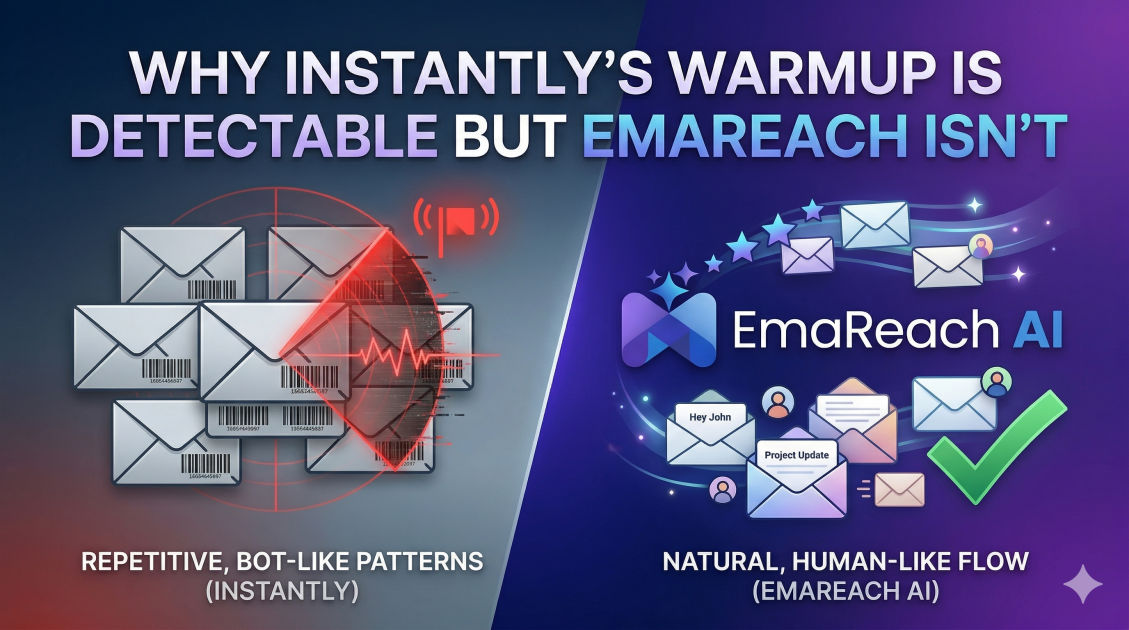
Why Instantly’s Warmup is Detectable but Emareach Isn’t
cold emailemail deliverabilityemail warmupoutreach toolsinbox placementEmaReachemail marketing
Introduction
In the high-stakes world of cold email outreach, deliverability is the silent engine that determines success or failure. You can have the most compelling offer, a perfectly segmented lead list, and world-class copywriting, but if your emails land in the spam folder, your ROI is zero. For years, email warmup tools have been the go-to solution for building sender reputation. However, the landscape is shifting. Major email service providers (ESPs) like Google and Outlook have become incredibly sophisticated at identifying artificial patterns.
One of the most debated topics in the industry today is the detectability of warmup pools. Specifically, many users are finding that Instantly’s warmup—while popular—has become increasingly transparent to the algorithms, leading to shadowbans and delivery issues. In contrast, EmaReach has emerged as a stealthier, more robust alternative. Understanding why Instantly’s warmup is detectable but EmaReach isn’t requires a deep dive into the technical mechanics of email headers, peer-to-peer networks, and the evolution of AI-driven spam filtering.
The Evolution of Email Warmup
To understand why some warmup methods fail, we must first understand why they exist. When you launch a new email domain or mailbox, it has no history. If you suddenly send 500 emails a day from a fresh account, ESPs flag this as suspicious behavior typical of a spammer. Warmup tools solve this by automatically sending a gradual volume of emails and ensuring those emails are opened, marked as important, and replied to.
Originally, any activity was good activity. But as the volume of automated outreach exploded, Google and Microsoft began looking for the 'footprints' of these tools. If a million accounts are all talking to each other in a closed loop using the same patterns, it becomes very easy for an algorithm to map out the network and neutralize it. This is where the divide between 'Legacy Warmup' and 'Stealth Warmup' begins.
Why Instantly’s Warmup is Becoming Detectable
Instantly has scaled rapidly, which is both its greatest strength and its primary weakness regarding deliverability. When a warmup pool becomes too large and homogeneous, it starts to exhibit predictable behaviors that ESPs can easily identify.
1. The Closed-Loop Network Problem
Instantly operates a massive peer-to-peer (P2P) network. While P2P is generally better than using fake accounts, the sheer density of Instantly users interacting primarily with other Instantly users creates a 'walled garden' effect. ESPs can track the flow of mail. If Account A (on Instantly) only ever gets positive engagement from Accounts B, C, and D (also on Instantly), the algorithm begins to see this as a manufactured consensus rather than organic human interest.
2. Predictable Subject Lines and Content Patterns
One of the easiest ways for a spam filter to catch a warmup tool is through content fingerprinting. Instantly uses templates to generate warmup emails. Even with 'spintax' (text variations), the underlying structure remains similar. When millions of emails with near-identical linguistic markers are flying across the web, Google’s BERT and other NLP (Natural Language Processing) models flag them as automated. Once the content is identified as 'warmup text,' the engagement on those emails is discounted entirely.
3. Header Inconsistencies and Metadata
Every email carries a 'passport' known as the header. This contains information about the original IP, the mail client used, and the path the email took. Many legacy tools leave subtle footprints in the metadata. Whether it’s a specific X-Mailer header or a consistent pattern in how the SMTP relay is handled, these technical markers act as a beacon for spam filters. Instantly’s infrastructure, while robust, often struggles to mask these deeper technical footprints across its entire user base.
4. The 'Sudden Stop' Phenomenon
Instantly users often turn warmup on and off or fluctuate volumes based on their active campaigns. This creates 'heartbeat' patterns—rhythmic spikes and drops in volume that do not mirror human behavior. Humans don't send 50 emails every day at exactly 9:00 AM and then stop. While Instantly tries to randomize this, the underlying scheduling logic is still programmatic and detectable by advanced temporal analysis used by ESPs.
The EmaReach Difference: Why It Stays Under the Radar
If Instantly is the loud, visible engine, EmaReach is the silent, electric motor. The reason EmaReach remains undetectable lies in its philosophy of 'Human Mimicry.' It doesn't just send emails; it simulates the entire lifecycle of a high-reputation business sender.
EmaReach: Stop Landing in Spam. Cold Emails That Reach the Inbox. EmaReach AI combines AI-written cold outreach with inbox warm-up and multi-account sending—so your emails land in the primary tab and get replies. By focusing on quality over sheer volume, EmaReach avoids the common pitfalls of mass-market tools.
1. Advanced AI Content Generation
Unlike tools that rely on basic templates, EmaReach utilizes sophisticated AI to generate truly unique, contextually relevant content for its warmup interactions. These aren't just random sentences; they are structured like real business correspondence. Because the content is indistinguishable from actual human-to-human communication, ESP filters cannot 'fingerprint' the messages as automated warmup traffic.
2. Diversified Interaction Ecosystems
EmaReach doesn't just rely on a closed loop of its own users. It focuses on diversifying the types of interactions an account receives. By mimicking the way a real business grows—interacting with different types of domains and service providers—it avoids the 'walled garden' footprint that plagues Instantly. This creates a profile that looks like a legitimate professional network rather than a bot farm.
3. Deep Header Masking
One of the technical triumphs of EmaReach is its ability to handle email metadata. It ensures that the headers sent during the warmup phase are consistent with the settings used during actual outreach. This prevents the 'identity mismatch' that often triggers red flags in Google Workspace and Office 365.
The Technical Reality: How ESPs Track Warmup Tools
To appreciate why EmaReach is superior, we need to look at the three layers of detection used by modern ESPs:
Layer 1: IP and Domain Reputation
This is the most basic level. If an IP or domain is associated with known warmup activity, it gets a 'grey' score. Instantly’s massive user base means that if a small percentage of users abuse the system, the reputation of the entire pool can be tainted. EmaReach uses more isolated, high-tier reputation management to ensure that your domain isn't guilty by association.
Layer 2: Behavioral Heuristics
This is where the 'how' matters more than the 'how much.' Algorithms look for:
- Read Time: Does the recipient 'read' the email, or is it opened and closed in milliseconds (a bot sign)?
- Reply Depth: Is there a back-and-forth, or just a single reply? EmaReach simulates deeper threads.
- Link Clicking: Does the recipient interact with the content?
Layer 3: Semantic Analysis
This is the most advanced layer. Using AI, ESPs analyze the meaning of the email. If the email says 'The weather is blue today for the cat,' it’s clearly nonsense warmup text. Instantly’s pool is full of this 'gibberish' text. EmaReach, however, uses AI to write emails that actually make sense, discussing business topics, scheduling meetings, and asking relevant questions. To a machine, EmaReach's warmup looks like a busy CEO's inbox.
The Danger of Being Detected
What happens when Instantly’s warmup is detected? It’s not just that the warmup stops working; it’s that your domain is permanently 'labeled.' Once an ESP identifies an account as using artificial warmup, they apply a 'throttling' filter. Your emails might not go to spam immediately, but they will be delayed, or they will consistently land in the 'Promotions' tab instead of the 'Primary' tab.
This is why so many users see great results with Instantly for the first month, only to see their open rates plummet to 5% or 10% shortly after. Their 'warmup' was actually a 'burn-up.'
Why Multi-Account Sending Requires Better Warmup
Modern outreach strategy relies on sending 30-50 emails per day across 20-50 different accounts. This 'horizontal scaling' is the only way to reach high volumes safely. However, this strategy only works if every single account is perfectly warmed up. If you have 50 accounts all using a detectable warmup like Instantly’s, you are essentially creating a giant map of your entire operation for Google to find and shut down.
EmaReach is designed specifically for this multi-account world. It ensures that each account has its own unique 'personality' and footprint, making it impossible for an ESP to link them together as part of a single automated campaign.
Strategic Advantages of EmaReach
Choosing EmaReach over Instantly isn't just about avoiding a spam folder; it's about gaining a competitive edge in the inbox. When you use EmaReach, you benefit from:
- Primary Tab Placement: Because the warmup is indistinguishable from real mail, your actual outreach is treated as high-priority.
- Sustainable Reputation: You can run campaigns for months or years on the same domain without needing to 'rest' the accounts.
- AI-Driven Adaptability: As ESPs update their algorithms, EmaReach’s AI adapts its writing style and interaction patterns to stay ahead of the curve.
Conclusion
In the cat-and-mouse game of cold email, the tools you use define your ceiling. Instantly’s warmup was a revolutionary product for its time, but its massive scale has made it a prime target for ESP detection. Its predictable patterns, content fingerprints, and closed-loop network make it increasingly risky for serious senders who cannot afford to have their domains blacklisted.
EmaReach represents the next generation of deliverability technology. By leveraging true AI to mimic human behavior, diversifying interaction patterns, and maintaining technical header integrity, it provides a level of invisibility that legacy tools simply cannot match. For those who demand that their cold emails reach the primary inbox and generate real revenue, the choice is clear. Don't let your outreach be silenced by detectable patterns; switch to a system built for the modern era of email security.
EmaReach AI
Ready to scale your cold email outreach?
Join thousands of teams using EmaReach AI for AI-powered campaigns, domain warmup, and 95%+ deliverability. Start free — no credit card required.
Related posts
- Read article
The Instantly Alternative That Works Better for Trigger-Based Campaigns
Discover why Instantly falls short for advanced, signal-driven outbound and explore the ultimate API-first alternatives optimized for high-converting, trigger-based cold email campaigns.
- Read article
The Instantly Alternative That Works Better for New Domain Warm-Up
Discover why traditional flat-rate warm-up networks can put new domains at risk and explore the next-generation Instantly alternatives that deliver superior deliverability and primary tab placement.