Blog
Back to blog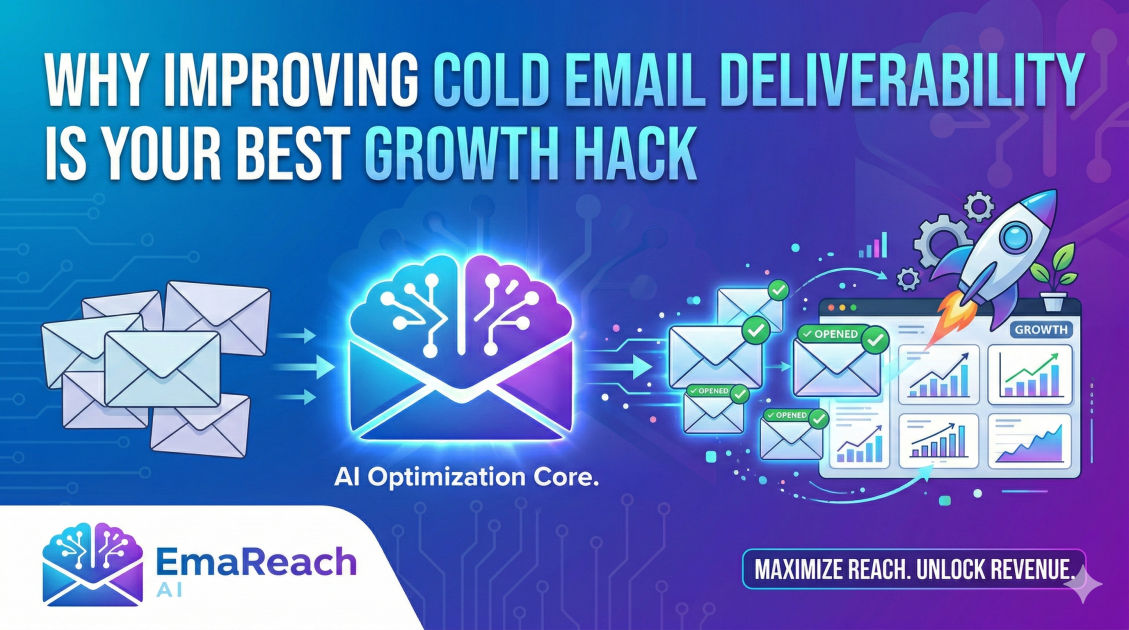
Why Improving Cold Email Deliverability is Your Best Growth Hack
cold emaildeliverabilitygrowth hackingoutreach strategyemail marketingB2B saleslead generation
Introduction
In the modern landscape of digital marketing and B2B sales, companies are constantly hunting for the next 'silver bullet'—that one secret strategy that will 10x their growth overnight. They pour thousands of dollars into paid advertising, spend months on SEO strategies that may never bear fruit, and burn out their social media teams trying to go viral. Yet, sitting right in front of them is one of the most powerful, direct, and scalable growth engines ever created: cold email.
However, there is a fundamental problem. Most cold email campaigns fail before they even start. It isn’t because the copy is bad (though it often is) or because the offer isn't compelling. It is because the email never actually reaches the prospect’s inbox. In an era where email service providers (ESPs) like Google and Outlook are deploying increasingly sophisticated filters, cold email deliverability has shifted from a technical footnote to the ultimate growth hack.
When you improve your deliverability, you aren't just 'fixing a tech issue'; you are unlocking a direct line of communication to your most valuable potential customers. This guide explores why prioritizing deliverability is the highest-leverage activity for any growth-focused organization.
The Mathematical Reality of Deliverability
To understand why deliverability is a growth hack, we must look at the math behind a typical outreach campaign. Most marketers focus on the 'top of the funnel' (the number of leads) or the 'bottom of the funnel' (the closing rate). They ignore the middle: the inbox placement rate.
Imagine two companies, Company A and Company B, both sending 10,000 cold emails per month with a 5% positive response rate on opened emails.
- Company A has poor deliverability. Only 40% of their emails land in the primary inbox; the rest go to spam or are blocked. Out of 10,000 emails, only 4,000 are even seen. At a 5% response rate, they get 200 leads.
- Company B prioritizes deliverability. They achieve a 90% inbox placement rate. Out of 10,000 emails, 9,000 land in the primary inbox. At the same 5% response rate, they get 450 leads.
Without changing a single word of their script or increasing their lead spend, Company B has more than doubled their growth. This is why deliverability is the ultimate leverage point. It is the only factor that provides a linear (and sometimes exponential) return on investment without increasing the volume of work.
The Changing Landscape of Email Privacy and Security
In recent years, the 'wild west' of cold emailing has ended. Major providers have implemented strict protocols to protect users from unwanted noise. If you are still sending emails the way people did five years ago—using single accounts, high volumes, and generic templates—your domain is likely already on a blacklist.
Modern deliverability depends on a complex interplay of technical configurations (SPF, DKIM, DMARC), sender reputation, and engagement signals. If your emails are consistently marked as spam or ignored, your 'Sender Score' drops. Once that score hits a certain threshold, even your personal, one-to-one emails to existing clients might start bouncing. Improving deliverability is about more than just growth; it is about protecting the digital lifeblood of your business.
The Pillars of High Deliverability
To turn deliverability into a growth hack, you must master the three pillars of the inbox: Technical Setup, List Hygiene, and Behavioral Signals.
1. The Technical Foundation
Before sending a single message, your infrastructure must be 'vouched for' by global standards. This includes:
- SPF (Sender Policy Framework): A record that tells servers which IP addresses are authorized to send emails on behalf of your domain.
- DKIM (DomainKeys Identified Mail): A digital signature that ensures the email wasn't tampered with in transit.
- DMARC (Domain-based Message Authentication, Reporting, and Conformance): A policy that tells receiving servers what to do if an email fails SPF or DKIM checks.
Without these three, you are essentially a stranger knocking on a door without an ID. Most security-conscious servers will simply refuse to let you in.
2. Domain Diversification and Warming
One of the biggest mistakes growth teams make is sending 500 cold emails a day from their primary company domain (e.g., name@company.com). If that domain gets flagged, the entire company loses its ability to communicate.
The growth hack approach involves using 'secondary domains' (e.g., name@getcompany.com) and 'warming' them up. Email warming is the process of gradually increasing sending volume while maintaining high engagement rates to prove to ESPs that you are a legitimate human sender.
EmaReach simplifies this entire process. By combining AI-written outreach with automated inbox warm-up and multi-account sending, it ensures that your emails land in the primary tab and get replies, effectively bypassing the technical hurdles that stop most campaigns in their tracks.
3. List Hygiene and Data Quality
Sending an email to a non-existent address is a 'Hard Bounce.' High bounce rates are a primary signal to Google and Outlook that you are a spammer using a scraped list. True growth hackers treat their data like gold. They use verification tools to ensure every email address is active before hitting send.
Why Deliverability Trumps Copywriting
There is a popular saying in the marketing world: "The best copy in the world can't sell if it isn't read." You could hire the world's most expensive copywriter to craft a masterpiece of persuasion, but if that masterpiece is sitting in a 'Spam' folder next to a Nigerian Prince scam, its value is exactly zero.
When you focus on deliverability, you ensure your message is actually competing for attention in the one place your prospect looks every morning: their primary inbox. This creates a 'compounding interest' effect. As your deliverability improves, your engagement rates rise. As engagement rates rise, ESPs trust you more, further boosting your deliverability.
Behavioral Signals: The Secret Ingredient
Modern filters don't just look at code; they look at behavior. They ask questions like:
- Do people open this email?
- Do they reply to it?
- Do they move it from the 'Promotions' tab to 'Primary'?
- Do they add the sender to their contacts?
If you send 1,000 emails and get 0 replies, your reputation takes a hit. If you send 100 emails and get 15 replies, your reputation soars. This is why personalization isn't just a courtesy—it's a deliverability strategy. AI-driven personalization allows you to send highly relevant content at scale, triggering the positive behavioral signals that keep you out of the spam folder.
Implementing the Deliverability Growth Hack
To implement this strategy, follow this checklist:
- Audit Your Current Standing: Use tools to check if your domain is currently blacklisted and what your current sender score is.
- Set Up Dedicated Outreach Domains: Never use your primary domain for cold outreach. Buy 3-5 similar domains.
- Configure Authentication: Ensure SPF, DKIM, and DMARC are perfectly aligned for every new domain.
- Automate the Warm-up: Use a service to simulate natural conversation on your accounts for at least 2-4 weeks before sending cold traffic.
- Optimize Your Sending Patterns: Avoid sending 'blasts.' Spread your sending out throughout the day to mimic human patterns.
- Monitor Your Metrics: Watch your bounce rates like a hawk. If they climb above 2%, stop and clean your list.
The Psychology of the Inbox
We must also consider the psychology of the recipient. When an email lands in the 'Spam' or 'Promotions' folder, the recipient's guard is immediately up. Even if they find it, they view the sender with suspicion.
Conversely, when an email lands in the Primary Inbox, it carries an implicit 'seal of approval' from the email provider. The prospect is in 'work mode' rather than 'delete mode.' By mastering deliverability, you are literally hacking the psychological state of your prospect, catching them when they are most open to new opportunities.
Scaling the Unscalable
The beauty of improving deliverability is that it allows you to scale. Once you have a 'clean' system where 95% of emails hit the inbox, you can simply add more domains and more warmed-up accounts to increase your reach. This is how small agencies and startups are able to compete with massive corporations. They don't have bigger budgets; they just have better 'pipes' to the customer.
Conclusion
In the race for growth, most people are focused on running faster. But if you are running toward a brick wall (the spam filter), speed doesn't matter. Improving your cold email deliverability is the equivalent of finding the door. It is a technical, strategic, and behavioral shift that turns a low-performing channel into a predictable, scalable revenue engine.
By focusing on the technical foundation, maintaining impeccable list hygiene, and leveraging AI tools like EmaReach to handle the complexities of warming and multi-account sending, you can ensure your voice is heard. In the end, the best growth hack isn't a secret trick—it's the simple, disciplined practice of making sure your message actually arrives.
EmaReach AI
Ready to scale your cold email outreach?
Join thousands of teams using EmaReach AI for AI-powered campaigns, domain warmup, and 95%+ deliverability. Start free — no credit card required.
Related posts
- Read article
The Instantly Alternative That Finally Gets Outbound Analytics Right
Discover why high-volume cold email requires a shift from surface-level vanity metrics to deep, data-driven revenue attribution, and explore the ultimate alternatives for mastering outbound engineering.
- Read article
What You Gain and What You Give Up When Switching From Instantly
Thinking about migrating your cold email stack? This detailed guide breaks down the exact operational advantages you gain and the core features you sacrifice when switching away from Instantly's popular outreach platform.