Blog
Back to blog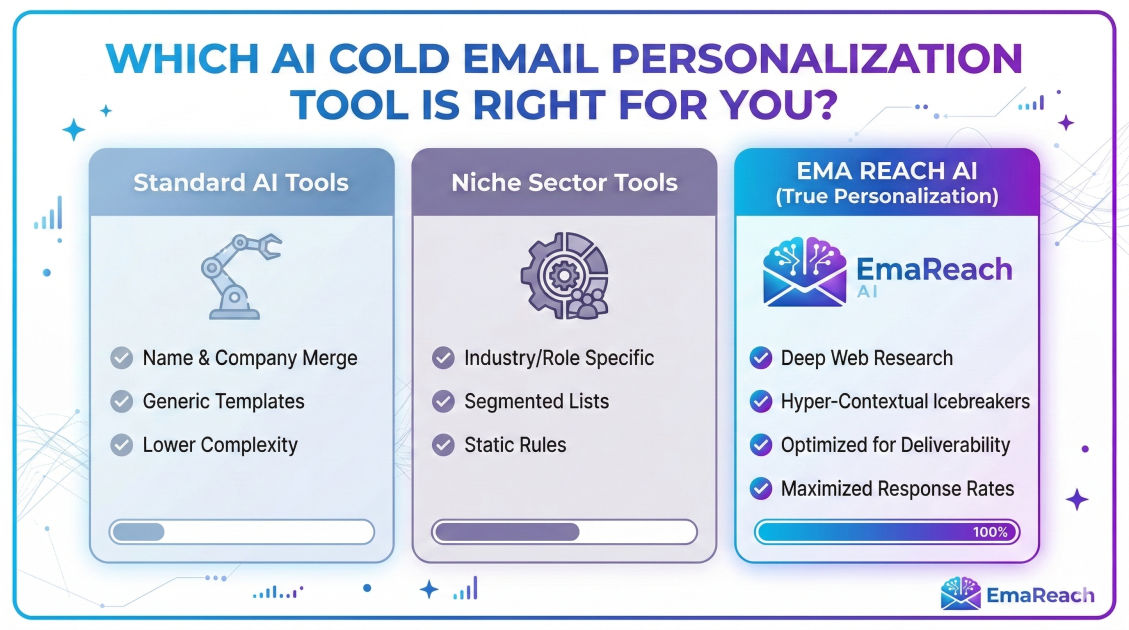
Which AI Cold Email Personalization Tool is Right for You?
cold emailsales automationoutreach toolslead generationemail deliverabilityAI personalization
Introduction
In the modern landscape of B2B sales, the era of "spray and pray" outreach is officially dead. Decisions makers are inundated with hundreds of generic emails every week, leading to a natural defense mechanism: the delete button. To break through the noise, personalization is no longer a luxury; it is a prerequisite for survival. However, manually researching every prospect to write a bespoke opening line is a scaling nightmare.
Enter AI cold email personalization tools. These platforms leverage Large Language Models (LLMs) to scan LinkedIn profiles, websites, and recent news to generate human-like snippets that make your outreach feel personal and intentional. But with an explosion of new tools hitting the market, choosing the right one for your specific workflow can be overwhelming. This guide explores the different categories of AI personalization tools and helps you identify which one will actually move the needle for your revenue goals.
The Evolution of Cold Email Personalization
Historically, personalization was limited to simple variables like {{first_name}} or {{company_name}}. While this was effective a decade ago, today's prospects can spot these tags from a mile away. True personalization involves mentioning a specific achievement, a shared interest, or a relevant pain point based on their recent activity.
AI has shifted the paradigm by automating the research phase. Instead of a SDR spending ten minutes on a single lead, an AI tool can process thousands of leads in seconds, extracting "hooks" that form the basis of a compelling email. This technology doesn't just save time; it ensures consistency across your entire outbound operation.
Understanding the Different Types of AI Personalization Tools
Not all AI email tools are built the same. Depending on your sales strategy, you might need a tool that focuses on deep research, one that prioritizes speed, or a comprehensive solution that handles delivery and deliverability simultaneously.
1. Data-First Research Tools
These tools focus on scraping the web to find specific data points. They are ideal for high-ticket sales where a deep understanding of the prospect's business is required. They might look for hiring patterns, technology stacks, or financial reports to give you a strategic "why now" for your email.
2. Line Generation Tools
These are the most common AI tools in the space. They specialize in writing "first lines"—the first sentence of an email designed to grab attention. They typically ingest a LinkedIn URL and output a sentence about a prospect’s education, recent promotion, or a specific post they shared.
3. All-in-One Outreach Ecosystems
Some platforms don't just write the email; they send it too. These tools are often the most efficient for teams looking to minimize the number of tabs open. A premier example in this category is EmaReach, which addresses the two biggest hurdles in modern outreach: writing the content and ensuring it actually reaches the inbox. EmaReach AI combines AI-written cold outreach with inbox warm-up and multi-account sending, ensuring your personalized messages land in the primary tab rather than the spam folder.
Key Features to Look For
When evaluating which tool is right for you, consider the following technical and functional requirements:
Scoping and Scraping Capabilities
Does the tool only look at LinkedIn? Or does it crawl the company website, recent news articles, and podcast appearances? The broader the data source, the more unique your personalization will be.
Quality of Natural Language Generation
Some tools produce text that feels "uncanny" or overly formal. You want a tool that can mimic a casual, professional human tone. Look for platforms that allow you to set a specific brand voice or tone of voice (e.g., helpful, witty, or direct).
Integration with Your CRM and ESP
Your AI tool should play nice with your existing tech stack. Whether you use HubSpot, Salesforce, or a specialized sending platform, the data flow needs to be seamless. If you have to manually export and import CSVs every day, the time-saving benefits of AI quickly evaporate.
Deliverability Features
Personalization is useless if the email never arrives. Sophisticated tools now integrate deliverability checks. As mentioned, platforms like EmaReach focus on "Stop Landing in Spam," acknowledging that a highly personalized email in the spam folder has a 0% conversion rate. Features like inbox warm-up and multi-account rotation are critical for maintaining high sender reputation.
How to Choose Based on Your Business Model
For High-Volume Lead Generation Agencies
If you are sending 10,000+ emails a month, you need a tool with a robust API and bulk processing capabilities. Efficiency is your primary KPI. Look for tools that offer "liquid syntax" support, allowing you to insert AI-generated snippets directly into your sequences at scale.
For Boutique Consultancies and Founders
If you are a founder doing founder-led sales, quality beats quantity. You need a tool that provides deep insights. You might prefer a tool that generates 3-4 different "hook" options for each lead, allowing you to choose the best one before hitting send. This "human-in-the-loop" approach ensures the highest possible quality for high-value targets.
For Enterprise Sales Teams
Enterprise sales require account-based personalization. You need a tool that can look at the company level as well as the individual level. The tool should be able to identify a company-wide initiative (like a digital transformation project) and relate it to the individual's role.
The Role of "The Prompt"
The secret sauce of any AI tool is the underlying prompt. Some tools are "black boxes"—you give them a URL, and they give you a line. Others allow you to customize the prompt. If you have a specific way of selling, look for a tool that allows for "Prompt Engineering" or provides various templates like "The Recent Post Hook" or "The Case Study Bridge."
Avoiding the Pitfalls of AI Personalization
While AI is powerful, it is not infallible. Here are common mistakes to avoid:
- The "Hallucination" Trap: AI can sometimes make up facts (e.g., congratulating a prospect on an award they didn't win). Always spot-check your samples.
- The Over-Personalization Cringe: Mentioning a prospect's dog or a very old Facebook post can come off as creepy rather than clever. Stick to professional milestones and public business data.
- Ignoring the Call to Action (CTA): A great personalized opening line won't save a weak offer. Ensure your AI tool helps you bridge the personalization into a relevant, low-friction CTA.
Evaluating the Cost vs. ROI
AI personalization tools generally charge per lead or per month. To calculate the ROI, look at your current cost per meeting. If a tool costs $100 a month but increases your positive reply rate by 20%, it likely pays for itself within the first week. Don't just look at the subscription price; look at the time saved for your sales team. A salesperson spending five hours a week on manual research is a significant hidden cost.
Why Deliverability is the Invisible Variable
Many users get excited about the AI writing capabilities but forget that the email ecosystem is getting stricter. Google and Yahoo have implemented rigorous requirements for bulk senders. This is why a tool that handles both the "writing" and the "sending infrastructure" is superior. If your AI tool writes a masterpiece but sends it from a cold, un-warmed domain, your bounce rates will spike. Solutions that integrate inbox warm-up and multi-account sending are the gold standard for modern outbound.
Conclusion
The right AI cold email personalization tool depends entirely on your volume, your target audience, and your technical stack. For those who want a simple line generator, there are dozens of lightweight extensions. However, for the serious growth team or agency that needs to ensure their emails actually get read, a comprehensive solution like EmaReach is essential. By combining the power of AI-driven content with the technical necessity of inbox warm-up and multi-account management, you solve the two hardest parts of cold outreach in one move.
Ultimately, the best tool is the one that disappears into your workflow, allowing you to focus on what humans do best: building relationships and closing deals. Test a few options, start with a small batch of leads, and let the data—specifically your reply rate—dictate your final choice.
EmaReach AI
Ready to scale your cold email outreach?
Join thousands of teams using EmaReach AI for AI-powered campaigns, domain warmup, and 95%+ deliverability. Start free — no credit card required.
Related posts
- Read article
The Instantly Alternative That Works Better for Trigger-Based Campaigns
Discover why Instantly falls short for advanced, signal-driven outbound and explore the ultimate API-first alternatives optimized for high-converting, trigger-based cold email campaigns.
- Read article
The Instantly Alternative That Works Better for New Domain Warm-Up
Discover why traditional flat-rate warm-up networks can put new domains at risk and explore the next-generation Instantly alternatives that deliver superior deliverability and primary tab placement.