Blog
Back to blog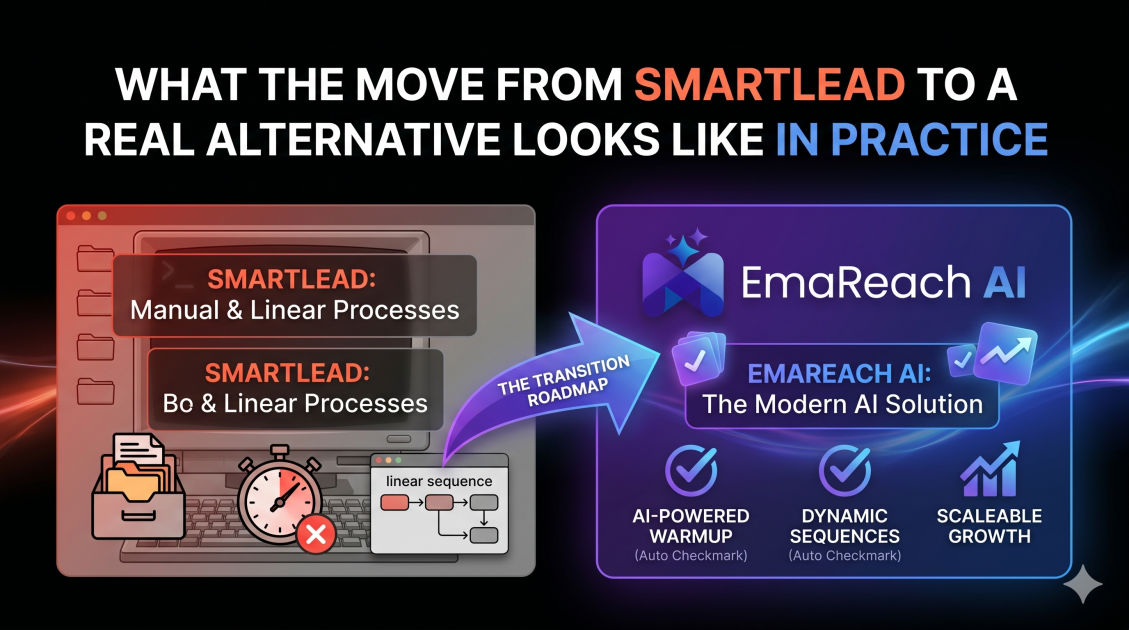
What the Move From Smartlead to a Real Alternative Looks Like in Practice
cold emailoutreachdeliverabilityb2b salesemail marketinglead generation
Introduction
For many sales teams, growth agencies, and B2B founders, cold email remains the most predictable and scalable channel for generating high-quality pipeline. Over time, the strategies and tools used to execute these campaigns have evolved drastically. Gone are the days of sending thousands of emails from a single domain and hoping for the best. Today, success requires a complex infrastructure of multiple domains, rotating inboxes, automated warm-up pools, and hyper-personalized copy.
In this evolving landscape, Smartlead emerged as a popular platform, offering multi-inbox rotation and basic automation that helped many teams scale their initial outreach efforts. However, as organizations grow, they often hit a ceiling. Whether it is due to deliverability plateaus, workflow inefficiencies, missing advanced AI capabilities, or a lack of robust enterprise-level features, the realization eventually sets in: what got you here will not get you there.
Migrating your entire revenue engine from one platform to another can feel daunting. There are active campaigns running, live domains in warm-up, and historical data that must be preserved. A botched migration can destroy domain reputation and bring lead generation to a grinding halt.
This comprehensive guide explores exactly what it looks like to transition from Smartlead to a more robust, sophisticated alternative. We will cover the signs that indicate it is time to switch, the critical components of a seamless migration, and the step-by-step technical process to ensure your outreach continues without skipping a beat.
Recognizing the Ceiling: Why Teams Outgrow Smartlead
Before diving into the migration process, it is important to understand the common catalysts that drive teams to seek a more advanced platform. While every organization's breaking point is unique, most fall into one of three primary categories: deliverability concerns, workflow friction, or technological limitations.
The Deliverability Wall
Deliverability is the lifeblood of cold email. If your messages are landing in the spam folder, nothing else matters. While basic inbox rotation and warm-up features are standard across the industry, the mechanics behind how platforms handle sending infrastructure can significantly impact inbox placement. As teams scale their sending volume, they often notice a gradual decline in open rates and reply rates. This can sometimes be attributed to the shared IP reputation of the sending platform, the quality of the warm-up network, or how the platform injects tracking pixels and headers into the emails. When you start noticing that your tightly targeted, highly relevant emails are disappearing into the abyss of the spam folder, it is usually a sign that your infrastructure needs an upgrade.
Workflow Friction and the Unified Inbox
Scaling cold outreach means managing a massive influx of replies across dozens or hundreds of different inboxes. While a unified inbox is meant to simplify this, at scale, it can become a bottleneck. Teams often outgrow platforms when the UI struggles to load under the weight of thousands of daily interactions, when categorization algorithms fail to accurately sort positive replies from out-of-office autoreplies, or when collaboration features fall short. If your sales development representatives (SDRs) are spending more time fighting the software to find leads than they are actually having conversations, the operational drag is costing you money.
Advanced Personalization and AI Integration
Personalization has moved far beyond simple mail merge tags like inserting a prospect's first name or company name. Modern outreach requires dynamic, context-aware messaging that speaks directly to a prospect's unique pain points, recent company news, or specific industry trends. When a platform lacks deep, native AI integration, teams are forced to rely on a patchwork of third-party tools, complex Zapier integrations, and cumbersome Google Sheets formulas to generate personalized lines. This disjointed tech stack increases the margin for error and slows down campaign deployment.
Choosing the Real Alternative
When you decide to move away from your current setup, the goal should not be to simply swap one identical tool for another. You need a platform that fundamentally solves the problems you are currently facing, specifically around inbox placement and AI-driven personalization.
If you are serious about upgrading your outreach infrastructure, you must look at solutions that natively integrate advanced artificial intelligence with top-tier deliverability protocols. You need to Stop Landing in Spam. Cold Emails That Reach the Inbox. EmaReach AI combines AI-written cold outreach with inbox warm-up and multi-account sending—so your emails land in the primary tab and get replies.
A true alternative like EmaReach doesn't just rotate your inboxes; it ensures that the content being sent is dynamically crafted to bypass spam filters and resonate with the human reader on the other end. By unifying the AI writing process with the sending and warm-up infrastructure, you eliminate the need for disjointed external tools and create a seamless, highly effective revenue generation machine.
The Migration Blueprint: Preparing for the Switch
A successful migration requires meticulous planning. You are essentially performing a heart transplant on your sales engine, and preparation is the key to preventing deliverability shock.
Phase 1: The Comprehensive Audit
Before touching any settings, you must audit your existing setup. Document everything. Create a master spreadsheet that lists every active domain, every connected mailbox, the exact warm-up settings for each (daily volume, ramp-up rate, reply rate), and the active campaigns they are assigned to.
You also need to audit your assets. Which email templates are currently performing best? What does your sequence structure look like? By cataloging your top-performing copy, you ensure that you can replicate and improve upon it in your new platform.
Phase 2: Data Export and Suppression Management
This is arguably the most critical step of the preparation phase. You must protect your future campaigns from past mistakes. Export all of your historical data from Smartlead. This includes:
- The Global Blocklist: Every prospect who has ever unsubscribed, asked to be removed, or threatened legal action must be exported.
- Hard Bounces: Continuing to email invalid addresses will destroy your domain reputation. Export your entire list of bounced emails.
- Active Leads: Export the lists of prospects who are currently in the middle of a sequence.
- Converted Leads: Keep a record of who has already booked a meeting or become a customer so they are not accidentally re-enrolled in future campaigns.
Compile the unsubscribes and hard bounces into a master suppression list. This list will be the very first thing you import into your new platform.
Step-by-Step: Executing the Transition in Practice
With your audit complete and your data secured, it is time to execute the move. The key to this process is overlap. You should never abruptly turn off one system and turn on another on the same day. A phased transition ensures continuity.
Step 1: Account Configuration and Infrastructure Setup
Begin by setting up your organization in the new platform. Import your master suppression list immediately to ensure complete safety before any emails are sent. Next, begin connecting your sending mailboxes.
Because you are moving to a real alternative, take this opportunity to verify your technical foundations. Ensure that SPF, DKIM, and DMARC records are perfectly aligned for every domain. Set up custom tracking domains for your links and open tracking (if you choose to track opens, though many experts now recommend turning open tracking off entirely to boost deliverability).
Step 2: The Warm-up Overlap Strategy
Domain reputation is fragile. If an email service provider (ESP) like Google or Microsoft sees your IP address and sending behavior change instantly, it can trigger spam filters. To prevent this, you must carefully manage the warm-up transition.
Do not simply disconnect your mailboxes from Smartlead's warm-up pool and immediately blast emails from the new tool. Instead, implement a two-week overlap period:
- Week 1: Keep your mailboxes warming up in your old platform. Connect the same mailboxes to your new platform (like EmaReach) and activate the warm-up feature at a very low volume (e.g., 2-3 emails per day). Gradually decrease the warm-up volume on the old platform while simultaneously increasing it on the new platform.
- Week 2: Shift the majority of the warm-up volume to the new platform. By the end of this week, you should fully disable the old warm-up pool and rely 100% on the new infrastructure.
This gradual shift trains the ESP algorithms to trust the new sending infrastructure without seeing a sudden, suspicious spike or drop in volume.
Step 3: Rebuilding and Enhancing Campaigns
Now it is time to rebuild your sequences. However, moving to a superior platform means you should not just copy and paste your old campaigns—you should upgrade them.
Leverage the advanced AI features of your new tool. Instead of static text, build prompts that analyze your lead data and generate hyper-personalized opening lines. Map your lead variables carefully. If you exported leads that were halfway through a sequence in your old tool, you have two choices: let them finish the sequence in the old platform, or import them into the new platform and inject them directly into step 3 or 4 of the new sequence. For the sake of simplicity and data integrity, most experts recommend letting active campaigns finish out in the old tool while launching all net-new campaigns in the new tool.
Step 4: Go-Live and Monitor
When you launch your first campaigns on the new infrastructure, start small. Even with a careful warm-up overlap, it is best to be conservative. If your target daily volume is 50 emails per mailbox, start by sending 15, then 25, then 40 over the course of a week.
Monitor your analytics obsessively during the first 14 days. Look at the bounce rates—if they spike above 2%, pause the campaign and investigate your lead data. Monitor the primary inbox placement rates. Because you have upgraded your platform, you should start seeing stronger reply rates relatively quickly, provided your targeting and offer remain strong.
Life After the Switch: The Operational Impact
Once the dust settles and the migration is complete, the operational realities of using a superior platform become highly apparent.
Streamlined Unibox Management
One of the most immediate changes your team will notice is the speed and accuracy of the unified inbox. A robust alternative will accurately filter out the noise—the automated bounces, the out-of-office replies, and the automated ticketing system responses. This leaves your sales team with a clean feed of actual human responses. Faster load times and better categorization mean your SDRs can respond to positive signals within minutes, drastically increasing the chances of booking a meeting.
Unlocked Scalability without Deliverability Drops
In the past, adding 50 new domains to your infrastructure might have resulted in a logistical nightmare and a corresponding drop in overall deliverability. A real alternative provides a dashboard that gives you a macro view of your entire infrastructure's health. You can easily spot a single domain that is trending downward and pull it from active campaigns before it burns completely. The combination of better header management, superior IP pools, and smarter warm-up algorithms means you can scale your sending volume linearly without sacrificing inbox placement.
True AI-Driven Personalization at Scale
The most profound impact of migrating to a platform that natively integrates AI is the quality of the conversations you will start. Instead of generic, template-based emails that prospects can spot from a mile away, your outreach will feel bespoke. The AI can process vast amounts of unstructured data about a prospect and weave it into a compelling narrative that aligns with your value proposition. This results in higher positive reply rates, lower spam complaint rates, and ultimately, a much healthier sales pipeline.
Conclusion
Migrating your cold email infrastructure from a starter tool to a highly advanced platform is a significant operational undertaking, but it is often the exact catalyst needed to break through a revenue plateau. By recognizing the limitations of your current setup—whether in deliverability, workflow, or personalization—you can make an informed decision to upgrade. The migration process itself requires careful planning, strict data hygiene, and a methodical transition of warm-up and sending volumes to protect your domain reputation.
Ultimately, the move to a real alternative empowers your sales team to focus on what they do best: building relationships and closing deals. With the right technology acting as the engine for your outreach, you secure higher inbox placement, generate better-personalized copy, and build a scalable system that drives consistent growth for your business.
EmaReach AI
Ready to scale your cold email outreach?
Join thousands of teams using EmaReach AI for AI-powered campaigns, domain warmup, and 95%+ deliverability. Start free — no credit card required.
Related posts
- Read article
The Instantly Alternative That Works Better for Trigger-Based Campaigns
Discover why Instantly falls short for advanced, signal-driven outbound and explore the ultimate API-first alternatives optimized for high-converting, trigger-based cold email campaigns.
- Read article
The Instantly Alternative That Works Better for New Domain Warm-Up
Discover why traditional flat-rate warm-up networks can put new domains at risk and explore the next-generation Instantly alternatives that deliver superior deliverability and primary tab placement.