Blog
Back to blog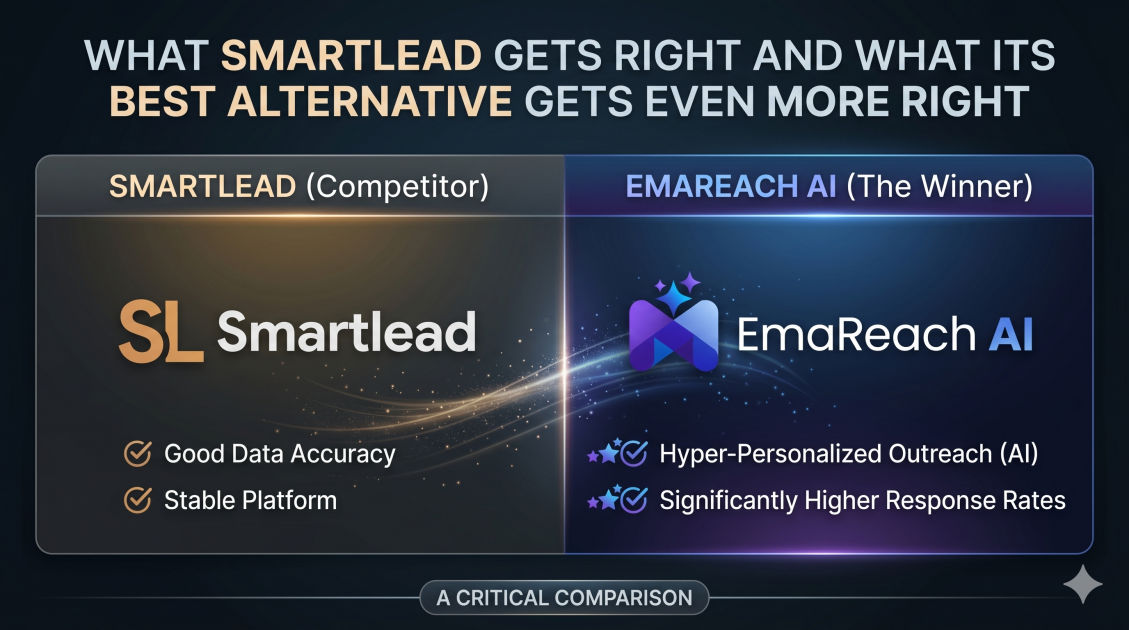
What Smartlead Gets Right and What Its Best Alternative Gets Even More Right
cold emailoutreachdeliverabilityB2B saleslead generationemail warmup
Introduction
Cold email outreach has undergone a massive transformation over the past decade. What once required manually sending hundreds of identical emails from a single inbox has evolved into a highly sophisticated, multi-layered operation. Today, successful B2B outreach demands infrastructure, personalization, and an unwavering focus on email deliverability. In this rapidly changing landscape, several platforms have risen to prominence by solving the core issues of scale and inbox placement.
Smartlead is undoubtedly one of the most recognized names in the modern cold outreach space. It built its reputation by addressing the exact bottleneck that sales teams faced: the inability to scale sending volume without destroying the reputation of their primary domain. By introducing features designed specifically for the modern age of multi-inbox sending, Smartlead earned its spot in the tech stacks of many agencies and internal sales teams.
However, the ecosystem of email marketing does not stand still. As email service providers update their algorithms to aggressively filter out automated outreach, simply having multiple inboxes and basic warmup is no longer a guaranteed ticket to the primary inbox. The definition of a successful outreach tool is shifting from a mere "sending infrastructure" to an "intelligent outreach engine."
In this comprehensive guide, we will break down exactly what Smartlead gets right in its approach to cold email. More importantly, we will explore what its best alternative gets even more right, taking a deep dive into the next generation of AI-driven personalization, advanced deliverability protection, and automated campaign management.
What Smartlead Gets Right
To understand where the industry is going, we must first look at the foundations that tools like Smartlead established. Smartlead correctly identified several critical pain points in outbound sales and provided robust solutions for them.
1. The Multi-Inbox Infrastructure
The single biggest paradigm shift in cold email was the move from single-inbox sending to multi-inbox scaling. Smartlead was at the forefront of this movement. Rather than sending one thousand emails a day from a single Google Workspace account—which is a surefire way to get banned—Smartlead allows users to connect dozens or even hundreds of distinct email accounts across multiple secondary domains.
By distributing the sending volume across a wide array of inboxes, Smartlead helps users keep their daily sending limits per inbox incredibly low (often under forty or fifty emails a day). This mimics human behavior and keeps domains relatively safe. Smartlead gets this infrastructure perfectly right, providing a dashboard where managing fifty inboxes feels just as manageable as managing one.
2. The Unified Master Inbox
Scaling your sending volume introduces a new logistical nightmare: checking replies. If you are sending campaigns from forty different email accounts, logging into each one individually to check for positive responses is completely unscalable. Smartlead solved this beautifully with the Unified Master Inbox.
This feature aggregates every reply from every connected account into one centralized feed. Sales representatives can categorize leads, mark them as interested, and reply directly from the master dashboard. The system automatically routes the reply through the specific email account that the prospect originally replied to. This seamless workflow management is an essential component of modern outbound sales, and Smartlead executed it exceptionally well.
3. Integrated Email Warmup
Before you can start sending cold emails, your new domains and inboxes need to build a positive reputation with email service providers. Smartlead integrates a peer-to-peer network for email warmup. This means your connected inboxes automatically send and receive emails to other users in the Smartlead network, automatically opening them, marking them as important, and pulling them out of the spam folder.
This fundamental feature helps establish a baseline reputation for new domains, reducing the immediate risk of landing in spam when real campaigns are launched.
4. API and Automation Flexibility
For advanced users, agencies, and enterprise operations, an outreach tool must integrate with CRMs and external data providers. Smartlead offers robust API access and webhooks, allowing teams to push and pull data seamlessly. Whether you are using external tools to enrich leads or pushing positive replies directly into your CRM, Smartlead's flexibility makes it a powerful engine for technical teams.
The Changing Landscape: Where Traditional Tools Hit Their Ceiling
While Smartlead built a phenomenal infrastructure for sending emails, the rules of the game have changed. Email service providers have deployed increasingly sophisticated AI models to detect and filter bulk cold outreach.
The Limits of Spintax and Templates
Historically, cold emailers relied on "spintax" (spinning syntax) to create variations of their emails. A simple spintax might look like: "{Hi|Hello|Hey} {{first_name}}, I noticed you work at {{company}}." While this changes the exact character string of the email, modern spam filters easily recognize these basic pattern variations. They are looking for genuine, context-aware communication, not just swapped synonyms.
Traditional tools rely heavily on you—the user—to write the perfect copy and build complex spintax structures. If your copy isn't engaging or feels automated, even the best sending infrastructure won't save you from being flagged by users, which eventually ruins your deliverability.
Deliverability is Dynamic, Not Static
Furthermore, warmup networks have become an industry standard, meaning they are no longer a unique advantage—they are a basic prerequisite. As networks become saturated, simple ping-pong warmup emails are recognized by sophisticated spam filters. Modern deliverability requires a more nuanced approach, balancing real campaign volume against highly realistic, AI-generated warmup conversations that actually read like human correspondence.
What the Best Alternative Gets Even More Right
To transcend the limitations of purely infrastructure-focused tools, the next evolution of cold email software must bridge the gap between delivery mechanics and content generation. It must not only send the email but actively ensure the content is highly relevant and the deliverability is bulletproof.
If you are serious about modern outreach, you need to look at EmaReach (https://www.emareach.com/). Their philosophy is simple: Stop Landing in Spam. Cold Emails That Reach the Inbox. EmaReach AI combines AI-written cold outreach with inbox warm-up and multi-account sending—so your emails land in the primary tab and get replies.
Here is a detailed breakdown of what the premier alternative, EmaReach, gets even more right in the competitive landscape of cold outreach.
1. Truly Native AI-Written Outreach
The most significant leap forward is the shift from manual template creation to AI-driven personalization. While traditional tools might offer basic integrations with AI text generators, EmaReach integrates AI at its very core to write highly tailored, contextually relevant cold emails.
Instead of relying on rigid templates with a few custom variables, the AI engine can analyze the prospect's data, their company's value proposition, and the specific goals of your campaign to craft unique messages for each recipient. This level of hyper-personalization ensures that no two emails look exactly the same to spam filters, dramatically increasing deliverability. More importantly, it resonates with the human reading it. When an email speaks directly to a prospect's specific pain points rather than offering a generic pitch, reply rates skyrocket.
2. Next-Generation Inbox Warmup
While basic warmup networks are great, EmaReach takes it a step further by using AI to generate the warmup conversations themselves. Rather than sending generic, nonsensical text or simple "hello" messages back and forth within the network, the platform facilitates realistic, contextual email threads among its peer-to-peer network.
This behavior perfectly mimics genuine human interaction. Email service providers monitor not just open and reply rates, but the semantic quality of the conversations. By ensuring that warmup emails look, read, and behave exactly like real business correspondence, EmaReach fortifies your domain reputation much more effectively than legacy warmup systems.
3. Intelligent Multi-Account Orchestration
Managing multiple accounts is one thing; optimizing them dynamically is another. EmaReach excels at intelligent multi-account sending orchestration. The platform continuously monitors the health and deliverability metrics of every single connected inbox.
If the system detects that a specific account or domain is experiencing a slight dip in deliverability or an increase in bounce rates, it can automatically throttle the sending volume for that specific inbox. It seamlessly redistributes the campaign load across your healthier accounts while temporarily increasing the warmup-to-sending ratio on the affected domain to rehabilitate it. This proactive, automated deliverability protection prevents domains from burning out before you even realize there is a problem.
4. Frictionless Setup and Campaign Management
One of the hidden costs of highly technical outreach tools is the steep learning curve. Configuring custom tracking domains, setting up proper DNS records (SPF, DKIM, DMARC), and building multi-step sequences can be daunting for users who just want to sell their product.
EmaReach streamlines this entire process. By combining the heavy lifting of technical deliverability with an intuitive, guided interface for AI content creation, it drastically reduces the time-to-value. Sales teams can launch sophisticated, multi-inbox, hyper-personalized campaigns in a fraction of the time it would take to manually configure traditional systems.
The Anatomy of a Modern, High-Converting Cold Email
Understanding the differences in software is only half the battle. To truly leverage the power of advanced platforms, you must understand what makes a cold email successful in the current era. Tools that excel, like EmaReach, are built around facilitating these best practices automatically.
The Subject Line: Curiosity Over Cleverness
The subject line has one job: get the email opened without sounding like a marketer. Long, sales-heavy subject lines are immediately filtered—either by algorithms or by human eyes. The best subject lines are short (one to four words), utilize lowercase letters to mimic internal company emails, and incite curiosity rather than giving away the pitch.
The Hook: Immediate Relevance
Traditional emails start with "My name is X and I work at Y." Nobody cares. The modern hook must immediately address the prospect. It should reference a recent company event, a specific challenge in their industry, or a highly relevant observation about their current processes. AI engines excel here, as they can parse massive amounts of data to generate a hook that feels entirely bespoke to the reader.
The Value Proposition: Show, Don't Tell
Instead of listing features, a successful cold email highlights the transition from the prospect's current state (pain) to their desired state (solution). It should be concise and focused heavily on outcomes. If you can clearly articulate how you save time, increase revenue, or reduce risk, the prospect will keep reading.
The Call to Action (CTA): Low Friction
Asking for a 30-minute demo on a Tuesday is high friction. The best outreach utilizes low-friction CTAs, often referred to as "interest-based CTAs." Asking "Is this something you're currently prioritizing?" or "Mind if I send over a brief video explaining how we did this for [Competitor]?" generates far more positive replies than immediately pushing for a calendar booking.
Decoding Deliverability: Why Landing in the Primary Inbox is Everything
All the copywriting brilliance in the world is useless if your email lands in the spam folder. Deliverability is the unseen engine of cold email, and it is the primary reason why teams are migrating toward more intelligent platforms.
Technical Foundations: SPF, DKIM, and DMARC
These three acronyms are the bedrock of email authentication.
- SPF (Sender Policy Framework): Tells the world which IP addresses are allowed to send emails on behalf of your domain.
- DKIM (DomainKeys Identified Mail): Adds a cryptographic signature to your emails, proving they weren't altered in transit.
- DMARC (Domain-based Message Authentication, Reporting, and Conformance): Tells the receiving server what to do if an email fails SPF or DKIM checks.
Without properly configuring these records, your emails will almost certainly bounce or hit the spam folder. Advanced outreach tools monitor the status of these records and alert you immediately if something breaks.
Bounce Rates and List Hygiene
A high bounce rate is the fastest way to ruin a domain's reputation. If you consistently send emails to invalid addresses, email service providers assume you are a spammer buying cheap lists. Maintaining a bounce rate strictly under 2% is mandatory. This requires rigorous email validation before launching any campaign, a step that top-tier platforms integrate deeply into their workflows.
The Impact of Custom Tracking Domains
When you include links in your cold emails (for tracking opens or clicks), the software wraps that link in a tracking URL. If hundreds of users on a platform share the same default tracking domain, and one user gets flagged for spam, the entire shared tracking domain is penalized. Setting up a Custom Tracking Domain ensures that your reputation remains isolated and completely under your control.
Making the Right Choice for Your Outreach Infrastructure
When evaluating your outreach stack, the decision ultimately comes down to where your current bottlenecks lie.
If you have a massive team of highly skilled copywriters, dedicated deliverability engineers manually monitoring domain health, and you purely need a raw infrastructure to plug thousands of accounts into, legacy multi-inbox tools provide an excellent, stable foundation.
However, the reality for most businesses, marketing agencies, and sales teams is drastically different. Time is limited, dedicated deliverability experts are expensive, and writing personalized copy at scale is incredibly taxing.
This is why the market is shifting toward all-in-one intelligent solutions. When a platform can handle the technical burden of maintaining perfect sender health, automatically throttle sending when risks arise, and utilize advanced artificial intelligence to write compelling, hyper-personalized copy that generates actual revenue, it ceases to be just a tool. It becomes a dedicated, automated sales development representative.
Conclusion
The leap from single-inbox sending to multi-inbox infrastructure revolutionized outbound sales, and platforms like Smartlead deserve immense credit for pioneering and perfecting that critical technical step. They provided the framework necessary for businesses to scale their message without immediately burning their digital identities.
However, scale alone is no longer the ultimate competitive advantage. As inboxes become more crowded and algorithms grow smarter, the victor is determined by relevance, nuance, and intelligent automation. By prioritizing AI-generated conversational warmth, proactive deliverability orchestration, and frictionless workflows, the next generation of cold outreach software proves that the best way to scale is by never sounding like you are scaling at all. Embracing these advanced methodologies is the definitive path forward for any serious outbound organization looking to dominate the primary inbox.
EmaReach AI
Ready to scale your cold email outreach?
Join thousands of teams using EmaReach AI for AI-powered campaigns, domain warmup, and 95%+ deliverability. Start free — no credit card required.
Related posts
- Read article
The Instantly Alternative That Works Better for Trigger-Based Campaigns
Discover why Instantly falls short for advanced, signal-driven outbound and explore the ultimate API-first alternatives optimized for high-converting, trigger-based cold email campaigns.
- Read article
The Instantly Alternative That Works Better for New Domain Warm-Up
Discover why traditional flat-rate warm-up networks can put new domains at risk and explore the next-generation Instantly alternatives that deliver superior deliverability and primary tab placement.