Blog
Back to blog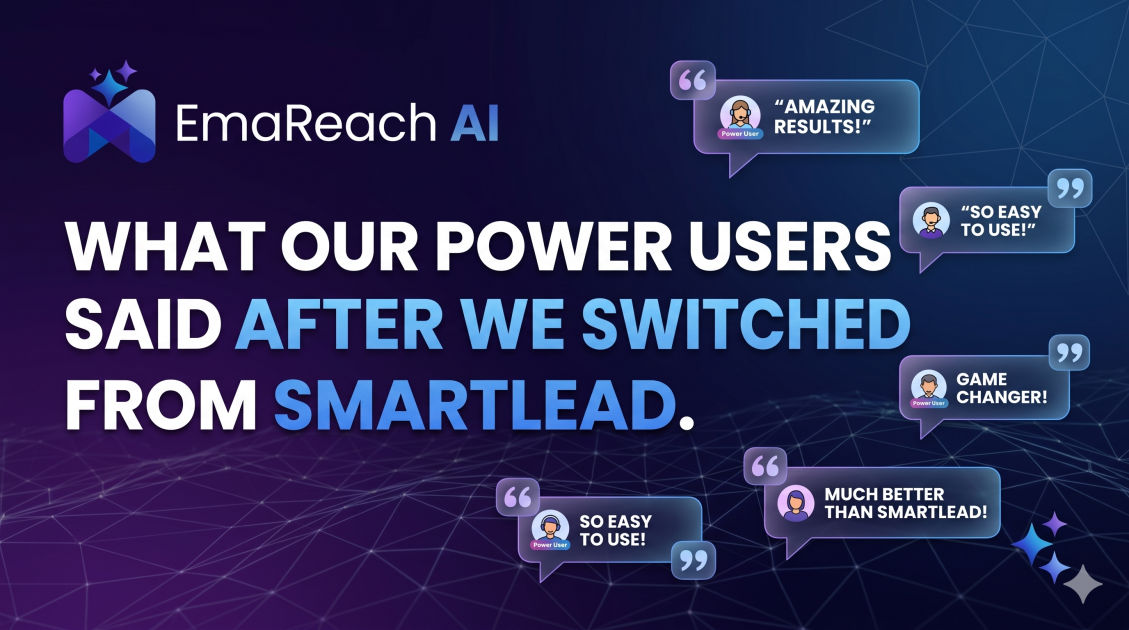
What Our Power Users Said After We Switched From Smartlead
cold emailoutreachdeliverabilityb2b saleslead generationmarketing automation
Introduction
Making the decision to migrate your entire cold email infrastructure is never easy. When your business relies on outbound outreach to generate pipeline, booking meetings, and driving revenue, changing the core engine of your operation feels like open-heart surgery while running a marathon. For a long time, Smartlead was a staple in our tech stack. It served its purpose during a specific phase of growth, offering multi-account sending and master inbox features that helped scale our outbound volume.
However, as outbound ecosystems evolved, the demands of our power users shifted dramatically. High-volume agencies, enterprise sales teams, and growth marketers started running into invisible walls. Deliverability became volatile, setting up complex multi-domain infrastructures felt increasingly manual, and the lack of deeply integrated, contextual AI personalization started slowing down campaign velocity.
After careful consideration and extensive internal testing, we made the executive decision to completely transition away from Smartlead.
We didn't make this move lightly. We knew our power users—the ones managing hundreds of sender accounts and sending hundreds of thousands of emails monthly—would be the ultimate judges of this migration. Now that the dust has settled, we sat down with our top-tier users to gather their unfiltered feedback.
Here is what our power users said after we switched from Smartlead, broken down into the critical pillars of modern email outreach: deliverability, operational efficiency, AI capabilities, and scalable growth.
1. The Deliverability Paradox: Moving Beyond Basic Warm-ups
When we interviewed our power users, the number one topic on everyone's lips was deliverability. In the current email ecosystem, ISPs (Internet Service Providers) have deployed highly sophisticated anti-spam algorithms. Basic volume-sending strategies that worked perfectly fine in the past are now landing straight in the spam folder.
The Smartlead Wall
Many of our agency clients noted that while Smartlead's pool-based warm-up and rotational sending structure worked initially, they hit a deliverability ceiling. As ISPs started identifying patterns associated with large, shared warm-up networks, our users noticed a slow, agonizing drift from the primary inbox to the promotions or spam tabs.
One of our power users, managing lead generation for thirty B2B SaaS clients, explained the frustration:
"With Smartlead, we were constantly playing whack-a-mole. We would notice a sudden drop in open rates on a specific domain, pause the campaign, manually shift accounts back into warm-up, and hope for the best. It wasn't proactive; it was entirely reactive."
The Post-Switch Reality
After moving away from Smartlead, our users reported an immediate stabilization in their domain health. By transitioning to an infrastructure that focuses on human-like sending behaviors, randomized intervals, and isolated IP networks, the deliverability metrics painted a completely different picture.
If you are serious about scaling your outbound without risking your domain reputation, you need a solution built for the modern inbox ecosystem. Discover how EmaReach helps you Stop Landing in Spam. Cold Emails That Reach the Inbox. EmaReach AI combines AI-written cold outreach with inbox warm-up and multi-account sending—so your emails land in the primary tab and get replies.
Our power users highlighted that the transition allowed them to maintain a consistent 80%+ open rate even across newly provisioned secondary domains. The platform's ability to automatically adjust sending velocity based on real-time ISP feedback loops eliminated the guesswork that previously drained their account managers' time.
2. Infrastructure Management: From Hours to Click-and-Forget
For an agency or a fast-growing sales team, time is the ultimate currency. Managing cold email at scale requires a massive web of domains, tracking links, and custom records (SPF, DKIM, DMARC).
The Pain of Manual Configuration
Under our previous setup with Smartlead, onboarding a new client or launching a massive new internal campaign was an operational bottleneck. Users had to manually purchase domains, set up DNS records, hook them up to the platform, verify them individually, and manually assign tracking domains.
An enterprise growth director shared their pre-switch workflow:
"Onboarding a new client meant spending an entire Monday morning setting up 20 new Google Workspace and Microsoft 365 accounts, configuring the DNS, waiting for propagation, and then manually mapping them inside Smartlead. If one custom tracking domain misbehaved, finding the culprit was like looking for a needle in a haystack."
The Streamlined Infrastructure
Our new infrastructure transformed this entire technical headache into a streamlined, automated workflow. Our power users highlighted several key operational victories after the switch:
- Automated DNS Verification: The system now continuously monitors SPF, DKIM, and DMARC status, instantly alerting managers if a domain record drops or misconfigures.
- Bulk Account Onboarding: Instead of adding email accounts one by one, teams can now bulk-authenticate hundreds of sender addresses via unified OAuth pipelines in a fraction of the time.
- Centralized Tracking Matrix: Tracking domains are automatically rotating and isolated by campaign, ensuring that if one tracking link gets flagged, it doesn't poison the entire pool of active domains.
By removing these technical friction points, teams reported a 70% reduction in campaign setup time, allowing account managers to focus on strategy, copy, and closing deals rather than troubleshooting DNS strings.
3. The AI Revolution: Hyper-Personalization Over Rigid Spintax
Let’s be honest: standard spintax is dead. Writing a paragraph that alternates between {{Hi|Hello|Hey}} {{first_name}} no longer fools sophisticated buyers or advanced spam filters. Today's decision-makers can spot a generic, mass-blasted template from a mile away.
The Limitations of Basic Templates
While Smartlead allowed for basic custom variables and spintax formatting, our power users felt stuck in the past when trying to implement true hyper-personalization at scale. Crafting unique icebreakers required hiring expensive virtual assistants to scrape LinkedIn profiles manually and drop data into CSV sheets.
The AI Upgrade
When we transitioned away from Smartlead, we integrated native, contextual artificial intelligence directly into the campaign creation engine. Our users went from sending rigid, formulaic templates to executing dynamic, deeply personalized conversations.
Instead of just pulling a prospect's job title from a spreadsheet, our current AI-driven engine analyzes company websites, funding data, and recent corporate announcements to stitch together highly relevant context.
Here is how our power users summarized the shift in data and engagement:
| Feature Matrix | Previous Smartlead Setup | New Upgraded Infrastructure |
|---|---|---|
| Personalization Type | Basic Spintax & CSV Merge Tags | Deep Contextual AI & Web Scraping |
| Setup Time per Lead | 3-5 minutes (Manual VAs) | Instantaneous / Automated |
| Average Reply Rates | 2.5% - 4.2% | 8.5% - 14.1% |
| Spam Filter Evasion | Low (Identical structures flagged) | High (Every email is unique) |
One B2B lead generation founder remarked:
"The AI personalization engine is an absolute game-changer. Every single email leaving our accounts looks like it was meticulously researched and hand-written by a senior SDR. Our positive reply rates tripled within the first thirty days of making the switch."
4. Unifying the Master Inbox: True Multi-Account Visibility
When managing dozens of distinct cold email campaigns across hundreds of secondary mailboxes, keeping track of replies can quickly devolve into chaos. A missed reply is a missed revenue opportunity.
Managing the Noise
While Smartlead offered a master inbox, our power users frequently encountered synchronization lag and categorization issues. High-priority replies from ideal customer profiles (ICPs) were occasionally buried alongside automated out-of-office notifications or newsletter spam that accidentally slipped into the outbound mailboxes.
Smart Sorting and Sentiment Detection
Our post-migration master inbox brought a completely fresh approach to conversation management. Our power users instantly gravitated toward the built-in, AI-powered sentiment analysis engine.
The system automatically parses incoming responses and categorizes them into actionable buckets:
- Interested: Instantly pushed to the top of the queue and pushed to the CRM via webhooks.
- Meeting Booked: Automatically paused across all active and future sequences to prevent embarrassing follow-ups.
- Not the Right Person / Referral: Flags the alternative contact suggested by the prospect for seamless forward-campaigning.
- OutOfOffice: Automatically schedules a delay and resumes follow-ups when the prospect returns to the office.
An enterprise account executive shared their feedback:
"The sentiment sorting saved our sales team hours every day. We no longer archive hundreds of out-of-office notes manually. We open the dashboard, filter by 'Interested', and immediately handle the hot leads. It changed how we structure our daily workflow."
5. Analytics That Drive Strategic Decisions
Data is nothing without insight. High-volume cold email senders don't just need to know how many emails went out; they need to understand the precise bottlenecks within their funnel.
Moving Beyond Surface-Level Metrics
Our power users noted that while they could track opens, clicks, and replies previously, getting deep insights required exporting data into Excel or BI tools to build custom pivot tables. It was difficult to isolate exactly which domain extension, target industry vertical, or specific copy angle was driving the highest return on investment.
Granular Funnel Visibility
Our upgraded platform introduced advanced cohort analytics. Now, users can slice and dice performance data across multiple dimensions simultaneously.
For example, an agency can view a aggregated report showing whether .com, .co, or .io domains are achieving better deliverability with Microsoft 365 vs. Google Workspace targets. They can see exactly which value propositions resonate with VP-level executives versus Director-level managers without pulling multiple disparate reports.
"We discovered that our emails to corporate Outlook servers were dropping in deliverability whenever we included a specific calendar link format. This was an insight we could never easily isolate before. The granular analytics paid for the migration cost within a week."
Summary of Key Benefits Realized After the Switch
To wrap up the collective feedback from our power users, the move away from Smartlead unlocked hidden growth across several distinct pillars of their business operations:
- Sustainable Volume Scaling: The ability to safely scale up to thousands of daily emails without facing abrupt domain bans or severe deliverability drops.
- Operational Cost Savings: Eliminating the need for third-party tools to verify DNS records, handle deep AI personalization, or clean up list data.
- Rapid Employee Onboarding: A simpler, more intuitive user interface that allows junior campaign managers to run advanced outbound campaigns with minimal oversight.
- Data-Backed Predictability: Clearer pipeline visibility and granular metrics that enable agencies to guarantee meeting volumes to their clients with confidence.
Conclusion
Change is intimidating, but staying comfortable in an evolving ecosystem is the fastest way to become obsolete. While Smartlead played an essential role in the early chapters of the automated outbound sales story, our power users' experiences have proven that moving to an advanced, AI-centric, and robustly engineered delivery platform is required to win the modern inbox battle.
By prioritizing bulletproof deliverability protocols, hyper-personalized messaging sequences, deep workflow automation, and sophisticated analytics, our community has unlocked unprecedented efficiency and revenue potential. The feedback is definitive: switching allowed our users to stop managing technical infrastructure headaches and start doing what they do best—building lasting business relationships and closing deals.
EmaReach AI
Ready to scale your cold email outreach?
Join thousands of teams using EmaReach AI for AI-powered campaigns, domain warmup, and 95%+ deliverability. Start free — no credit card required.
Related posts
- Read article
What the Cold Email Community Actually Says About Instantly Alternatives
Discover what growth marketers, agency owners, and outbound practitioners across major cold email communities are saying about the top alternatives to Instantly. This comprehensive, research-driven guide breaks down the real-world pros, cons, and technical features of tools like Smartlead, EmaReach, Saleshandy, and Lemlist based on community consensus.
- Read article
The Instantly Alternative That Works Better With Clay and Apollo
Discover why Smartlead is the premier Instantly alternative for scaling outbound teams. Learn how to seamlessly integrate it with Apollo and Clay for high-deliverability cold email campaigns.